



ISLAMABAD, Nov 2, 2026: Senate Chairman Syed Yousaf Raza Gilani on Monday said that the Indus Waters Treaty remained a binding international agreement and no party could unilaterally alter, suspend or revoke its provisions.
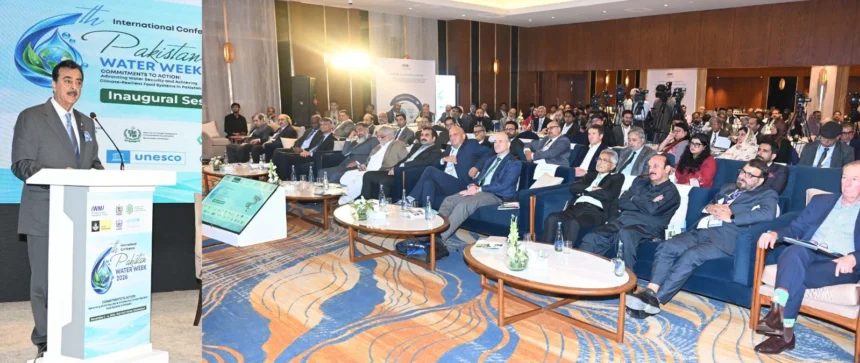
Addressing the Sixth Pakistan Water Week 2026 as chief guest, Gilani warned that any attempt to block, suspend or divert Pakistan’s legitimate share of water would constitute an act of war and invite a direct response.
He said Pakistan would never allow water to be weaponised or used as an instrument of geopolitical pressure, adding that the country’s water security, sovereignty and national interests were non-negotiable.
The Senate chairman said Pakistan’s position on the treaty was firm and principled, and any attempt to undermine its rights under the agreement would have serious consequences.
Highlighting the challenges facing the country’s water sector, Gilani said Pakistan was confronting a dual crisis of catastrophic floods, which displaced millions of people, and prolonged droughts, which depleted soil resources and threatened agricultural productivity.
He said declining per capita water availability had brought the country to a critical threshold, making water security an urgent national priority.
Gilani congratulated the International Water Management Institute, the Consultative Group on International Agricultural Research, the Ministry of Water Resources, the Pakistan Council of Research in Water Resources and other development partners for sustaining Pakistan Water Week as an important platform for scientific dialogue, policy development and collaborative solutions.
Recalling his experience as prime minister during the devastating floods of 2010, which affected approximately 20 million people, he said he had witnessed first-hand the enormous human cost of natural disasters. Referring to his engagement with flood-affected communities during recent floods, he said he had personally witnessed their suffering, heard their accounts and mobilised efforts for relief and rehabilitation.
“Every disaster is a warning we ignored. Disaster response is not resilience, and no single institution can address these challenges in isolation,” he said.
Gilani stressed that Pakistan must move beyond a reactive approach to disaster management and develop a comprehensive framework focused on prevention, preparedness, climate adaptation and long-term resilience.
He underlined the need for stronger institutional coordination, enforceable legislation, effective planning and adequate financial allocations for preventive measures.
The Senate chairman assured that the Senate would play its constitutional and institutional role in supporting this transition through legislation governing river basins, parliamentary oversight to ensure that water policies delivered tangible benefits to farmers and communities, and advocacy for dedicated budgetary allocations for disaster prevention and water conservation.
Emphasising the importance of water as a unifying factor for the federation, Gilani said equitable water distribution and effective coordination between the federation and provinces were essential for national cohesion.
He referred to the 1991 Water Accord and the National Water Policy 2018 as important milestones reflecting the country’s collective commitment to managing its water resources.
He said the real challenge was effective implementation of these national frameworks, adding that the Senate, as the House of the Federation, provided an important constitutional forum for strengthening federal-provincial cooperation, building consensus and addressing issues of national significance.
Gilani said Pakistan’s water security was closely linked with its agricultural economy, food security, environmental sustainability and overall economic development.
He called for greater investment in water conservation, efficient irrigation systems, modern water management technologies, research and climate-resilient agricultural practices.
He said scientific research, innovation and knowledge-sharing must remain central to policymaking, while partnerships between government institutions, research organisations, academia and international development partners should be strengthened to develop practical and sustainable solutions.
Setting a national vision for the future, Gilani said Pakistan must emerge as a water-secure and flood-resilient nation by 2047, when the country would celebrate its centenary of independence.
He expressed confidence that sustained institutional partnerships, scientific expertise and collective national commitment would enable Pakistan to achieve this ambitious vision.
He particularly acknowledged the role of IWMI and its development partners in supporting Pakistan’s efforts to address complex water-related challenges.
Concluding his address, the Senate chairman expressed the hope that the Sixth Pakistan Water Week would produce actionable recommendations, innovative solutions and a clear roadmap for strengthening Pakistan’s water security.