



PILDAT has completed an annual NSC review as Prime Minister Muhammad Shehbaz Sharif began his second year in office on March 5, 2025, examining how the National Security Committee has performed and contributed to national decision-making over the past year.
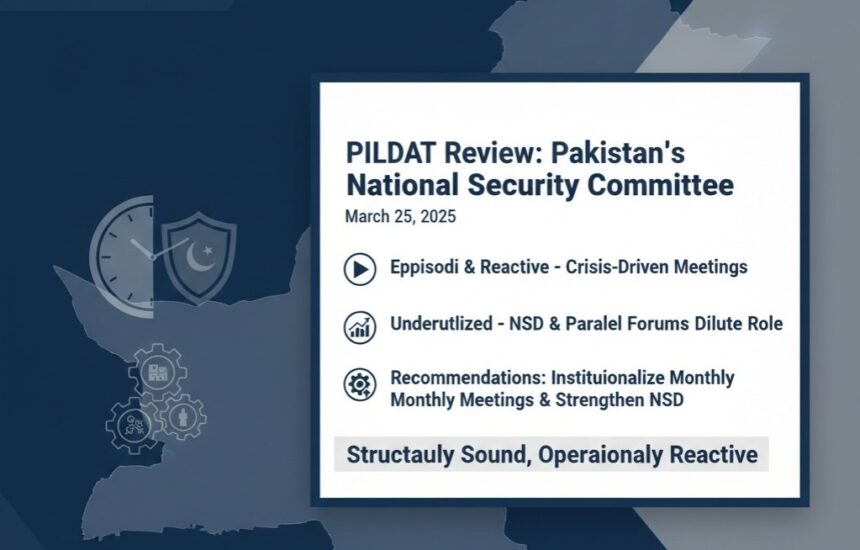
The study notes that the Committee met on three occasions but operated in an episodic and largely reactive manner, convened primarily in response to acute security crises. The April–June 2025 meetings, called after the Pahalgam attack in Indian Illegally Occupied Jammu and Kashmir and ensuing cross-border escalation, highlighted the NSC’s role in enabling civil-military consultation and coordinating national responses during high-pressure moments.
The June 2025 session also broadened the agenda beyond immediate bilateral tensions, allowing participants to assess regional developments such as Israeli military strikes on Iran. That discussion demonstrated the NSC’s potential to serve as a strategic forum for deliberation on wider regional dynamics, not only crisis management.
PILDAT’s review, however, points out that overall use of the National Security Committee remains irregular. The National Security Division has been underutilized because the NSC meets infrequently, and growing reliance on parallel coordination mechanisms — including Apex Committees under the National Action Plan and other ad hoc high-level meetings — has diluted the NSC’s institutional prominence and undermined strategic coherence.
To strengthen strategic governance, PILDAT recommends that the NSC be institutionalized as a regular forum for civil-military consultation with monthly meetings to proactively review domestic and international security developments. The review calls for bolstering the National Security Division’s analytical, operational, and coordination capacities so that high-level deliberations rest on evidence-based analysis and long-term planning. It also urges a clear reaffirmation of the NSC as Pakistan’s principal strategic decision-making platform and a precise delineation of its role relative to parallel committees to prevent duplication and improve accountability.
Overall, the second year of the Shehbaz Sharif government reflects a national security architecture that is structurally sound but remains operationally reactive, underscoring the need for regularized NSC processes and stronger institutional support to guide Pakistan’s strategic choices.