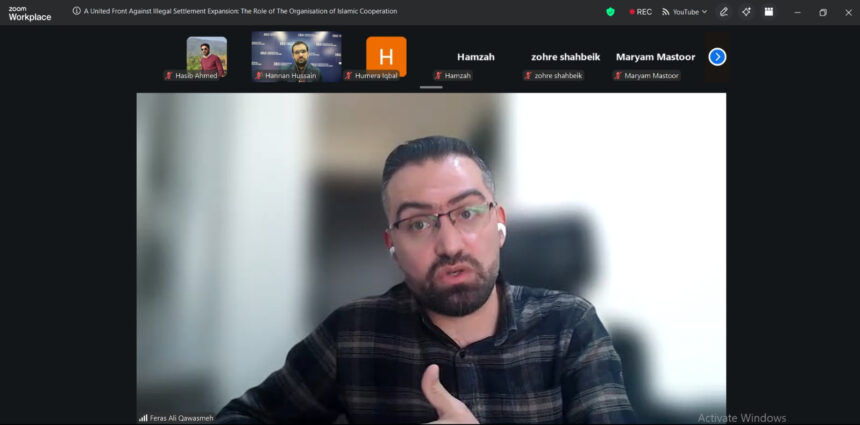
The Institute of Regional Studies in Islamabad hosted an expert webinar that examined the accelerating expansion of illegal settlements in the occupied West Bank and the diplomatic avenues available to counter them. Dr Feras Qawasmeh, Assistant Professor of Public Policy at the Joaan Bin Jassim Academy for Defence Studies in Qatar, spoke to a regional audience about the need for coordinated action and sustained international scrutiny.
Dr Qawasmeh outlined shifting patterns of settlement growth and rising settler violence, including arson attacks and daily impediments to civilian life, arguing that these trends require stronger regional diplomacy and support for Palestinian-led grassroots campaigns. He stressed that an effective response depends on political consensus, and highlighted how the recent extraordinary open-ended ministerial session of the OIC has helped advance a unified stance.
Central to the discussion was Pakistan’s continued support for a two-state solution and its firm position against any illegal aggression that undermines Palestinian statehood. Speakers linked Pakistan’s diplomatic efforts to a broader strategy in which the OIC consensus amplifies the voices of Muslim-majority states and creates leverage for coordinated measures at multilateral fora.
Dr Qawasmeh also examined the role of popular movements, notably the Boycott, Divestment and Sanctions campaign, in drawing international attention to settlement expansion. He proposed policy measures to channel Palestinian rights advocates and organized civil society groups into a pipeline that can engage Pakistan and key Gulf partners within the OIC to build momentum against forced annexation and entrenched occupation.
Hannan Hussain, head of the West Asia Program at the Institute, provided an on-ground assessment of the occupied West Bank, noting how the long-term impacts of the Oslo Accords have shifted security controls and political liberties to the detriment of Palestinians. He warned that these dynamics remain understudied in official discourse even as tensions rise between local populations and those driving violence.
Speakers pointed to Pakistan’s recent interventions at the UN Security Council as proof points of its commitment to Palestinian liberties and opposition to settlement expansion. The session concluded with an interactive question and answer segment that explored constraints and opportunities for regional players to improve Palestinian freedoms, emphasising how a sustained OIC consensus can help prevent further entrenchment of the occupation in line with international legal obligations.