



By Nadeem Tanoli
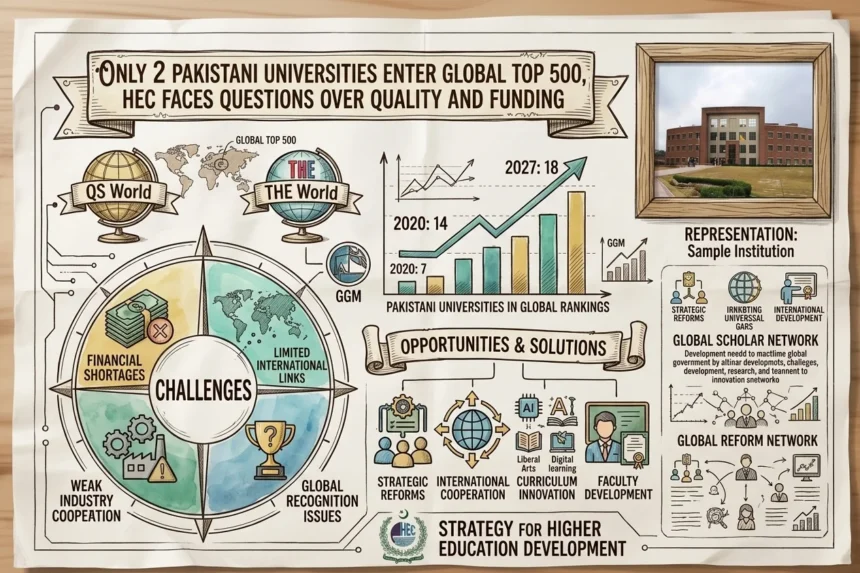
ISLAMABAD: Despite a sharp increase in the number of Pakistani universities appearing in international rankings, only two institutions from the country have secured places among the world’s top 500 universities, as the higher education sector continues to face financial shortages, weak international linkages and limited industry cooperation.
The figures were presented by Higher Education Commission (HEC) Chairman Dr Niaz Ahmad Akhtar during a briefing to the National Assembly Standing Committee on Federal Education and Professional Training on November 3, 2026.
According to the briefing, Pakistan’s representation in international university rankings has grown significantly in recent years. However, the HEC chairman acknowledged that universities continue to face serious challenges, particularly inadequate funding, limited global recognition and difficulties in collaboration with international institutions.
The HEC informed the committee that the number of Pakistani universities listed in the QS Asia University Rankings increased from 29 in 2020 to 83 in 2026. Pakistan’s representation in the Times Higher Education Asia Rankings also rose from 14 universities in 2020 to 48 in 2026.
In global rankings, Pakistani universities appearing in the Times Higher Education World University Rankings increased from 14 in 2020 to 56 in 2027. Similarly, the number of Pakistani institutions listed in the QS World University Rankings rose from seven in 2020 to 18 in 2027.
Despite the rise, only two Pakistani universities secured positions among the world’s top 500 in the QS World University Rankings 2027. Twelve Pakistani universities were placed among the top 1,000 in the same rankings, while 22 Pakistani universities featured among the top 1,000 in the Times Higher Education World University Rankings 2026.
The figures have raised questions over whether the growing presence of Pakistani universities in international rankings is translating into better teaching standards, stronger research output and improved employment prospects for graduates.
Dr Akhtar told the committee that rankings were important as they reflected universities’ international reputation, research performance, graduate employment prospects and linkages with institutions across the world. However, he said that improving ranking positions should not be the only objective.
The real aim, he added, should be sustainable improvement in education quality, institutional performance and international competitiveness.
The HEC chairman identified financial and budgetary shortages as a major hurdle. He also pointed to barriers linked to international relations, limited recognition of Pakistani institutions abroad and weak cooperation between universities and industries.
He explained that international ranking systems assessed several areas, including research, employment outcomes, quality of learning, international engagement and sustainability. Pakistan, he said, had strong human resources, but financial constraints made it difficult for universities to improve in these areas.
To address the issue, the HEC has formed a committee on international university rankings. The committee has been tasked with preparing a coordinated national plan, explaining ranking methodologies to universities and helping institutions identify weaknesses requiring improvement.
Dr Akhtar also informed the parliamentary panel that around 20 task forces had been constituted to study key areas of higher education and recommend reforms.
The commission is reviewing and developing policies on undergraduate education, cross-border education, liberal arts, dual and joint degree programmes, computing education, curriculum reforms and the use of artificial intelligence in academic programmes.
Scholarships and international partnerships also came under discussion during the briefing. The HEC highlighted programmes including the Pak-US Knowledge Corridor, Fulbright and DAAD scholarships, Quaid-i-Azam Memorial Scholarships and the Stipendium Hungaricum Programme.
The commission also referred to Allama Iqbal Scholarships for international students, academic partnerships with Chinese universities and technology companies, and its Global Scholar Network Portal. The portal is aimed at connecting Pakistani scholars working abroad with universities, teachers and researchers in Pakistan.
For faculty development, the HEC said it had launched free artificial intelligence training for teachers and administrative staff in public and private universities.
The HEC chairman also highlighted the introduction of an online and paperless degree attestation system developed in collaboration with the Ministry of Foreign Affairs and the Inter Boards Coordination Commission.