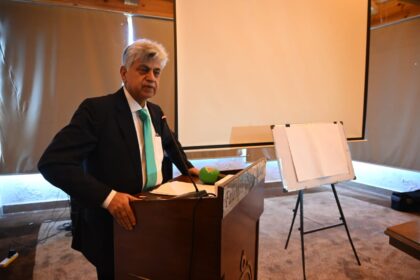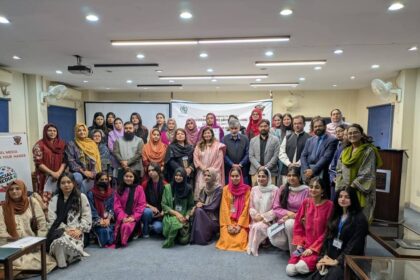




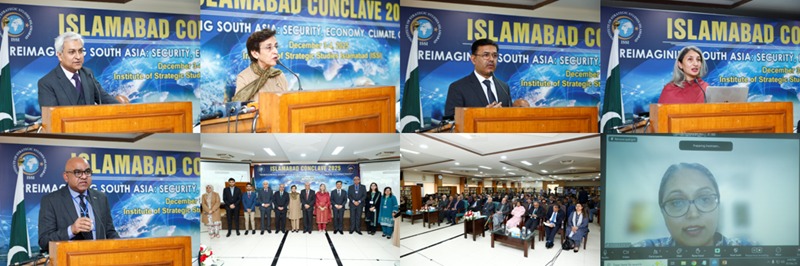
The Arms Control & Disarmament Centre at the Islamabad Conclave 2025 convened Working Session III on December 03, 2025, to examine emerging strategic security risks and chart a peaceful path forward for Pakistan. Senior policymakers, academics and regional experts warned that Strategic Security now spans a wide array of military and non-military threats that demand integrated national responses.
Ambassador (Retd.) Tehmina Janjua argued that the principal regional challenge is India’s asserted hegemonic posture, which she linked to ideological drivers and increasingly assertive policies. On Afghanistan she said the enduring challenge stems from irredentist currents amplified by the Taliban’s worldview and called for a comprehensive review of Pakistan’s policy to address cross-border tensions while safeguarding national interests. She also drew attention to climate change and water insecurity as urgent non-military threats that must be central to Pakistan’s Strategic Security planning.
Malik Qasim Mustafa, director of ACDC, framed South Asia as an evolving security environment shaped by traditional rivalries and Emerging and Disruptive Technologies such as AI, hypersonics, drone swarms and cyber tools. He argued that these technologies are redefining deterrence and complicating regional stability even as Pakistan’s geographic position offers opportunities to promote cooperation.
Dr. Zahir Kazmi warned that the rapid diffusion of autonomous and digital systems, including unmanned underwater vehicles and AI-enabled platforms, is altering escalation dynamics. With international negotiations on Lethal Autonomous Weapons Systems stalled, he urged Pakistan to invest in institutional foresight and capabilities to manage faster, less predictable crises driven by technological change.
Dr. Nishara Mendis placed the Indian Ocean at the centre of South Asia’s strategic future, noting that naval modernisation and maritime domain awareness are now essential for coastal states. She identified persistent deficits—a missing regional security architecture, limited economic cooperation and weak regional frameworks—that undermine the region’s ability to manage both conventional and non-conventional threats.
Dr. Salma Malik highlighted Pakistan’s geostrategic assets, from Gwadar Port to access toward Central Asia and proximity to the Strait of Hormuz, while warning that unresolved conflicts such as Kashmir, border tensions with Afghanistan and a faltering SAARC reduce the country’s ability to capitalise on these advantages. She emphasised that domestic stability, economic resilience and diplomatic agility are prerequisites for an effective Strategic Security posture.
Ambassador Tahir Hussain Andrabi cautioned that intensifying great-power rivalry, rapid technological change and blurred nuclear thresholds are producing dangerous spillover effects in South Asia. He noted India’s expanding nuclear and conventional capabilities, including ICBMs, submarine assets and hypersonic development, and warned that compressed decision windows and multidomain operations increase the risk that conventional incidents are misread through a nuclear lens. He stressed the need for measured, multidomain preparedness to limit escalation.
Speakers across the session converged on practical priorities for Pakistan’s Strategic Security: strengthening institutional foresight, building resilience to non-military shocks such as climate and water stress, investing in detection and deterrence for new technologies, and pursuing balanced diplomatic engagement to reduce regional tensions. The Islamabad Conclave discussions underscored that Pakistan’s strategic location gives it both responsibility and opportunity to contribute to a more stable South Asian security environment.