



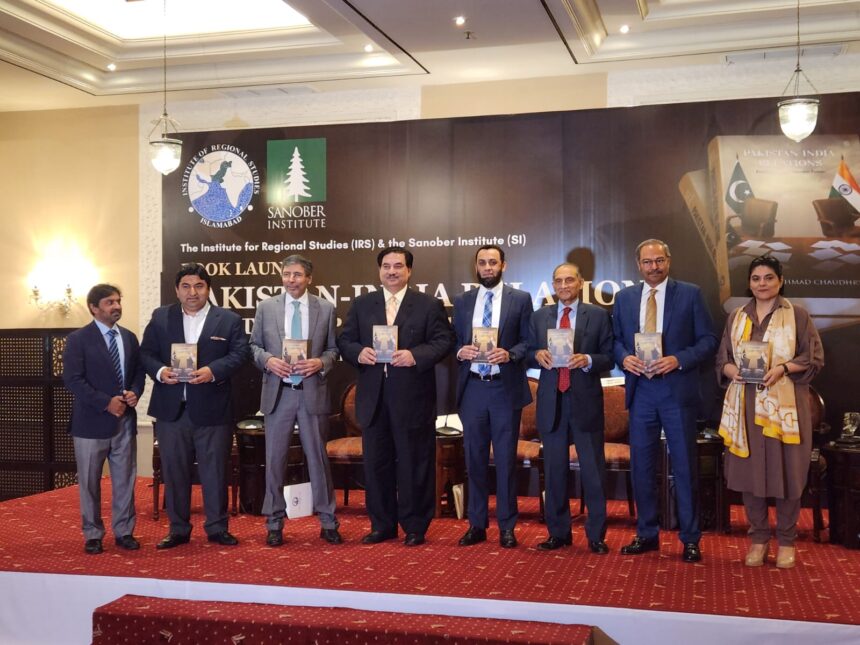
A new book examining the long-standing tensions between Pakistan and India was launched in Islamabad, arguing that deep mutual distrust and India’s ambitions for regional dominance have prevented meaningful cooperation and left the future of bilateral relations uncertain. The book, Pakistan-India Relations – Fractured Past, Uncertain Future, authored by former ambassador Aizaz Ahmad Chaudhry, was presented at a joint event hosted by the Institute of Regional Studies Islamabad and the Sanobar Institute Islamabad. Speakers at the launch called for sincere dispute resolution, mutual respect for sovereignty, and a move away from zero-sum thinking to open paths for peace.
Aizaz Ahmad Chaudhry framed the book around a central question: are unresolved disputes the primary reason for the failure to build good neighborly relations, or are deeper dynamics at work? Drawing on his diplomatic experience, he analyzes India’s refusal to engage constructively on Kashmir, the politicization of terrorism narratives, and broader aspirations for regional dominance. The book reviews past mistakes and considers whether a more hopeful future for South Asia is possible.
Federal Information Minister Atta Tarar used the launch to stress that despite Pakistan’s efforts, relations have remained mired in distrust, which he attributed largely to India’s regional ambitions. He said the recent military confrontation demonstrated Pakistan’s resolve and underlined that lasting peace in South Asia requires sincere efforts to resolve outstanding disputes and mutual respect for sovereignty and territorial integrity. He praised the book for shedding light on the region’s tensions and Pakistan’s role in seeking stability.
Ambassador Johar Salim, president of the Institute of Regional Studies, urged both countries to keep channels of cooperation open despite tensions. He called on Indian leadership to abandon zero-sum thinking and adopt frameworks grounded in mutual respect and peaceful coexistence, arguing such a shift could underpin regional stability and long-term prosperity.
Former federal minister Engineer Khurram Dastgir traced decades of hostile policies and conflicts between the two states, saying peaceful coexistence has remained elusive largely because of India’s sustained desire for regional dominance. He argued that under Prime Minister Narendra Modi, narratives centered on national security and identity have intensified, often portraying Pakistan negatively and complicating diplomatic ties between the two nuclear-armed neighbors.
Murtaza Solangi, spokesman to the President of Pakistan, cited his own book, The War that Changed Everything, to argue that recent Indian aggression and Pakistan’s defensive responses reflect a deeper problem: India’s pursuit of regional primacy fuels instability. He suggested that greater Indian cooperation could have brought earlier peace to the region.
Retired Lieutenant General Aamir Riaz, former president of the National Defence University, commended the book for highlighting how obstructive Indian policies have kept the Kashmir dispute unresolved. He also noted the author’s critique of how cross-border terrorism has been used politically, pointing to research that attributes some high-profile incidents in India to internal actors rather than external sponsorship.
Professor Arshi Saleem Hashmi, dean of the Faculty of Contemporary Studies at the National Defence University, praised the book’s opening chapter for its clear explanation of the rise of Hindu and Muslim nationalisms in the subcontinent. She said the book addresses many common criticisms of Pakistan and highlighted its final chapter, which catalogs treaties and confidence-building measures that could provide a foundation for cooperation if Indian policy shifts.
The launch was broadcast live and is being shared on social media. Organizers said the book will be the subject of academic panels and podcasts in the coming weeks to foster further discussion among young researchers and scholars.