



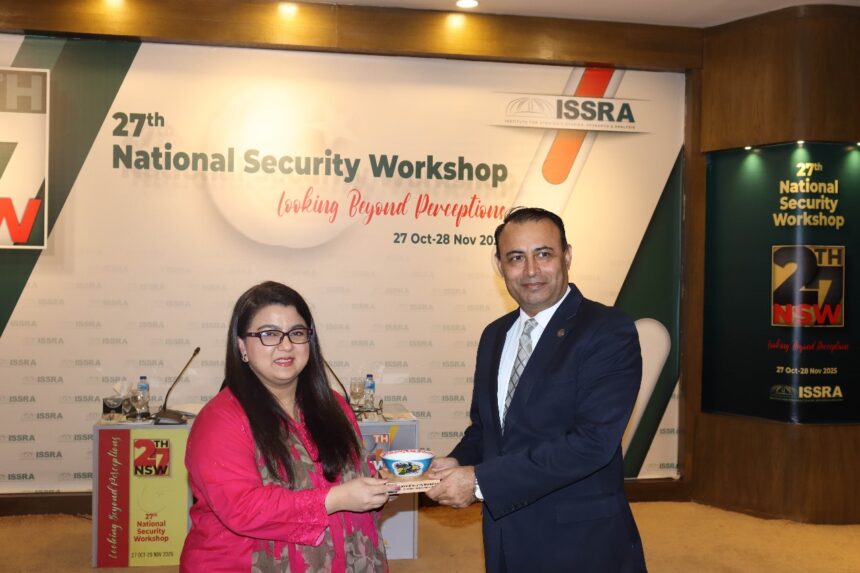
Federal Minister for Information Technology and Telecommunication Shaza Fatima Khawaja addressed the 27th National Security Workshop at the National Defence University after an invitation from the Director General ISSRA, speaking on Pakistan IT potential to a gathering of parliamentarians, entrepreneurs, journalists and civil society representatives.
The minister said Pakistan IT is now a foundational asset for economic security, strategic resilience and global competitiveness, underlining broad political support from the Prime Minister, Field Marshal, the federal cabinet and the Strategic IT and Finance Council. She emphasised that digital transformation is embedded in the national security and economic resilience agenda and that federal and provincial governments, industry, academia and international partners are working together to build an inclusive digital ecosystem.
Shaza Fatima Khawaja outlined the national frameworks driving this shift, naming TechDestination Pakistan to grow the IT industry and exports and Digital Nation Pakistan to advance digital economy, society and governance. She noted that telecom, cybersecurity and artificial intelligence remain cross-cutting domains supporting these pillars and enabling Pakistan IT to scale responsibly.
The minister highlighted concrete gains in the local ecosystem, including 43 Software Technology Parks, repurposed malls hosting more than 400 tech companies, and a nationwide network of 85 incubators. The startup landscape has expanded with over 4,100 startups supported, eight National Incubation Centers, two CEGA centers and strong international representation across the USA, UK, Canada, UAE, KSA, Azerbaijan, Germany and Jordan.
Recent initiatives cited include the Pakistan Startup Fund offering equity-free grants with the Ministry of IT and Telecommunication contributing up to 30% of each round, BridgeStart sending 13 startups to international accelerators, the Prime Minister Cloud Program, DigiSkills 3.0 training 4.3 million Pakistanis, and the Prime Minister’s SkillTech Initiative. National reforms such as updated HEC IT and AI curricula and a semiconductor initiative training 7,200 chip-design professionals were also highlighted, along with collaborations like TikTok’s STEM Feed and Meta’s AI-in-Urdu program.
A major development announced was Google completing registration to open an office in Pakistan and signing an MoU with the ministry focused on advanced digital skills, training and global-standard capacity building for Pakistani talent. The minister also pointed to innovation events and programmes such as the AI Wrapper Competition, a Cybersecurity Hackathon and Ignite-funded initiatives including WISE Lab, Code4AI and SAP-based training programs that strengthen the Pakistan IT talent pipeline.
On the international front, Pakistan showcased its digital vision at events including WAIC Shanghai, LEAP Riyadh, the DCO General Assembly in Amman, the AI for Good Summit in Geneva and GITEX Global 2025, securing new partnerships and more than US$700 million in digital investments. Referring to Marka-e-Haq, the minister said the national response was a historic demonstration of unity and technological strength under the leadership of Prime Minister Shehbaz Shareef and Field Marshal Syed Asim Munir, with government institutions, the armed forces and private cyber experts jointly strengthening the country’s cyber defences.
She concluded by reaffirming Pakistan’s commitment to build a modern, secure and globally competitive digital nation and to continuously enhance cyber readiness as part of the broader Pakistan IT agenda.