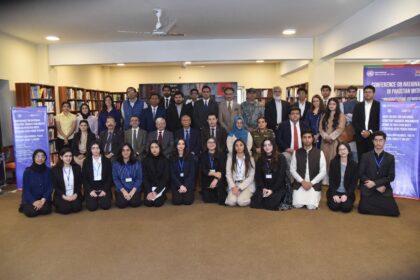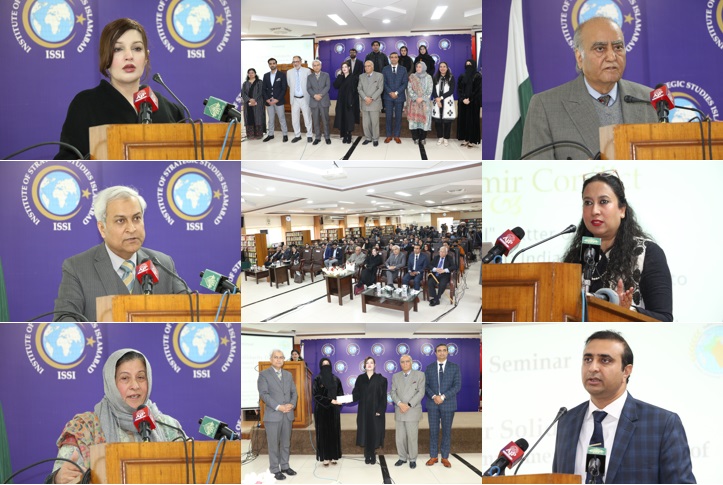
The India Study Center at the Institute of Strategic Studies Islamabad convened a seminar on Kashmir Solidarity Day bringing together policymakers, civil society and Kashmiri leaders to renew Pakistan’s commitment to Kashmir self-determination. The session opened with a Fatiha for President Azad Jammu and Kashmir Sultan Mehmood Chaudhry and a tribute to his lifelong service to the Jammu and Kashmir cause.
Ambassador Khalid Mahmood, Chairman of the ISSI Board, delivered the inaugural remarks and framed the dispute through political, legal and humanitarian lenses. He reaffirmed that United Nations Security Council resolutions on Jammu and Kashmir remain valid and underscored the centrality of the right to self-determination under international law. He also highlighted the severe human rights situation in Indian Illegally Occupied Jammu and Kashmir and Pakistan’s pursuit of peaceful and diplomatic avenues to resolve the conflict.
Mushaal Hussein Mullick spoke as chief guest and drew attention to the human tragedy and wider security risks posed by the dispute, describing Kashmir as both a humanitarian crisis and a nuclear flashpoint. Sharing her experience as a half-widow, she spoke of the peaceful resilience of Kashmiri communities and raised urgent concerns about the fate of political prisoners, including calls for extraordinary safeguards for detainees such as Yaseen Malik, Asia Andarabi and Musarat Alam. She urged the international community to consider an international board of peace for Kashmir and pressed for collective measures to protect those incarcerated for political reasons.
Ambassador Tahir Andarabi addressed the legal aspects and anomalies surrounding the dispute, reiterating that Pakistan’s position is grounded in established international legal principles and that UNSC resolutions remain applicable until implemented or superseded. He detailed documented human rights violations in IIOJK, noting increases since 2019, and highlighted arbitrary detentions, curbs on civil liberties, violations of women’s and children’s rights, ecological harm and exploitation of natural resources. He reaffirmed Pakistan’s legal, diplomatic and humanitarian support for a resolution based on UN mechanisms and dialogue.
Dr Khurram Abbas, Director of the India Study Center, stressed the heightened importance of international attention after Operation Bunyan-ul-Marsoos and the escalation potential the dispute poses for regional peace. He described ISSI’s efforts to engage Pakistani youth through research and writing, announcing the results of an essay competition that drew strong participation nationwide and concluding with a prize distribution to the winners.
Dr Maria Saifuddin Effendi offered an academic analysis titled Pathways to Peace in which she described the conflict as multi-level and increasingly internalized by India. She characterized the ongoing abuses as structural violence, termed ‘systematic genocide’, and argued that the revocation of Articles 370 and 35-A has reshaped the demographic and political landscape of IIOJK, weakening prospects for a free and fair plebiscite.
Mrs Shamim Shawl highlighted the determination of Kashmiri women and the broader population in resisting occupation, rejecting pity and instead framing their endurance as resilience. She condemned discriminatory practices, economic coercion and environmental damage linked to military deployments and disrupted agriculture, urging Pakistan to leverage its diplomatic standing to advance the Kashmir cause internationally.
The seminar closed with a reaffirmation of Pakistan’s resolve to pursue Kashmir self-determination through legal, diplomatic and humanitarian channels and with the prize distribution for the essay competition, signaling continued engagement by scholars and youth on the dispute.