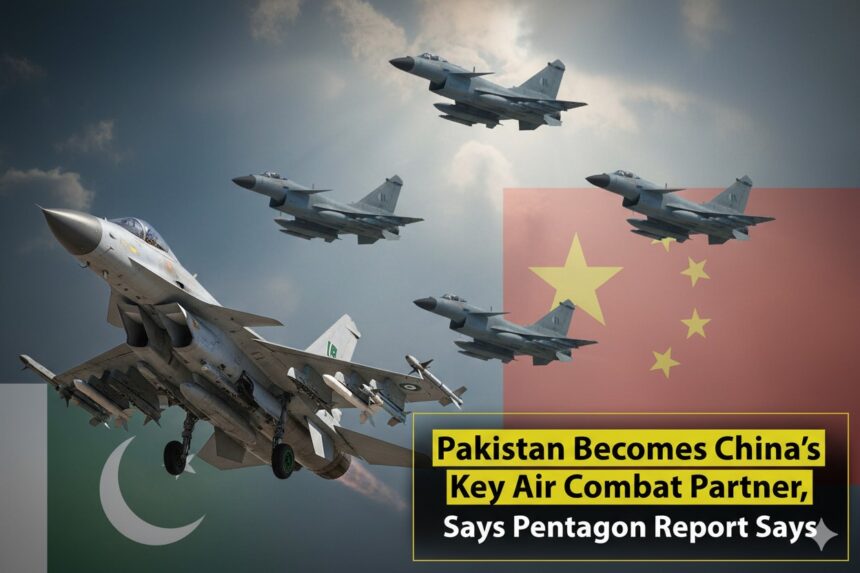
The Pentagon’s 2025 assessment to Congress identifies Pakistan as the most significant partner for China in advanced air combat platforms, highlighting Islamabad’s unique access to the J-10C fighter and a widening defence relationship that is altering regional air power dynamics.
According to the report, Pakistan is the only export operator of the J-10C fighter, with Beijing contracting 36 jets since 2020 and 20 already delivered by May 2025; remaining deliveries are expected to conclude by early 2026. The J-10C fighter brings modern avionics and an AESA radar into the Pakistan Air Force inventory, marking a substantial upgrade in operational capability and interoperability with Chinese systems.
The assessment also places this air combat partnership within the context of China’s expanding role in the global arms market, noting that China became the world’s fourth-largest arms exporter by December 2024. State-owned firms such as AVIC and Norinco are prominent suppliers, and their export strategy—often aligned with broader economic initiatives—offers cost-competitive options for developing militaries.
Beyond the J-10C fighter, Beijing and Islamabad sustain long-standing industrial collaboration. The co-produced JF-17 Thunder remains a symbol of that partnership and has been exported to several countries. Pakistan has also received strike-capable unmanned aerial vehicles including the Caihong and Wing Loong series, alongside Chinese frigates and air defence equipment that further broaden the bilateral defence ecosystem.
Analysts in Islamabad and Washington read the report as evidence of an operational and strategic alignment rather than a purely transactional relationship. The integration of the J-10C fighter and other Chinese platforms has implications for deterrence calculations in South Asia, particularly in relation to India’s air capabilities, and signals Beijing’s growing influence in arms markets that traditionally favoured Western suppliers.
For Pakistan, access to the J-10C fighter and associated joint production and training arrangements strengthens force modernisation and tactical cooperation with China, while prompting closer scrutiny from regional actors. The Pentagon assessment frames this partnership as a notable shift in defence ties that will reverberate across regional security and global defence trade trends.