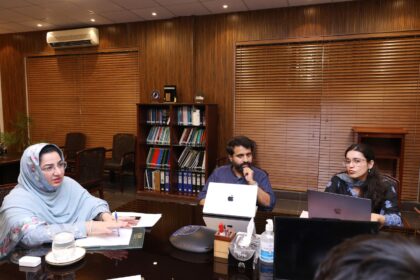




The Ministry of National Health Services, Regulations and Coordination today released the latest UHC Service Coverage Index estimates showing national progress and persistent gaps across districts. With technical support from the UK’s Evidence for Health programme and the World Health Organization, Pakistan’s UHC Service Coverage score improved to 54.7 in 2024 from a baseline of 40 in 2015, a 37.8 percent rise since 2015 though growth slowed to an annual increase of just 1.5 percent since 2023.
Federal Minister of Health Syed Mustafa Kamal welcomed the results and underlined the government’s commitment to expand access, improve quality and reduce financial burdens for underserved populations. “Our mission is to channelise new efforts and enhance technologies to bring essential healthcare services closer to the doorstep of people, improve quality of healthcare, and reduce financial burden, especially for the underserved and marginalised,” he said, and noted work toward a new National Health and Population Policy for 2026–2035 aimed at managed liberalisation, partnerships and investment to strengthen primary healthcare.
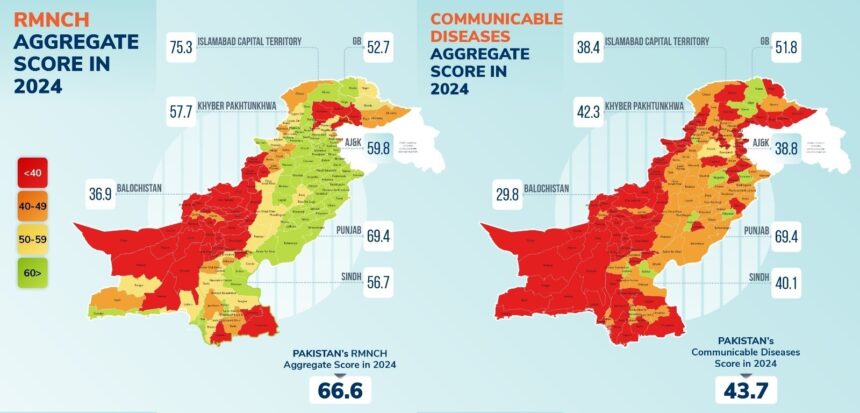
The provincial and territorial picture is uneven. Islamabad Capital Territory scored highest at 62, followed by Punjab at 55.2, Khyber Pakhtunkhwa at 53.5, Sindh at 51.4, Gilgit Baltistan at 49.7, Azad Jammu and Kashmir at 49.5 and Balochistan at 38.8. At district level, 45 districts remain below a UHC Service Coverage score of 40, 39 districts fall in the 40–49 band, 65 districts are between 50 and 59, and only nine districts have reached 60 or above, highlighting the distance to the Sustainable Development Goal target of 80 by 2030.
Performance also varies by service category. Jhelum leads the Reproductive, Maternal, Newborn and Child Health category with an aggregate score of 78.4, followed by Hunza and Lahore. Diamer tops the Infectious Diseases category at 70.1, with Peshawar and Hyderabad following. For Non-Communicable Diseases the report notes a persistent data gap, indicating a need for more disaggregated information to inform planning. Service capacity and access performance is led by Karachi South, with Islamabad and Abbottabad following.
Minister of State Dr Malik Mukhtar Ahmed reiterated the government’s intention to strengthen health systems and increase public investment in health, stressing that no family should be driven into poverty to access essential services. Federal Secretary Hamed Yaqoob Sheikh called for stronger coordination between federal and provincial authorities, health institutions and communities to make healthcare reliable, affordable and available to all.
International partners acknowledged progress and pledged continued support. The British High Commission Head of Health and Education Group, Maria Wyard, said the UK remains committed to supporting governance, innovation and delivery reforms so health systems serve everyone without financial hardship. WHO Representative Dr Luo Dapeng congratulated Pakistan on steady advances and urged alignment of national priorities, evidence and partner support to accelerate UHC and health security.
The report’s findings make clear that while national UHC Service Coverage has improved since 2015, uneven provincial and district performance and gaps in key data areas require targeted investment, better coordination and faster implementation to meet Pakistan’s UHC goals by 2030.