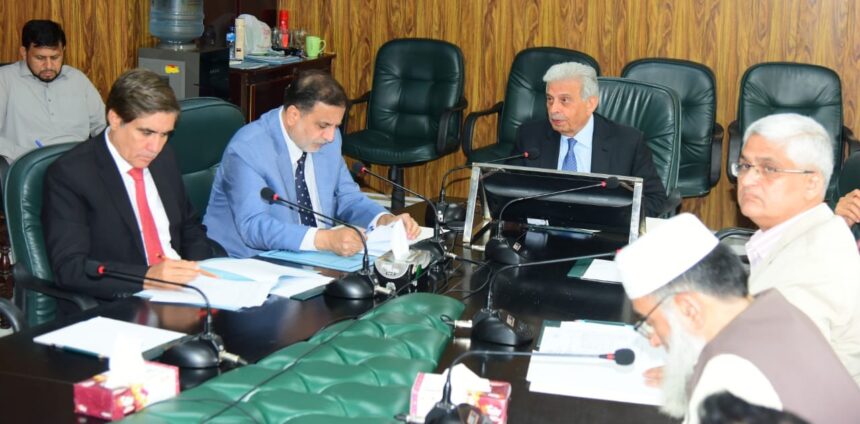
The Government of Pakistan has assured the public that there is no threat of a wheat shortage in the country, affirming that existing reserves are sufficient to meet national demand. Federal Minister for National Food Security and Research, Rana Tanveer Hussain, made this statement during a meeting of the Wheat Board, where officials reviewed the supply and demand situation for wheat and the availability of key agricultural inputs for the upcoming Rabi season.
Rana Tanveer Hussain emphasized that wheat stocks currently stand at 33.47 million metric tons, while the national requirement is 33.58 million metric tons, indicating only a minor shortfall of 0.11 million metric tons. He clarified that this difference is insignificant and there is no cause for public concern regarding wheat availability. The minister also announced that Pakistan will not import wheat at this time, as current reserves are adequate for domestic needs.
Highlighting the government’s priorities, the minister stressed that protecting the interests of local farmers takes precedence over market or trader interests. Efforts have been made to ensure a sufficient supply of urea and other agricultural fertilizers for the upcoming sowing season, aiming to prevent any difficulties for growers. Despite rising global prices for fertilizers, the government has maintained strict control over local prices to keep farming expenses manageable for Pakistani farmers.
Rana Tanveer Hussain also cautioned against unnecessary and stringent provincial policies, particularly in Punjab, which could lead to panic in the market and disrupt stability. He pointed out that following the eighteenth constitutional amendment, many powers have shifted to the provinces, occasionally causing challenges in implementing uniform national agricultural policies. The minister called for stronger coordination between federal and provincial governments to ensure effective policy execution.
He further noted that sustainable food security in Pakistan depends on increasing wheat yield per acre and reducing production costs, which requires adopting modern technology and providing enhanced support to farmers. Instead of relying on short-term measures, the government is focusing on lasting solutions to empower farmers and achieve self-sufficiency in wheat production.
The meeting concluded with a commitment to work closely with provincial governments to safeguard farmers’ interests and guarantee the uninterrupted supply of wheat to the public.