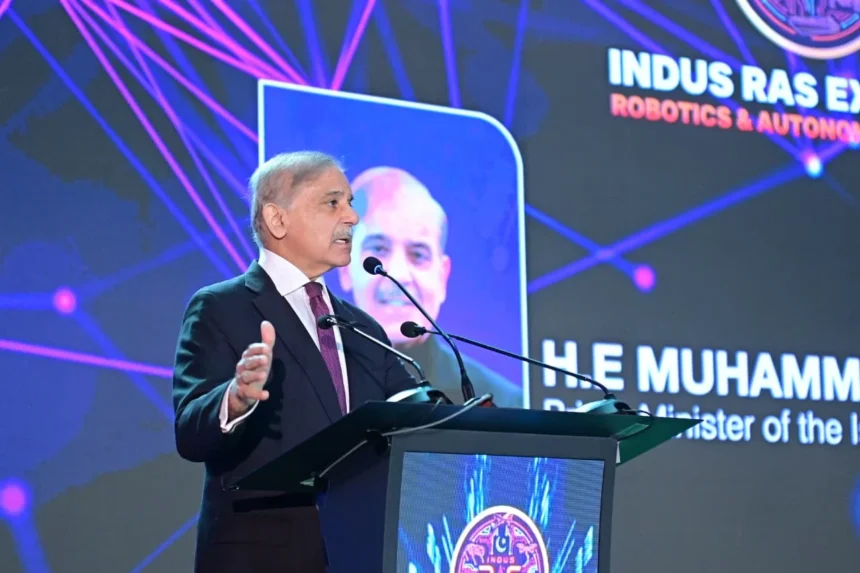
ISLAMABAD: Prime Minister Muhammad Shehbaz Sharif on Wednesday urged all stakeholders to become part of a unified national innovation ecosystem, stressing the need to develop indigenous knowledge and technological capabilities in Pakistan.
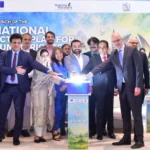
Addressing the inaugural ceremony of the “Indus RAS – Robotics and Autonomous Systems Expo 2026”, the prime minister said Pakistan must embrace the technological revolution while ensuring that its benefits reach every segment of society.
“Let our universities, research and development centres, startups, industries, and farmers become part of one national innovation ecosystem, ensuring that the knowledge behind these technologies is indigenous, owned, and continuously advanced in Pakistan,” he said.
Shehbaz Sharif said the robotics and autonomous systems revolution should not remain confined to advanced economies, large corporations or major cities. Instead, he added, it should become a catalyst for inclusive growth by improving the lives of farmers, small businesses, women entrepreneurs, young innovators and underserved communities across Pakistan and the Global South.
Highlighting the rapid advancement of emerging technologies, the prime minister said their growing power also increased the responsibility of governments and stakeholders.
“We must establish clear regulatory and ethical frameworks to ensure autonomous systems are safe, secure, transparent, and always used for the benefit of mankind,” he said.
He reiterated the government’s commitment to promoting innovation and technological development while ensuring that emerging technologies are deployed responsibly and inclusively for sustainable national progress.
The ceremony was attended by Chief of Defence Forces and Chief of Army Staff Field Marshal Syed Asim Munir, federal ministers, experts, industrialists, entrepreneurs, foreign delegates, brands, companies and students.
The prime minister announced two landmark government initiatives aimed at shaping the future of robotics and autonomous systems in the country. These included the launch of the Spark and Elevate programme to transform Pakistan’s research into world-class technologies, globally competitive enterprises and high-productivity jobs, and the establishment of the Pakistan Venture Fund with an initial commitment of $20 million to catalyse investment in the technology ecosystem.
Shehbaz Sharif said the future of robots and autonomous machines that Pakistan sought was not merely a story of technology, but the story of a nation of about 250 million resilient people determined to re-imagine, compete and build a better future for coming generations.
“In fact, it is the story of our very young, bright people whose cherished dreams are ignited by the spark of curiosity, whose talent knows no bounds and whose ingenuity will shape our motherland, Pakistan, for a wonderful future,” he maintained.
The prime minister said Pakistan stood at the cusp of a historic opportunity, “one we cannot and shall not miss, inshallah.” He said Pakistan would not be a nation that merely inherited choices made by others, but would shape its own destiny through innovation, enterprise, self-reliance and untiring efforts.
He called for building a brighter, stronger and prosperous Pakistan through determination, saying future generations should feel proud of these efforts.
Terming the Indus RAS Expo a landmark initiative, the prime minister said it reflected Pakistan’s determination to become a leading player in the technologies that would define the 21st century.
He recalled that earlier this year Pakistan had hosted the Indus AI Summit, bringing together governments, technology leaders, researchers and entrepreneurs to shape the country’s journey in the age of artificial intelligence. The RAS Expo, he said, gave that vision a tangible form by demonstrating how innovation could be translated into viable solutions that strengthen the economy, enhance security and improve people’s lives.
“We stand at an extraordinary moment in history where machines no longer merely calculate; they can perceive, decide and act swiftly. What once belonged to the realm of imagination has become part of our everyday reality,” he observed.
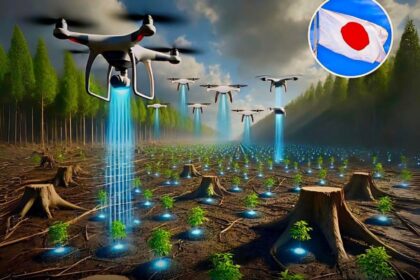
Referring to agriculture, the prime minister said farmers had for generations worked at the mercy of nature, facing water scarcity, rising input costs, fragmented land holdings and climate challenges. He said emerging technologies had helped bring a revolution in the agriculture sector, while in times of crisis the same technology provided access and helped save lives where roads and bridges were washed away.
Shehbaz Sharif said Pakistan had made remarkable progress in developing indigenous autonomous capabilities in defence and security.
“Under the dynamic leadership of Field Marshal Syed Asim Munir, our armed forces have adopted cutting-edge technologies, some of which I just witnessed on display outside this hall. I have seen simulators 100% manufactured and assembled in Pakistan. Drones have already achieved more than 60% indigenization,” he added.
The prime minister commended the IT ministry, experts, professionals and technocrats for their achievements for the country.
Referring to last year’s Marqa-e-Haq, he said the entire world witnessed how Pakistan’s valiant armed forces guarded the physical and cyber frontiers through the effective use of advanced autonomous systems led by Field Marshal Syed Asim Munir and supported by Air Chief Marshal Zaheer Ahmed Babar Sidhu and Naval Chief Admiral Naveed Ashraf.
He said the armed forces had proved that Pakistan possessed not only the resolve to safeguard its sovereignty, but also the indigenous capability, technological prowess and operational excellence required to employ advanced autonomous technologies in defence of the motherland.
“These remarkable military advancements are an integral part of our national defence. They will further strengthen our security architecture, make our defence more impregnable, and enhance our resilience against emerging and future threats,” he observed.
Earlier, Minister for IT Shaza Fatima Khawaja said the countries that led new technologies would define the future economy.
She said Pakistan would own full value chains of robotics and artificial intelligence as advanced technological self-reliance was a national decision. Under the prime minister’s leadership, she said, the government had embraced the clear direction of Digital Nation Pakistan, where technology was not simply another lever of the economy but an engine of productivity, employment and national competitiveness.
The minister said the government was creating an enabling environment for startups, investors and young people to compete globally.
“And the results are already visible. The export numbers tell you that this year the ICT exports grew by almost 21%. This is a testament to the resilience of our industry and our policies. We’ve moved 14 ranks up in the E-Governance Development Index, and we’ve moved 27 ranks up this year in ITU’s ICT Development Index,” she added.