



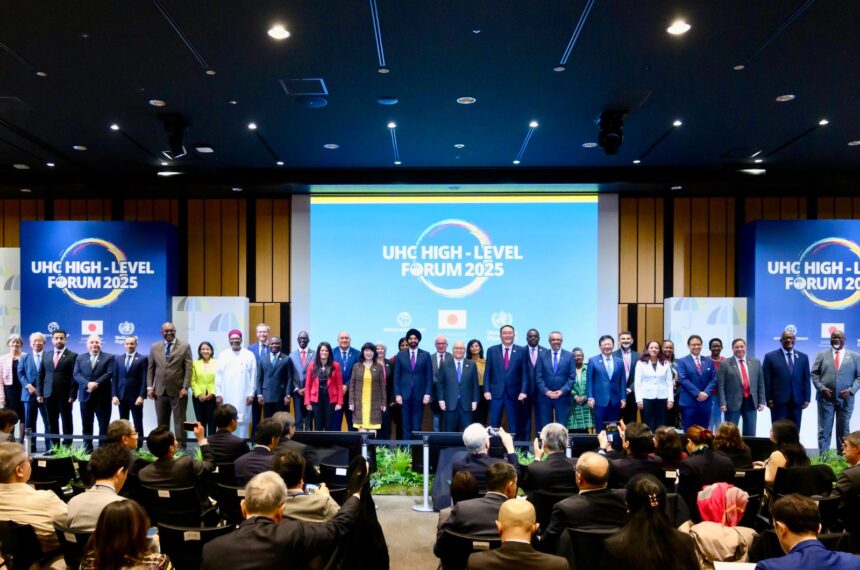
Fifteen countries unveiled National Health Compacts at the Tokyo Universal Health Coverage High-Level Forum, signalling renewed global momentum to expand primary healthcare and reach the World Bank Group target of delivering affordable, quality services to 1.5 billion people by 2030. The Compacts set practical, five-year reform agendas that unite Health and Finance Ministries around measurable targets for service reach, financial protection, and workforce strengthening.
Since the goal was announced in April 2024, World Bank Group efforts and partner support have helped 375 million people access quality, affordable care, and work is now underway with roughly 45 countries to scale proven primary care approaches that improve outcomes while generating employment across health workforces and local supply chains.
The 2025 Global Monitoring Report, released at the forum, underlines the scale of the challenge: 4.6 billion people still lack access to essential health services and 2.1 billion face financial hardship because of health expenses. These figures reinforce the need for long-term reforms to build more resilient and equitable systems and to make primary healthcare affordable and reliable.
World Bank Group President Ajay Banga highlighted the broader value of strong primary systems, saying “Strong primary health systems do more than safeguard health—they support jobs and economic opportunity.” The forum showcased country-led commitments that aim to translate those words into concrete investments and policy changes.
Country pledges include digital and infrastructure upgrades, delivery model diversification, workforce digital enablement, and expanded insurance coverage. Examples presented in Tokyo include the Philippines connecting health facilities nationwide, Uzbekistan digitizing processes to reduce workloads by roughly 30 percent, and Sierra Leone planning 300 new facilities and solar- and digitally-equipped upgrades so citizens can access primary care within five kilometres. Bangladesh and Indonesia are expanding digital and multi-platform primary care models, while Ethiopia and Saint Lucia are investing in digital tools and workforce modernization.
Several countries announced major moves to reduce financial barriers: Kenya plans to double public health spending to reach 5 percent of GDP and expand social health insurance coverage from 26 percent to 85 percent with full subsidies for vulnerable populations, and Morocco will extend mandatory health insurance to an additional 22 million people. Nigeria is prioritising regional manufacturing by training 10,000 pharmaceutical and biotech professionals and offering incentives to grow local production of vaccines, medicines, diagnostics, and health technologies.
Progress depends on coordinated financing and technical support. The World Bank Group, Gavi, and the Global Fund announced aligned financing, including $2 billion co-financed with Gavi and the Global Fund, while philanthropic partners are mobilising up to $410 million through the Global Financing Facility and the Health Systems Transformation and Resilience Fund. Seed Global Health and donor countries such as Japan and the United Kingdom committed technical assistance to support policy, planning, and advanced workforce development. Japan, WHO, and the World Bank Group also launched a Universal Health Coverage Knowledge Hub to share evidence-based solutions and peer learning.
For Pakistan, the forum’s practical focus offers actionable lessons: the National Health Compacts emphasise digitally enabled facilities, workforce training, and financing reforms that Pakistani policymakers and development partners can adapt. Closer engagement with regional initiatives, access to pooled financing, and learning from digital primary care pilots across compact countries could help Pakistan strengthen primary healthcare delivery and financial protection as it faces similar demographic and fiscal pressures.
The 15 countries that presented National Health Compacts at the Tokyo forum are Bangladesh, Egypt, Ethiopia, Fiji, Indonesia, Mexico, Morocco, Nigeria, Philippines, Sierra Leone, Syria, Tajikistan, Uganda, Uzbekistan, and Zambia. Their combined commitments reflect a shared, practical push to expand primary healthcare, reduce out-of-pocket costs, and build resilient health systems that also create jobs and economic opportunities.