



“Seats Empty, Standards Lowered, Fees Inflated”: Senate Exposes Deep Crisis in Private Medical Colleges
Nadeem Tanoli
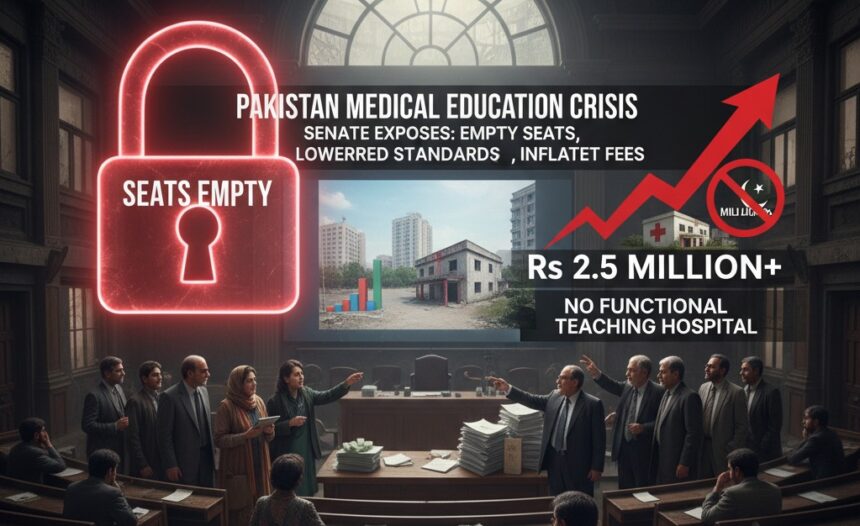
Islamabad: A major crisis in Pakistan’s medical education system has come to light as the Senate Standing Committee on National Health Services, Regulations and Coordination exposed serious irregularities in private medical colleges, including empty seats despite massive demand, fee overcharging, lack of teaching hospitals, and declining education standards.
The most controversial revelation was that despite over 140,000 students qualifying the MDCAT, thousands of seats in private medical colleges remain vacant, raising serious questions about the credibility and quality of these institutions. Senators directly challenged the narrative that financial constraints are the main barrier, pointing out that top tier institutions like Aga Khan and Ziauddin have no vacant seats, indicating that the real issue lies in the quality of education rather than affordability.
PIMS controversy grows over contract extension
Senator Rubina Khalid strongly criticized the decision to lower MDCAT passing marks to 55 percent for MBBS and 50 percent for BDS, alleging that the move was designed to help underperforming private colleges fill their vacant seats. She raised concerns about a conflict of interest within the regulatory structure, claiming that private college owners influence key decisions to protect their commercial interests.
Officials acknowledged the issue, confirming that several colleges still fail to attract students and admitted that these institutions may lack basic quality standards. It was announced that all colleges with vacant seats will undergo fresh inspections, signaling a possible crackdown on substandard institutions.
The debate took a sharper turn when lawmakers exposed serious deficiencies in infrastructure, particularly the absence of functional teaching hospitals in some colleges. Senators questioned why institutions without proper hospitals are allowed to operate, warning that students are being enrolled without access to adequate clinical training. The committee was informed that a medical college is required to have a 500 bed hospital for 100 students and 650 beds for 150 students, but officials admitted that actual facilities often fall far short of these standards.
In a candid admission, the Health Minister acknowledged this as a “weak area,” while another participant highlighted the ground reality, stating that students are admitted and fees are collected without any proper hospital arrangements in place.
The issue of overcharging by private medical colleges further intensified the debate. Despite a regulatory cap of Rs. 1.8 million for annual tuition fees, several institutions were found charging between Rs. 1.9 million and Rs. 2.5 million. The committee was informed that around 15 to 18 colleges had violated the fee cap. Authorities claimed that these institutions were forced to return the excess amount through fee adjustments and that their admission portals were temporarily suspended as a punitive measure.
Lawmakers questioned whether such actions were sufficient, arguing that repeated violations indicate weak enforcement rather than isolated breaches.
Another critical concern raised during the session was the growing migration of experienced faculty from public to private medical colleges, driven by better salaries in the private sector. Senators warned that this trend is weakening public sector institutions and called for immediate salary reforms to retain qualified doctors and teachers.
The committee also discussed the controversial 15 percent quota reserved for overseas students, which operates on separate merit lists, and the broader issue of limited local capacity. It was revealed that more than 40,000 Pakistani students go abroad annually to study medicine, resulting in an estimated loss of $800 million in foreign exchange. Some lawmakers argued that increasing local seats could reduce this outflow and discourage students from enrolling in low-quality foreign institutions.
In response to the mounting concerns, regulators have issued final warnings to private medical colleges, directing them to comply strictly with fee caps and regulatory requirements. Any violation, concealment, or misrepresentation could lead to suspension of accreditation and a complete halt on admissions.
A senior participant, speaking anonymously, described the situation as “a systemic failure where commercial interests have overtaken academic standards,” while another observer warned that “if immediate corrective action is not taken, the credibility of Pakistan’s medical education system will continue to erode.”