



Two Crises, One Region: Why Stability Matters from the Middle East to South Asia
By Tasadduq Gilani
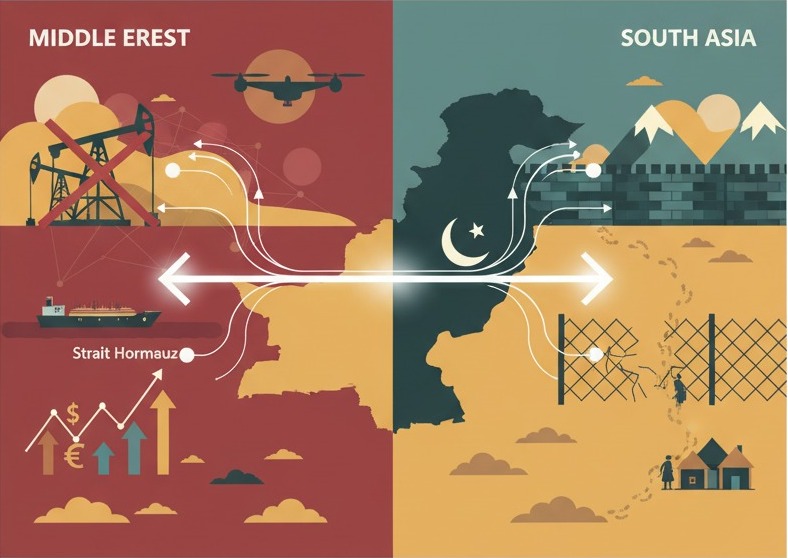
The international system is once again entering a period of heightened tension. In recent weeks, the confrontation involving the United States, Israel, and Iran has intensified in the Middle East, while security tensions along the Pakistan–Afghanistan border have also drawn regional attention. At first glance, these developments appear to be separate crises occurring in different theatres. Yet, viewed through a broader geopolitical lens, they reveal how instability in one region can quickly influence dynamics in another.
For countries such as Pakistan, which occupy a strategically important geographic position linking South Asia, Central Asia, and the Middle East, such developments demand careful attention and balanced diplomacy.
Iran’s Oil Warning and Global Energy Concerns
One of the most striking developments in the current Middle Eastern crisis has been Iran’s warning that, should hostilities escalate further, it could prevent oil supplies from reaching the United States, Israel, and their allies. While such statements are part of strategic signaling during periods of conflict, they nonetheless highlight the central role that energy security plays in global geopolitics.
The Middle East remains the heart of the world’s oil supply. Any disruption to shipping routes—particularly through the Strait of Hormuz—would have immediate global consequences. A significant percentage of the world’s oil exports passes through this narrow waterway. Even the perception of instability there can cause sharp fluctuations in energy markets.
For energy-importing countries such as Pakistan, volatility in global oil markets translates directly into economic pressure. Rising energy prices affect industrial productivity, transportation costs, and overall economic stability. Consequently, maintaining stability in the Gulf region remains an important priority not only for Middle Eastern states but for the wider international community.
The Strategic Context of the Iran–US–Israel Tensions
The confrontation between Iran, the United States, and Israel reflects a complex and longstanding strategic rivalry. Washington and Tel Aviv view Iran’s expanding regional influence and strategic capabilities as potential security challenges. Iran, on the other hand, regards external pressure and sanctions as attempts to limit its sovereignty and regional role.
These competing perspectives have created a persistent environment of mistrust and confrontation. Yet, it is important to note that prolonged escalation benefits no one. A wider conflict in the Middle East would risk destabilizing the entire region, disrupting energy markets, and increasing humanitarian suffering.
In such circumstances, diplomacy, restraint, and international engagement remain essential. Pakistan has consistently advocated peaceful dialogue and the resolution of disputes through diplomatic channels—an approach that remains equally relevant today.
Pakistan–Afghanistan Border Dynamics
At the same time, developments along the Pakistan–Afghanistan border have added another layer of complexity to the regional security landscape. Pakistan has repeatedly expressed concerns about cross-border militant activity that threatens its internal security. Ensuring stability along its western frontier remains a key national priority.
However, Pakistan has also consistently emphasized the importance of constructive engagement with Afghanistan. Stability in Afghanistan is directly linked to stability in Pakistan and the broader region. Both countries share deep historical, cultural, and economic ties, and long-term peace along their shared border is in the interest of both nations.
In recent years, Pakistan has advocated dialogue and cooperation to address security concerns, recognizing that regional challenges cannot be solved through confrontation alone.
A Broader Geopolitical Moment
The simultaneous emergence of tensions in the Middle East and South Asia also reflects broader shifts in global geopolitics. Major powers are reassessing their strategic priorities, while regional actors are navigating complex security and economic pressures.
In such an environment, localized tensions can easily acquire wider significance. Energy routes, trade corridors, and security partnerships increasingly intersect across regions. As a result, developments in the Gulf can influence political calculations in South Asia, and vice versa.
Pakistan’s geographic location places it at the crossroads of these evolving dynamics. This position offers both opportunities and responsibilities: opportunities to serve as a bridge for regional connectivity, and responsibilities to promote stability through balanced diplomacy.
The Path Forward
For Pakistan, the guiding principles of foreign policy remain clear: respect for sovereignty, peaceful resolution of disputes, regional cooperation, and economic stability. In an increasingly interconnected world, these principles are not merely diplomatic ideals—they are strategic necessities.
De-escalation in the Middle East, continued engagement with Afghanistan, and broader regional cooperation will be essential to preventing current tensions from spiraling into larger conflicts.
The coming weeks will likely prove critical. The decisions taken by regional and global actors will determine whether the current crises evolve into deeper confrontations or gradually move toward dialogue and stability.
At a time when geopolitical uncertainty is rising, responsible diplomacy and strategic patience remain the most valuable tools for safeguarding peace.