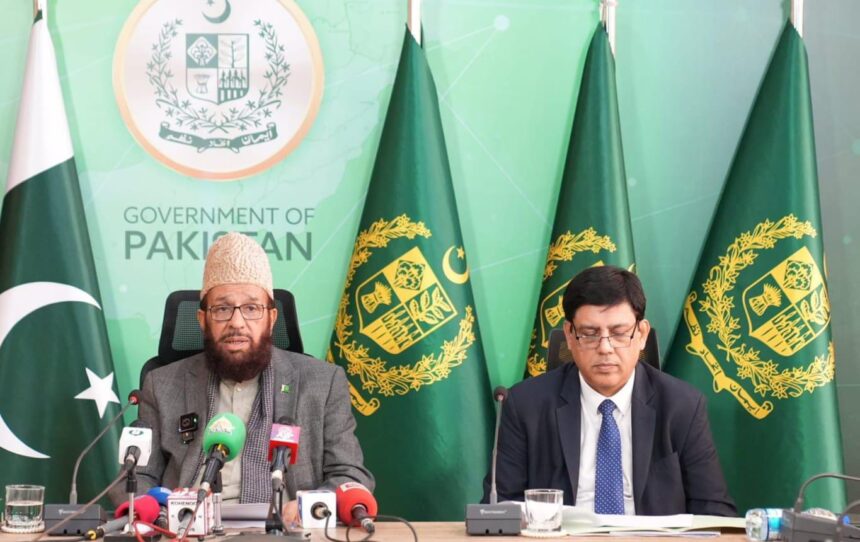
The Religious Affairs Ministry completed a broad programme of reforms and public initiatives in 2025 that strengthened Quranic education, promoted the Seerat of the Prophet and advanced interfaith harmony across Pakistan. An international Quran recitation competition held at the Jinnah Convention Centre in Islamabad from 24 to 29 November 2025 welcomed reciters from 37 countries, with Malaysia claiming first place, Iran second and Pakistan third, while visiting qaris and judges participated in cultural programs in Islamabad, Lahore and Karachi that raised youth interest and enhanced Pakistan’s religious image abroad.
Following provincial rounds, national competitions were organised in September 2025 across ten categories for men, women, huffaz, qaris and youth, culminating in 30 winners receiving certificates and cash prizes. Prominent participants from these events were nominated to represent Pakistan at international contests in Dubai, Russia, Turkey, Saudi Arabia, Kuwait and Morocco, and national selections for Ramadan’s last ten nights produced well-regarded reciters for congregational programs.
A landmark Seerat conference held at the Convention Centre Islamabad marked the 25th edition of the event under the OIC declaration of Nabi al-Rahma and coincided with a commemorative programme. Delegations from Palestine, Egypt, Bangladesh and Bahrain joined leading Pakistani scholars, while a concurrent national Quran and Seerat exhibition showcased research and outreach materials. Federal and provincial directions led to nationwide Seerat and naat gatherings during the Ashra Rahmat period that emphasised tolerance and peaceful coexistence.
The ministry also invested in education and research by organising an essay competition on contemporary issues in the light of the Seerat, awarding scholars and digitising the national Seerat competition system. A project to digitise fifty years of Seerat research is underway and transparency measures now include artificial intelligence and plagiarism detection tools to uphold scholarly standards.
On interfaith policy, the National Ulama and Mashayakh Council was reconstituted and met twice in 2025 to present unified recommendations against extremism, terrorism and hate narratives. The Interfaith Harmony Policy and Religious Tolerance Strategy were approved on 12 February 2025, and the National Commission for Minorities Act became law on 1 December 2025. Financial support for minority welfare included allocations of PKR 100 million for 2024–25 and PKR 85 million for 2025–26, approval of 32 small development schemes, scholarships awarded to 2,236 students from 7,965 applications and direct financial assistance to deserving non‑Muslim beneficiaries in both the previous and current fiscal years.
Efforts to ensure authentic and error‑free Quran publishing reached a national consensus, with an authorised soft copy made available on the ministry website and the launch of a digital Quran and mobile app. An amended Quran Act to secure accurate printings was enacted while implementing rules remain in preparation. A respectful disposal system for damaged or retired Quran pages has passed a successful pilot at a recycling plant now in its final stages, and provinces have been instructed to install green boxes for dignified handling of sacred pages.
Hajj services earned international recognition when the Saudi Ministry of Hajj and Umrah presented Pakistan with an excellence award for Hajj 2025 arrangements. A delegation led by the Saudi deputy minister inspected the Pakistan Hajj Mission and extended congratulations, and the Prime Minister presented a special shield to the Federal Minister for Religious Affairs for the mission’s performance. Hajj 2026 policy has been drafted building on prior reforms to reduce costs and improve services, while digital tools introduced during Hajj 2025—including the Pak Hajj mobile app—provided pilgrims with guidance, training, accommodation, flight and ritual information, and reforms in the private Hajj scheme helped bring down complaints. Refunds were issued to roughly 75 percent of pilgrims totalling PKR 3.5 billion, with per‑pilgrim returns ranging from PKR 12,000 to PKR 110,000.
Logistics for Hajj 2026 were finalised with registrations completed for 119,000 government and 60,000 private pilgrims and competitive procurement concluded for catering, transport and related services. Comprehensive training took place at 147 venues nationwide with audio‑visual support, contributing to disciplined pilgrim conduct. The Route to Makkah initiative expanded to include Karachi airport with efforts ongoing to add Lahore as a departure hub.
Visiting pilgrim arrangements for Iraq and Iran were modernised by phasing out the salar system and introducing a digital ZGO platform; 221 companies have been registered so far out of 1,413 applications with registrations expected to rise above 300. An online portal and mobile app for ziyarat facilitation are due to launch soon. The Prayer Times Committee was revived and a unified calendar for prayer and azaan was implemented beginning from Kohsar Block at the Pak Secretariat.
Institutional reforms reduced budgetary pressure by eliminating a large share of vacant posts and by enforcing merit‑based recruitment and procurement. The ministry’s web evaluation cell reviewed some 74,700 online links and forwarded problematic content to PTA for action while launching a public awareness campaign on safe social media use. The Kartarpur corridor was restored within 24 hours after flood damage and senior leaders visited to express solidarity with Sikh pilgrims. Committees have also been established to reform the Evacuee Waqf and Mutawakkif boards and to improve facilities for Sikh visitors.
Religious leaders from multiple faiths partnered in public health and social outreach campaigns on HIV/AIDS prevention, maternal and child health, nutrition and children’s rights in collaboration with UN agencies and civil society. The ministry’s 2025 programme of Quranic, social and digital initiatives reflects a focused commitment to service delivery, transparency and the promotion of religious harmony across Pakistan.