



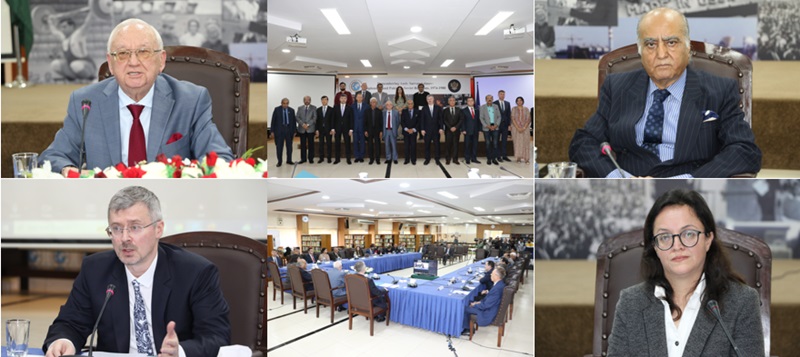
The Institute of Strategic Studies Islamabad through its Centre for Strategic Perspectives, in partnership with the Embassy of the Russian Federation in Islamabad, convened a roundtable on March 30, 2026 to reflect on the diplomatic legacy of Sarvar Azimov and the course of Pakistan Soviet relations between 1974 and 1980.
Dr Neelum Nigar, Director of the Centre for Strategic Perspectives, opened the discussion by stressing the value of revisiting diplomatic histories at a time of global instability and declining trust. She argued that studying figures such as Sarvar Azimov can yield lessons for sustaining dialogue and cooperation in complex international contexts.
Ambassador Khalid Mahmood, Chairman of the ISSI Board of Governors, described the roundtable as both a commemoration and an analytical exercise. He recalled that Ambassador Azimov served during an era of Cold War tensions and regional realignments, requiring patient and nuanced diplomacy. Ambassador Mahmood highlighted how Pakistan and the Soviet Union navigated periods of caution and gradual engagement, and noted that historical experience remains instructive for contemporary policymakers.
Ambassador Albert P. Khorev of the Russian Federation reflected on Ambassador Azimov’s combination of intellectual depth and diplomatic skill, and on Soviet-supported projects that shaped Pakistan’s industrial landscape. He pointed to the Karachi Steel Mills and several thermal power plants as examples of cooperation that contributed to Pakistan’s industrial growth and technical capacity, and he noted the expansion of trade and training collaboration during the 1973–1980 period.
Ambassador Anvar S. Azimov, the late ambassador’s son and a distinguished Russian diplomat, offered personal and strategic perspectives on his father’s methods. He recalled the Soviet role in facilitating dialogue during the 1965–66 India–Pakistan conflict, including the Tashkent process, and emphasised that Ambassador Sarvar Azimov prioritised trust-building, respect and engagement across political divides to maintain continuity with successive Pakistani leaderships.
Speakers highlighted how Soviet technical assistance and training for Pakistani engineers created enduring institutional links and people-to-people ties. Participants agreed that the historical cooperation in steel, energy and technical training established foundations that remain relevant for Pakistan today, especially as Islamabad seeks partners for industrial and energy projects.
The discussion widened to consider the evolution of Pakistan Russia relations from Cold War constraints to present-day engagement, including opportunities in energy, connectivity and regional multilateral frameworks. Panelists argued that reflection on past diplomatic practice is not merely commemorative but can guide pragmatic steps to deepen cooperation grounded in shared interests and mutual respect.
The roundtable concluded with a vote of thanks and the presentation of mementos to the speakers, and with a shared view that the legacy of Sarvar Azimov offers practical lessons for strengthening Pakistan Soviet, now Pakistan Russia, ties in the years ahead.