



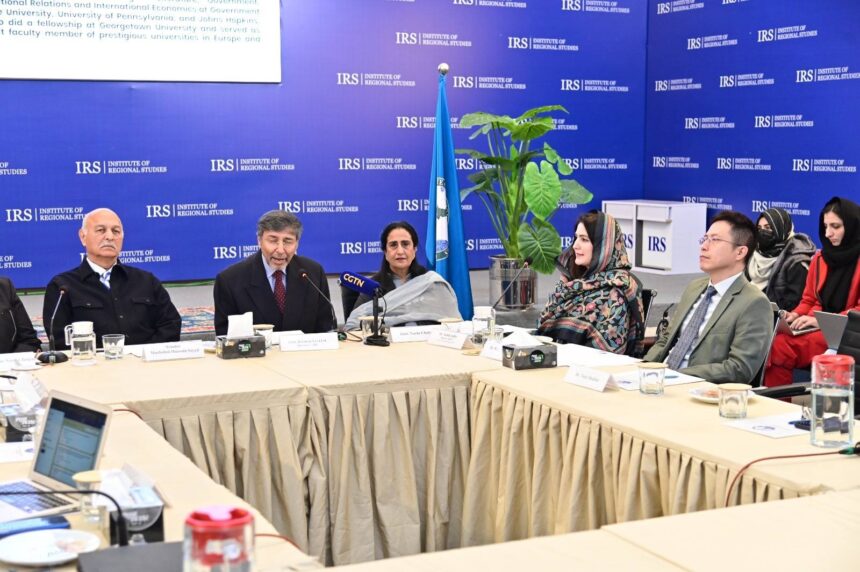
The China Program at the Institute of Regional Studies, Islamabad hosted a seminar that examined the urgent need for multilateralism in a fragmented world order marked by rising great power competition and unilateral actions. Panellists analysed how weakening international institutions and selective engagement have disrupted peace and stability, arguing that reinforcing multilateral frameworks is essential for lasting security.
Amb. Jauhar Saleem, President of IRS, opened the proceedings, and a keynote address was delivered by Senator Mushahid Hussain Sayed, Chairman of the Pakistan-China Institute. Speakers included academics and diplomats from Pakistan and China who explored the role of China-led initiatives in addressing development gaps, geopolitical fragmentation and conflict management.
Contributors such as Dr. Zafar Nawaz Jaspal and Amb. Naela Chohan reflected on the erosion of trust in global governance caused by veto politics and unilateral interventions, citing India’s proclivity for military aggression as part of the broader trend undermining collective institutions. There was a consensus that multilateralism must move from rhetoric to practical mechanisms that prevent conflict rather than respond to crises after they erupt.
Panelists highlighted China’s emphasis on inclusive development and shared prosperity, noting the Belt and Road Initiative as an example of multilateral economic engagement that draws wide participation. Chinese scholars including Dr. Qian Feng and representatives like Mr. Wang Shengjie outlined how Beijing’s approach frames multilateralism as human-centric and development-oriented, offering a model for cooperative global governance reforms.
Speakers called for reinventing mediation tools to be preventive, inclusive and representative, underlining that mediation is a collective responsibility. Academics such as Dr. Manzoor Afridi and Dr. Noor Fatima stressed that Pakistan stands to benefit from stronger multilateral conflict-resolution mechanisms and closer engagement with regional initiatives that prioritise stability and development.
The session, organised and moderated by Ms. Nabila Jaffer, Head of the China Program at IRS, concluded with a clear message: multilateralism is not optional but a necessary strategy to protect shared interests and to sustain global peace and stability in an increasingly fragmented international landscape.