



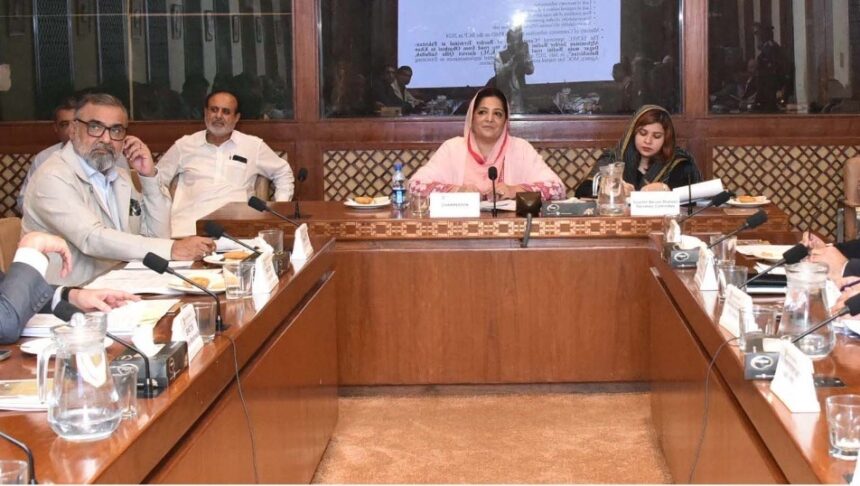
The Senate Standing Committee on Commerce, led by Senator Anusha Rahman, pressed for stronger policy reforms and faster implementation of the Prime Minister’s directives after reviewing a range of trade-related issues, including delayed border openings, the barter trade arrangement with Iran, weaknesses in the process for establishing foreign chambers of commerce in Pakistan, the need to convert MoUs into tangible investments, activation of sector-specific export councils, and concerns over state-owned enterprises and privatization oversight.
Committee members voiced strong concern over the continued non-functionality of the Badini border crossing. Although the crossing was inaugurated previously, it remains closed to regular trade because of poor road conditions, lack of basic amenities, and inadequate support from the Afghan side. The committee called for the rapid completion of the 40-kilometer road project, improved coordination between the Ministry of Commerce, the Ministry of Interior, and the Government of Balochistan, and the appointment of a dedicated focal person to monitor progress. Members also called for all stakeholders to participate in an upcoming meeting and urged parallel efforts with Afghan counterparts, including a proposed site visit to the Afghan side.
On barter trade with Iran, the committee discussed trader difficulties arising from the current arrangement and raised concerns over bureaucratic delays in implementing SRO 642(1)/2023. Lawmakers directed that the barter trade framework remain facilitative and allow business-to-business transactions under clear conditions. The Ministry of Commerce was asked to coordinate closely with the Ministry of Foreign Affairs, the Federal Board of Revenue, and the Law Division to finalize amendments that protect trader interests while ensuring compliance with international obligations.
The committee criticized Pakistan’s procedures for allowing foreign chambers of commerce to operate in the country, noting bureaucratic hurdles, outdated policies, delays in application processing, unresolved deficiencies in pending cases, and the inactivity of some chambers. Members urged a review of policies to streamline procedures, appoint focal persons, and adopt reciprocal practices used by successful international models. Recommendations included allowing embassy-based verification in place of a separate no-objection certificate and deploying trade officers abroad to support Pakistani chambers. A revised policy framework was requested to provide clarity and strengthen international trade facilitation in line with the Prime Minister’s targets.
Regarding memoranda of understanding and protocols, the committee emphasized the need to implement the Prime Minister’s directives and create mechanisms that ensure agreements translate into concrete outcomes. The Ministry reported that it had shared a list of companies with the Board of Investment for follow-up, and the BOI has been tasked to engage and monitor these firms directly. Members stressed coordinated efforts between the Ministry of Commerce, BOI, and the Trade Development Authority of Pakistan to avoid overlap or gaps, and noted that chambers with Chinese-speaking representatives could help maximize opportunities under existing agreements.
The committee reviewed progress on sector-specific export councils, which have been reactivated and expanded, with the Trade Development Authority serving as secretariat. Members underscored the importance of meaningful consultation with stakeholders, particularly chambers in Balochistan, given the province’s role in exports such as rice, potatoes, citrus, seeds, and mangoes. Stakeholders highlighted persistent constraints including weak infrastructure, limited official expertise, high energy costs, and inadequate cold-chain facilities. The committee insisted that export roadmaps be sector-specific while also addressing cross-cutting supply chain issues and protecting domestic produce from non-tariff barriers.
A brief discussion touched on the release of retrospective salary payments, with clarification that such decisions fall within the authority of the respective boards. The committee also examined the functioning of state-owned enterprises, expressing concern about the status of privatization efforts and accountability frameworks. It was noted that many SOEs are managed by private-sector representatives with oversight by the Central Monitoring Unit under the Ministry of Finance. Members directed that representatives from the Privatization Division and the Central Monitoring Unit be invited to the next meeting to discuss nomination processes, performance evaluation, and the status of entities undergoing privatization.
Present at the meeting were Senators Amir Walliuddin Chishti, Rahat Jamali, Saleem Mandviwalla, Ahmed Khan, and Sarmad Ali, along with the Secretary In-charge and Additional Secretary from the Ministry of Commerce and senior officials from the relevant departments.