



Simplicity: The Hallmark of True Leadership
By Zaheer Ahmed Awan
History stands witness to the fact that the real strength of nations lies in the character of their leadership. When rulers themselves embody simplicity, integrity and sacrifice, nations are able to overcome adversity and move forward on the path of progress. However, when leaders choose comfort and luxury while asking the public to endure hardship, the foundations of trust begin to erode.
If we turn to our own history and civilisation, the finest example is found in the Seerah of the Holy Prophet Hazrat Muhammad (PBUH). Despite possessing authority and power, the Prophet (PBUH) lived a life of remarkable simplicity. His household reflected contentment and modesty; days would pass without a fire being lit for cooking, yet there was never any compromise on justice, honesty or service to humanity. It was this practical example that won hearts and laid strong foundations for society.
The lives of the Khulafa-e-Rashideen (RA) further illuminate this principle. Hazrat Abu Bakr Siddique (RA) maintained a simple lifestyle even after assuming the office of Caliph. Hazrat Umar Farooq (RA) remains remembered for his strict accountability, including the famous instance when he accounted for a piece of cloth taken from the public treasury. Hazrat Usman Ghani (RA) and Hazrat Ali-ul-Murtaza (RA) also exemplified modesty, integrity and a deep sense of responsibility. These leaders first made personal sacrifices and only then expected sacrifice from the people, who in turn stood firmly by them.
Islamic history clearly demonstrates that the simplicity of rulers fosters public confidence, and when leadership sets high standards of accountability, the state grows stronger. Even in contemporary times, this principle holds true. In Bangladesh, Dr. Muhammad Yunus presented an example of economic improvement within a short period, strengthening foreign exchange reserves and restoring international confidence. India’s first Prime Minister, Pandit Jawaharlal Nehru, advised his cabinet to adopt a simple lifestyle and avoid ostentation in order to minimise the gap between rulers and the public.
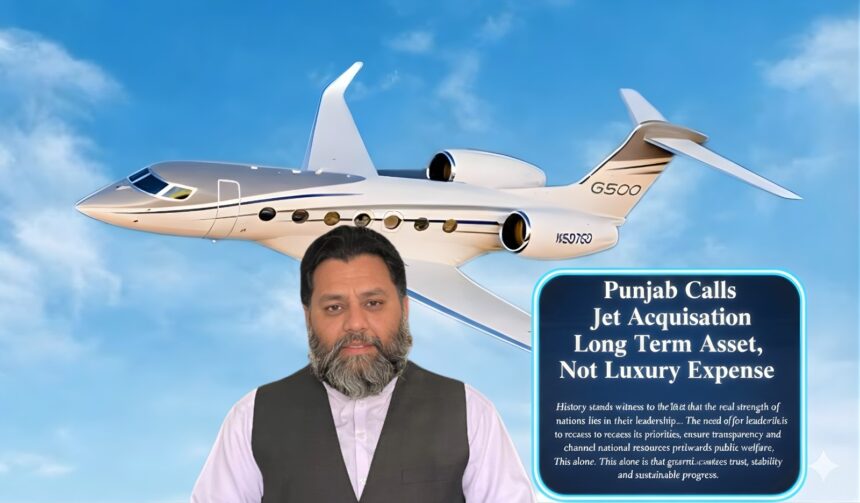
On the other hand, Pakistan’s former Prime Minister Zulfikar Ali Bhutto purchased an eight-seat official aircraft after coming to power, a move that left a deep impression on public opinion. Following the end of his government, the Falcon aircraft he had acquired was later added to the PIA fleet. The episode serves as a reminder that governmental decisions do not remain above public scrutiny and are ultimately subject to accountability.
The reality is that developed countries do maintain official aircraft and state facilities, but they prioritise fundamental public needs such as education, healthcare and employment before anything else. Simplicity is not merely a moral virtue; it is also a practical strategy for effective governance. When leaders reduce their own expenditures, they send a powerful message that in times of hardship, all citizens stand equal.
Today, in Pakistan, the issue is not confined to one aircraft or a single decision; it is a matter of priorities. When people are struggling with inflation, unemployment and lack of basic services, a lavish lifestyle among rulers intensifies feelings of deprivation. States are sustained not by power alone but by trust, and trust is built when leadership leads by example.
Those who ask the public to make sacrifices must first demonstrate sacrifice themselves. Only then can they reasonably expect cooperation from the people. If leaders adopt simplicity, the nation will stand with them in difficult decisions. Otherwise, questions will continue to multiply and the distance between rulers and the ruled will widen.
The need of the hour is for leadership to reassess its priorities, ensure transparency and channel national resources primarily towards public welfare. This alone is the path that guarantees trust, stability and sustainable progress.