



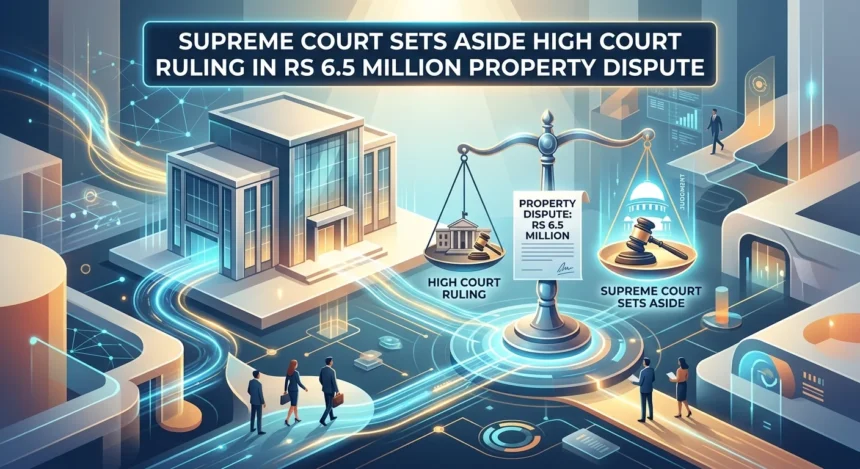
ISLAMABAD: The Supreme Court has held that a person challenging a registered sale deed cannot shift the burden of proof to the other side merely by denying the genuineness of the document.
The court ruled that a party alleging fraud, forgery or misrepresentation must first produce clear and convincing evidence in support of such allegations.
The ruling was issued in Khurram Rasheed versus Ch. Haider Zaman and others by a two-member bench comprising Justice Jamal Khan Mandokhail and Justice Naeem Akhtar Afghan. The hearing took place on March 26, 2026.
The case arose out of a family dispute over House No K-617, measuring 10 marlas, in Rawalpindi, and a registered sale deed executed on August 21, 2000.
According to the case record, Ch. Muhammad Anwar had filed a civil suit in May 2001 seeking a declaration and permanent injunction. He claimed that the property had been transferred in favour of Khurram Rasheed through fraud and forgery.
Muhammad Anwar alleged that his signatures had been obtained on the pretext that they were required for another two-marla property in Waris Khan Street, and were later used for the disputed sale deed concerning the 10-marla house.
He also maintained that he had not received any sale consideration for the house and that the sale deed had been prepared and registered without his lawful consent. He relied on his old age and weak eyesight, contending that the transaction had been carried out by taking advantage of his condition.
The defendants denied the allegations and maintained that the registered sale deed was genuine. They stated that the full sale consideration of Rs650,000 had been paid and that Muhammad Anwar had himself appeared before the Sub-Registrar in Rawalpindi to complete the registered document in the presence of witnesses.
They further asserted that Muhammad Anwar was in good health at the time of the transaction and was not suffering from any disability or sickness that could affect his capacity to enter into the sale.
The defendants also pointed out that Muhammad Anwar had undergone an eye operation on April 20, 2000, while the suit challenging the transaction was filed around 13 months later. They argued that the case was filed to deprive Khurram Rasheed of the disputed house.
After completion of pleadings, the trial court framed issues relating to the validity of the sale deed, allegations of fraud and forgery, cause of action and maintainability of the suit.
During trial, the attesting witnesses of the registered sale deed were produced. The record also included documentary evidence and statements of the parties. The trial court dismissed the suit through judgment dated September 29, 2011.
The plaintiffs challenged the trial court’s decision. The Additional District Judge, Rawalpindi, accepted the appeal on January 12, 2012. The matter then came before the Lahore High Court, Rawalpindi Bench, through Civil Revision No 331-D of 2012. The High Court dismissed the revision on September 26, 2023, after which Khurram Rasheed approached the Supreme Court.
The apex court examined the matter in the light of Article 117 of the Qanun-e-Shahadat Order, 1984, which places the burden of proving a fact on the person who asserts it when the other side merely denies it.
The court also referred to the principle “ei incumbit probatio qui dicit, non qui negat”, meaning that the burden of proof lies on the person who makes an assertion and not on the person who simply denies it.
The Supreme Court observed that allegations of fraud and forgery must be backed by clear and convincing evidence. It held that general allegations or a mere denial of signatures on a registered sale deed are not sufficient to shift the initial burden of proof.
The court specifically held that where a person who executed a registered sale deed later denies the document, such denial alone does not transfer the initial burden to the beneficiary of the document. If the plaintiff fails to establish fraud, the burden does not move to the defendant to prove the validity of the transaction.
In the present case, the Supreme Court found that the plaintiffs had failed to produce convincing evidence, or even a witness, to establish fraud, forgery or misrepresentation against Khurram Rasheed in relation to the sale deed dated August 21, 2000.
On the other hand, Khurram Rasheed produced the marginal witnesses to the registered sale deed. The court found their statements reliable and confidence-inspiring. It also noted that the statement of the attorney representing the petitioner and the other contesting defendants supported the genuineness of the registered transaction.
The judgment further noted that there had been earlier litigation among members of the same family relating to another sale transaction concerning a two-marla plot. Those cases were consolidated and later dismissed by the trial court after the plaintiffs failed to prove fraud, forgery or misrepresentation. The consolidated judgment was not challenged before higher courts and had attained finality.
After reviewing the evidence and settled legal principles, the Supreme Court concluded that the plaintiffs had failed to discharge the burden of proving fraud, forgery or misrepresentation in the execution of the registered sale deed in favour of Khurram Rasheed.
The court held that the trial court had properly appreciated the evidence and law and had committed no illegality or irregularity while dismissing the suit. It found that the appellate and revisional courts had erred in their appreciation of evidence and settled law.
The Supreme Court converted the petition into an appeal and allowed it. It set aside the Lahore High Court judgment dated September 26, 2023, and the Additional District Court judgment dated January 12, 2012, while restoring the trial court judgment dated September 29, 2011, through which the suit had been dismissed.
The ruling reinforces the principle that a registered document cannot be treated as fraudulent only because the person who executed it later denies the transaction. The party making such a serious allegation must first bring sufficient evidence before the court. Until that initial burden is discharged, the other side is not required to prove the validity of the transaction.