



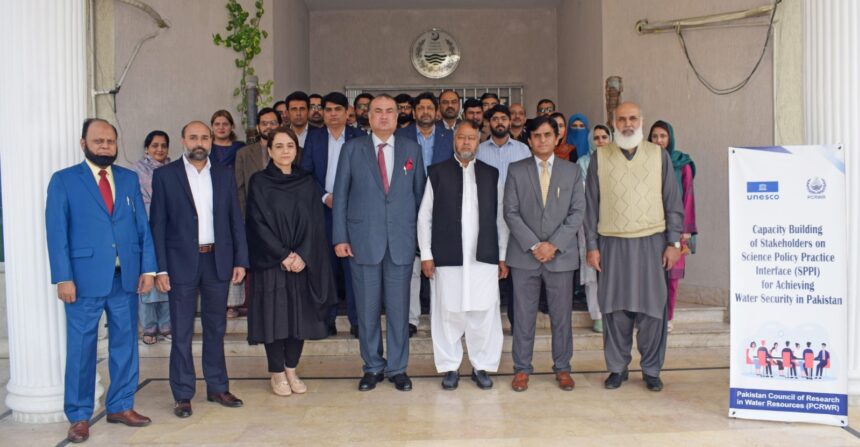
On 20 November 2025 at the PCRWR Regional Office in Lahore, a UNESCO funded capacity building workshop on the Science Policy Practice Interface (SPPI) convened researchers, academics, government officials, civil servants and civil society to address Pakistan’s mounting water challenges and chart practical steps toward lasting water security.
Engr. Faakhar Raza, Regional Director PCRWR Lahore, opened the session by urging broad multi‑stakeholder collaboration to confront water insecurity. He emphasised that strengthening the interface between science, policy and practice is essential to translate research into actionable interventions that improve water security for communities across Pakistan.
Engr. Muhammad Kashif Manzoor, Deputy Director PCRWR, presented the SPPI framework and underlined its role in closing communication gaps between scientists, policymakers and practitioners. His presentation highlighted knowledge exchange, capacity building and integrated water resource management as central to aligning research with on‑the‑ground solutions that support water security.
Participants engaged actively and offered constructive feedback. Dr. Muhammad Aslam of the University of Lahore called for a comprehensive strategy to sensitise politicians and the bureaucracy on water issues and their responsibilities in governance. Engr. Tariq Yameen from the Water Resources Zone, PID, Lahore reported that the WRZ has geo‑tagged 1.4 million tubewells across Punjab and maintains extensive groundwater monitoring records, while also pointing out coordination gaps between end users and policymakers.
Dr. Ghulam Zakir Hussain Sial from IRI PID urged the establishment of village‑level water management mechanisms with full stakeholder participation and offered access to groundwater level and quality data collected from 5,000 piezometers across Punjab. Engr. Masood Ahmed of CEWRE UET Lahore stressed that university research must be issue based and aligned with policy frameworks to secure legal backing and effective implementation, and CEWRE pledged support for collaborative research initiatives.
Engr. Mushtaq Ahmed Gill, CEO of SCAN, encouraged academia to lead issue‑driven research and called for stronger coordination between academic institutions and industry. Mr. Mohsin Ali of the Punjab Rural Support Program reiterated the importance of involving local communities in water management decisions to ensure sustainable outcomes.
Dr. Muhammad Irshad, former Dean at UAF, noted persistent technical and coordination gaps and stressed that sound policymaking must rest on robust research. Syed Babar Zulfiqar of the Civil Services Academy recommended raising public awareness on conservation, initiating a national dialogue with legal backing to address inter‑provincial water disputes, and building consensus before pursuing new dam projects.
Speakers and attendees agreed that the SPPI approach can accelerate progress toward water security by improving collaboration, data sharing and policy relevance of research. PCRWR reaffirmed its commitment to advance the science policy practice linkage, and participants left the workshop with a renewed focus on collaborative, actionable steps to safeguard Pakistan’s water future.