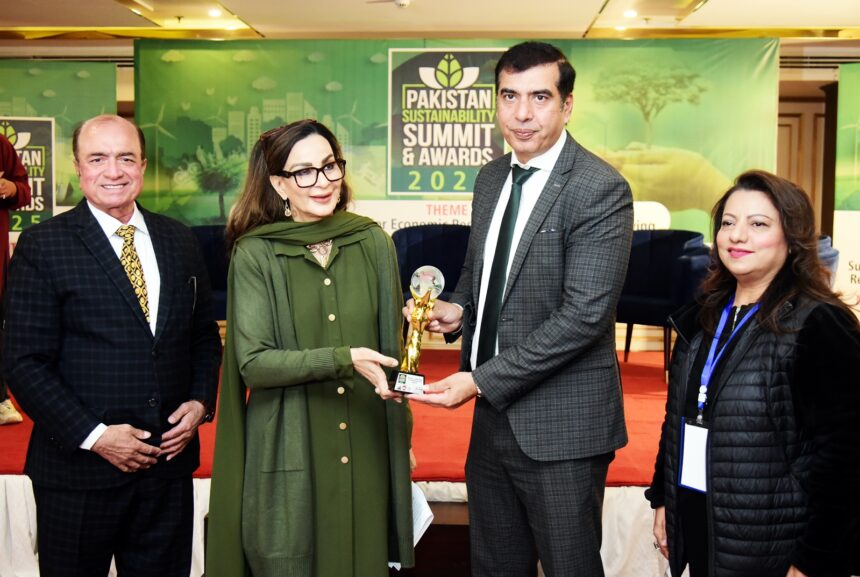
Islamabad, 3 December 2025 — Senator Sherry Rehman raised urgent alarm over the environmental cost of current construction and rapid urban expansion during her address at the 2nd Pakistan Sustainability Summit and Awards, organised by Development Communications Network (DevCom Pakistan). The summit theme focused on sustainable housing, economic resilience and climate-smart lifestyles and brought together policymakers, industry leaders and experts to push for cleaner building practices.
Rehman noted that Pakistan already has green building codes but enforcement remains weak, and she cited the 2025 Climate Risk Index that ranks Pakistan among the most climate-vulnerable countries. She warned that the industrial sector accounts for 38 percent of energy-related carbon emissions and that the cement industry alone contributes 49 percent of those emissions, underlining the need for an urgent transition to sustainable housing and low-carbon construction methods.
Pointing to the catastrophic floods of 2022 and 2025, Rehman said poorly sited and inadequately built structures collapsed in moments and questioned why such construction was ever permitted. With only 39 percent of the population classified as urban and that figure rising to 88 percent when peri-urban areas are included, she urged stronger urban planning to manage fast-growing settlements and reduce climate risk.
Syed Munir Ahmed, Executive Director of DevCom Pakistan, highlighted an annual shortfall of 400,000 homes and said 40 percent of urban residents live in informal settlements lacking basic services. He stressed that the construction and real estate sectors are major economic drivers but also the largest consumers of natural resources and energy, making the promotion of sustainable housing central to Pakistan’s climate and development agenda.
Sardar Tahir Mahmood, President of the Islamabad Chamber of Commerce and Industry, recommended three core measures to scale sustainable housing: transparent and effective public-private partnerships, modern climate-aligned regulatory and urban planning, and adoption of climate-responsive development models in line with UN-Habitat guidance. He said Islamabad could become a regional model if policy and private sector collaboration is strengthened.
Waseem Hayat Bajwa, Chief Executive of PIDCL, said the Ministry of Housing is implementing an integrated strategy to mainstream climate-resilient construction, energy-efficient building standards and affordable green housing models. He added that PIDCL is committed to embedding sustainability at every stage of policy and implementation.
Hamid Mumtaz Khan, Deputy Programme Manager at UN-Habitat Pakistan, warned that since 2005 some 4.5 million homes have been affected with losses exceeding 9 billion dollars. He called for immediate adoption of climate-smart housing, improved building performance, swift implementation of the National Housing Policy 2025, nature-based solutions and efficient water use. Khan said the summit will provide important guidance for Pakistan’s transition to a safer, more resilient urban future.
The summit underscored that sustainable housing is not only an environmental imperative but a development priority for Pakistan’s growing cities, demanding coordinated action from government, industry, technical experts and donors to reduce emissions, build resilience and close the housing gap.