




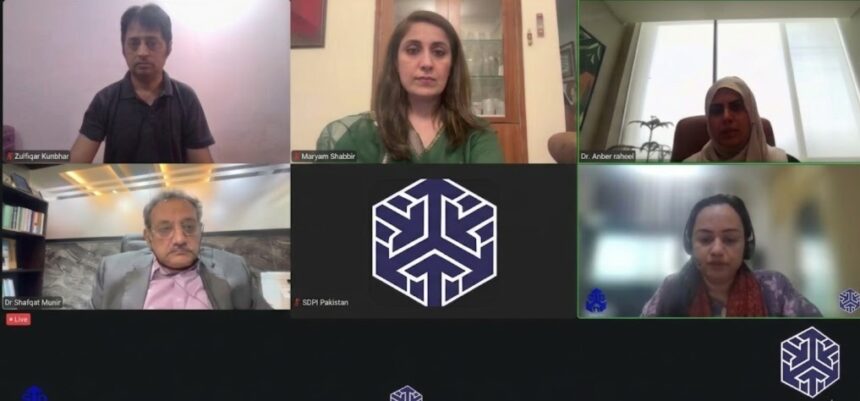
At a webinar hosted by the Sustainable Development Policy Institute, experts called for planned responses to rising climate-induced displacement and stronger data systems to guide policy in Punjab. Speakers stressed that effective climate mobility strategies must be rooted in real-time information and cross-department coordination.
Maryam Shabbir Abbasi, Associate Research Fellow at SDPI, said terminology varies but the impacts are clear: heavy monsoon rains and unprecedented downpours in 2025 displaced hundreds of thousands. She noted around 523,000 people were displaced in six districts of Southern Punjab, with Muzaffargarh, Dera Ghazi Khan, Jhang and Rahim Yar Khan among the worst affected. Authorities have been urged to adopt preemptive measures as the National Disaster Management Authority projects further abrupt rainfall.
Shabbir warned that much of the movement is unplanned, driving rural populations into urban slums where infrastructure is strained. Displaced communities often accept lower wages and face risks of malnutrition and higher infant mortality, she said, underscoring the role of media in raising awareness about displacement dynamics.
Mehak Masood of the International Organization for Migration argued that the term climate mobility better captures the spectrum from planned migration to forced displacement. She pointed to droughts and floods accelerating movement across Pakistan and cited World Bank projections that as many as 260 million people globally could be internally displaced by 2050 due to climate impacts. Masood also recalled Pakistan’s 2022 floods that affected 33 million people and displaced nearly eight million, and she urged that mobility be integrated into the National Adaptation Plan alongside robust data-driven projections. She welcomed Punjab’s Climate Resilient Plan and highlighted a white paper by the Pakistan Synergy Mobility Group that promotes localized solutions for safe migration and livelihoods.
Zulfiqar Kumbhar, an environmental journalist, warned that climate migration remains underreported in Sindh despite repeated disasters. He described diverse migrant categories arising from pluvial flooding, sea intrusion and heatwaves, and said nearly 160,000 climate migrants are living in settlements along a 10-kilometre stretch of the Super Highway, surviving largely on philanthropy and lacking formal recognition.
Dr Amber Raheel, Director of Environment and Climate Change Research at EP&CCD Punjab, described climate-induced migration as an emerging governance challenge. She acknowledged large data gaps and limited departmental records on displaced populations while noting PDMA figures that about 0.7 million people had been rescued from disaster-hit areas and nearly 0.6 million relocated to temporary shelters. Dr Raheel said Punjab is preparing its first Heatwave Management Plan with the Pakistan Meteorological Department, revising heatwave thresholds, developing a draft Climate Change Act and establishing a Punjab Climate Observatory to provide real-time climate data for evidence-based policymaking.
Dr Shafqat Munir Ahmed, SDPI Deputy Executive Director (Policy), emphasised that climate-related movement has been part of international climate dialogues for decades and that migration itself represents a form of loss and damage. He argued that anticipatory action frameworks and preemptive planning can reduce displacement risks, save lives and allow more organised, resource-efficient relocation of affected communities. Across the discussion, participants returned to a common point: improved data and coordinated planning are essential to manage climate mobility and protect vulnerable populations in Punjab and beyond.