



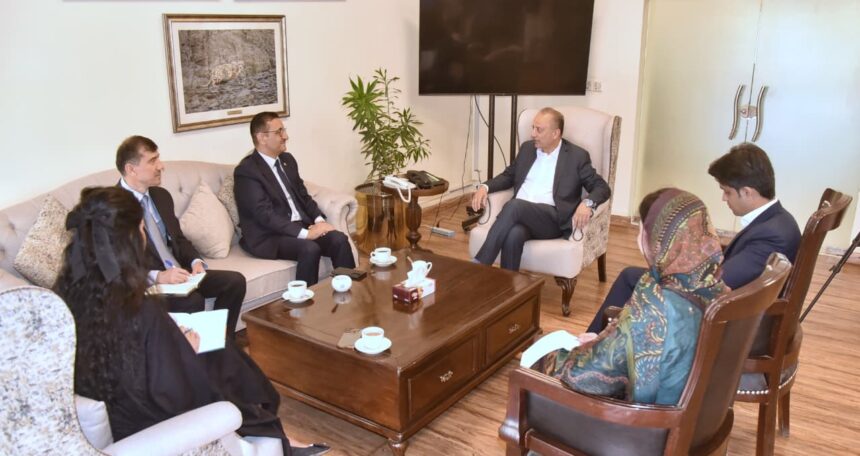
Ambassador Yusuf Sharifzoda, Tajikistan’s envoy to Pakistan, met Federal Minister for Climate Change and Environmental Coordination Dr. Musadik Malik in Islamabad today to discuss strengthening climate cooperation on shared environmental challenges.
The discussion focused on water management, glacial preservation and wildlife protection in the lead up to the 4th High-Level International Conference on the International Decade for Action Water for Sustainable Development (2018–2028) in Dushanbe, where Dr. Musadik Malik will represent the Prime Minister of Pakistan.
Both sides drew attention to striking geographic parallels: Pakistan and Tajikistan each host nearly 13,000 glaciers and have already lost about 1,000 glaciers to climate impacts. These figures were cited to underline the urgency of regional climate cooperation to address glacial melt, downstream water security and related risks to communities.
Ambassador Sharifzoda highlighted overlapping wildlife ranges that include markhor, snow leopards, ibex and numerous migratory bird species, and pointed to Tajikistan’s protected valleys and conservation zones as examples for joint action. He proposed exploring formal agreements and memorandums of understanding to coordinate conservation efforts between the two countries.
Dr. Musadik Malik emphasized that energy, water and climate are intrinsically linked and affirmed Pakistan’s interest in strengthening collaboration on climate resilience, water resource management and wildlife conservation. The minister expressed readiness for technical cooperation, data sharing and capacity building as part of broader climate cooperation initiatives.
Officials also discussed a regional corridor proposal intended to support both environmental cooperation and enhanced trade and connectivity, as well as potential projects to leverage regional weather patterns and innovative approaches to improve water and climate management.
The meeting reinforced deep historical and cultural ties between the peoples of Pakistan and Tajikistan and set the stage for practical steps toward stronger climate cooperation ahead of the Dushanbe conference and in future bilateral work.