



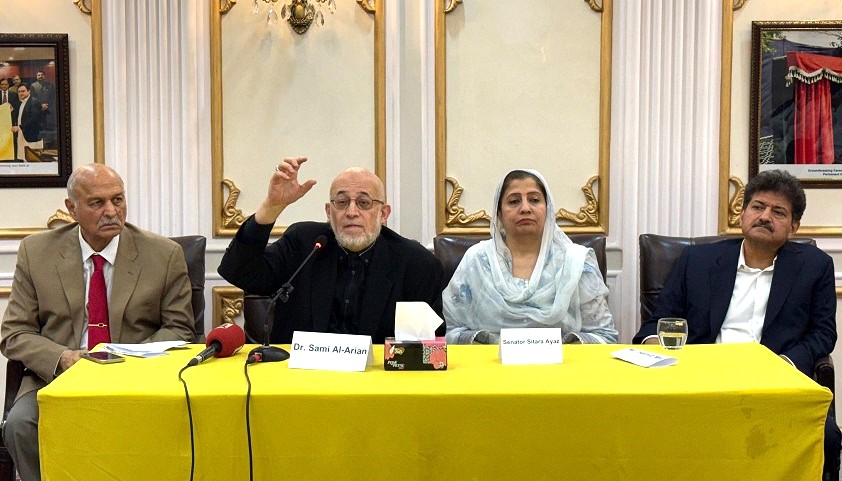
In Islamabad, Professor Sami Al-Arian, director of the Centre for Islamic & Global Affairs in Istanbul, told a packed lecture that Pakistan remains a vital source of Pakistan support for the Palestinian people as a nuclear Muslim state that does not recognise Israel and is viewed as a strategic concern by the Israeli establishment.
The event, hosted by the International Parliamentarians Congress in collaboration with the Pakistan Africa Institute for Development and Research, brought together parliamentarians, diplomats, retired military officers and civil society figures. Senator Mushahid Hussain Sayed and Senator Sitara Ayaz joined in hosting the session and offered analysis on historical and contemporary dimensions of the Palestine issue and Pakistan’s position.
Professor Al-Arian framed his remarks around the evolving Middle East and what he called the Zionist-Hindutva nexus, stressing that civil society must continue to raise its voice where governments face constraints. He argued that dismantling the ideology of Zionism is essential for lasting peace and that Pakistan support plays an important symbolic and practical role for Palestinians on international platforms.
Senator Mushahid recalled Pakistan’s early diplomatic stance, noting founder Mohammad Ali Jinnah’s correspondence with world leaders and the December 13, 1947 letter to US President Harry Truman that questioned the legitimacy of the Israeli state. He reiterated Pakistan’s long-held policy that Kashmir and Palestine are intertwined issues rooted in national conviction and Pan-Islamic solidarity.
The speakers described Pakistan’s military contribution to Arab efforts in past conflicts as part of their account: according to the lecture, Pakistani pilots flew with Jordan and Iraq in June 1967 and again served on the Syrian and Egyptian fronts in October 1973. These points were presented as part of Pakistan’s historical backing for Palestine and as elements of Pakistan support cited by the panel.
Professor Al-Arian also reviewed regional dynamics, including attacks on nuclear programmes in the region. He suggested that actions against Iraq and current pressure on Iran’s programme reflect a wider campaign to limit the defensive capabilities of Muslim states, and he held up Pakistan’s nuclear status as a remaining deterrent that gives courage to the wider Muslim world.
Journalist Hamid Mir drew a parallel between policies in Israel and India, saying Prime Minister Netanyahu and Prime Minister Modi pursue aligned agendas of Zionism and Hindutva respectively, and noted domestic criticism of both leaders. Senator Mushahid urged Muslim regimes to abandon duplicity and to unite against what he described as the Hindutva-Zionist alliance, while also praising Iran’s resistance and warning that Tehran has been targeted because of its support for Palestine.
The gathering included representatives from occupied Kashmir, among them Hurriyat leaders Ghulam Mohammad Safi and Hameed Lone, and senior figures from diplomacy and defence such as Additional Foreign Secretary Ambassador Hamid Asghar Khan, Ambassador Khalid Mahmood, Ambassador Sarwar Naqvi, Major General (r) Dr Raza and Major General (r) Ehsan Mahmood. Speakers said two recent attempts to move Pakistan toward recognition of Israel were frustrated by strong public sentiment and sustained Pakistan support for Palestinian statehood.