



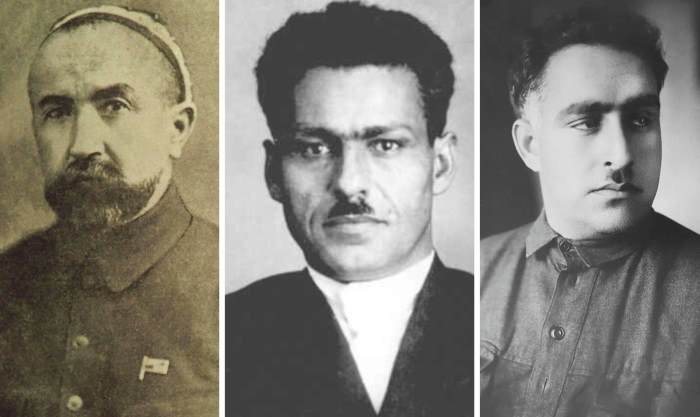
Russia has handed over capsules containing soil from the burial sites of prominent Tajik figures, a transfer that was accepted by President Emomali Rahmon upon arrival at Dushanbe airport. The capsules relate to the graves of Nusratullo Makhsum, Shirinsho Shohtemur and Nisar Muhammad Yousafzai, the latter originally from Zaida in Swabi, Khyber Pakhtunkhwa.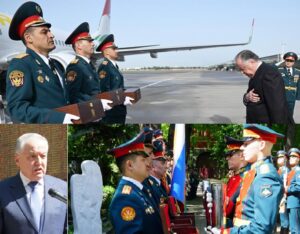
The formal acceptance of the soil took place on May 18, 2026, at the Donskoye Cemetery in Moscow, where a delegation from Tajikistan led by Foreign Minister Sirojiddin Muhriddin participated in the ceremony. The following day, May 19, the capsules were delivered to Dushanbe and received as part of a state memorial initiative.
The transfer was carried out at the direction of President Emomali Rahmon and is presented by officials as part of efforts to restore historical justice and preserve national memory. Tajik leaders have described the return of the soil as a symbolic spiritual reunification with the homeland for these historical figures who played roles in the founding and early development of the Tajik Soviet republic. Foreign Minister Muhriddin emphasized that Nusratullo Makhsum and Shirinsho Shohtemur demonstrated outstanding political will in the 1920s and 1930s defending the right of the Tajik people to self-determination.
Nisar Muhammad Yousafzai (1897 – 8 October 1937) was born to an Esapzai Pashtun family in Zaida, Swabi District, the son of Awal Khan and grandson of Mohammad Ali. A decorated soldier of the Third Anglo-Afghan War, Nisar later joined Soviet political and educational efforts, took part in a Soviet expedition in Gilan and became an advocate for creation of a separate Tajik entity within the USSR. He served as Tajikistan’s first People’s Commissar of Education from 1926 until his murder in 1937, taught Pashto at Moscow University and was known for fluency in Pashto, Persian, Russian and Uzbek.
Nisar Muhammad was arrested on 8 October 1937 by the NKVD during the Great Purge on charges described by contemporaries as false. During an interrogation he was involved in an altercation that resulted in his being shot by guards. The capsules and their incorporation into the national memorial complex in Dushanbe have been presented as a means to underline continuity across generations and to reconnect modern Tajikistan with the legacies of these Tajik heroes.