



MDCAT Weightage Sparks Concern Over A Level Students Medical Admission Chances
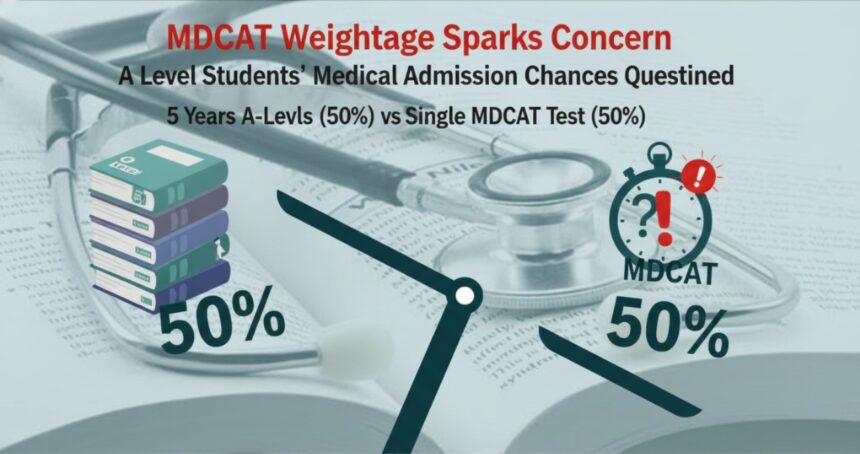
Islamabad: Pakistan’s medical admission policy has come under scrutiny after concerns were raised in the Senate that O Level and A Level students may be placed at a disadvantage because five years of their examination results carry only 50 percent weightage, while the MDCAT, a single admission test for which educational institutions do not formally prepare students, also carries 50 percent weightage and remains mandatory for MBBS and BDS admissions.
The issue was raised by Senator Anusha Rahman Ahmad Khan, who questioned whether the current admission formula unfairly lowers the value of O Level and A Level academic performance compared with MDCAT. She also asked whether the MDCAT format and method fully align with the A Level examination system and curriculum methodology.
In response, Federal Health Minister Syed Mustafa Kamal informed the Senate that the Pakistan Medical and Dental Council Act provides for conducting MDCAT for admission to MBBS and BDS programmes in Pakistan. He said marks obtained in MDCAT must constitute at least 50 percent of the weightage for admission in public and private medical and dental colleges.
The minister clarified that passing MDCAT is mandatory and the passing score for MBBS is 55 percent. He also stated that PM&DC has no legal role in preparing students for MDCAT, a point that strengthens the concern raised by A Level students and parents that a high stakes test carries decisive importance despite no formal institutional preparation.
According to the written reply, the current PM&DC admissions policy gives 50 percent weightage to MDCAT, 40 percent to FSc Pre Medical or equivalent A Level qualification, and 10 percent to Matric or equivalent O Level qualification. This means the combined O Level and A Level record carries 50 percent, while the single MDCAT test carries the remaining 50 percent.
The controversy centres on whether this formula fairly treats students who spend several years in the Cambridge stream. Senator Anusha Rahman questioned whether reducing the practical weightage of long term O Level and A Level performance in comparison with MDCAT places such students at a disadvantage.
PM&DC, however, rejected the suggestion of discrimination. The written reply stated that the Council has formulated and notified a uniform common MDCAT curriculum and syllabus aligned with all streams of education in the country, including board and Cambridge systems. It said the syllabus was developed in consultation with stakeholders including the Inter Boards Coordination Commission, federal and provincial boards, education departments and admitting universities.
The reply further stated that PM&DC has developed a national common MDCAT question bank with input from subject experts, including those associated with the Cambridge University Assessment Office, to ensure quality, relevance and alignment of questions with diverse educational streams.
The government maintained that MDCAT is conducted by universities authorized by federal, provincial and regional authorities, while PM&DC provides policy standards, a uniform curriculum and a common question bank to ensure transparent, standardized and merit based testing. It said these measures give all candidates equal opportunity, regardless of educational background.
However, the issue remains politically and academically sensitive because MDCAT has become the decisive gatekeeping test for medical admissions. For students from O Level and A Level backgrounds, the concern is that years of structured academic performance may be outweighed by one standardized test based largely on an intermediate or equivalent syllabus.
The written reply also cited the PM&DC Act, which states that each province, Gilgit Baltistan and Islamabad Capital Territory conduct a single admission test based on intermediate or equivalent syllabus for students seeking admission in public and private medical and dental colleges. The Act also states that no student can be awarded a medical or dental degree in Pakistan without passing MDCAT before admission, except specified foreign or overseas seats.