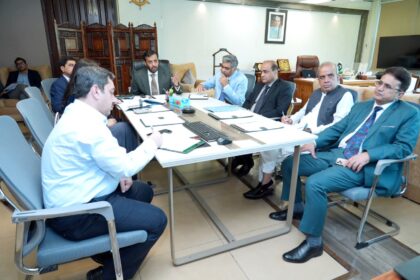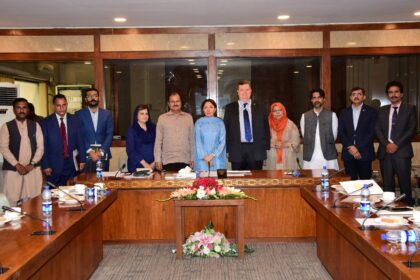




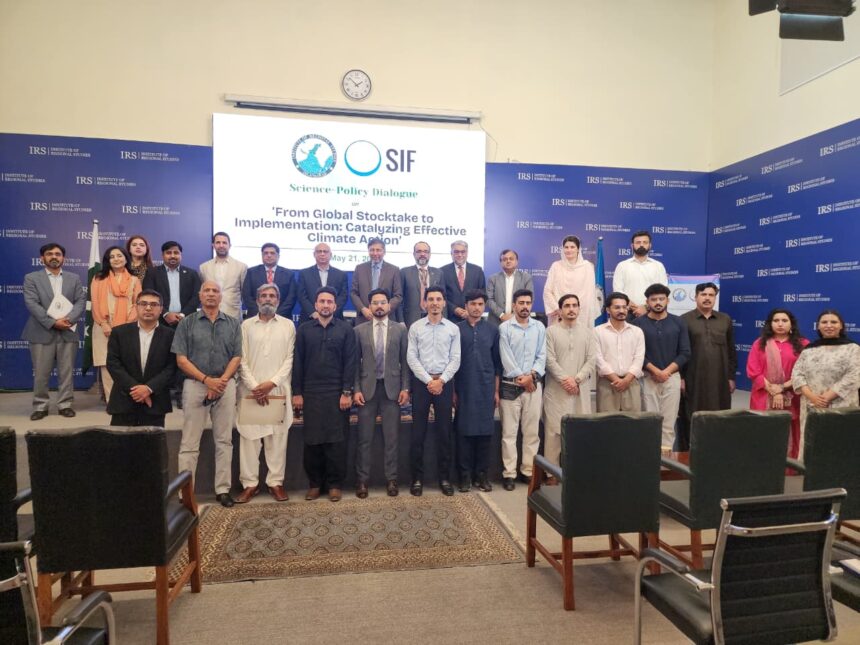
The Institute of Regional Studies (IRS), in partnership with Secours Islamique France Pakistan, convened a high-level Science-Policy Dialogue to map practical pathways for translating the Global Stocktake into actionable Climate Action across Pakistan and the region. The session gathered international organisations, government bodies, development partners, academia and civil society to deliberate on implementation strategy following the GST at COP28.
Ambassador Jauhar Saleem, President of IRS, underlined Pakistan’s acute exposure to climate-induced disasters despite its negligible share of global emissions, stressing that Climate Action must be rooted in an integrated national strategy addressing water scarcity, environmental degradation and population pressures. He called for stronger climate financing, resilient infrastructure and coordinated governance backed by public awareness to build long-term resilience.
Shiraz Shah, Assistant Resident Representative UNDP Pakistan, urged turning policy pledges into delivery mechanisms and resilient governance systems. He emphasised locally driven solutions, institutional coordination and integrated policy frameworks as essential for sustained Climate Action, and highlighted the role of partnerships among governments, development institutions and communities.
Thomas Conan, Deputy Country Director WFP Pakistan, warned of mounting climate threats to food security and advocated resilient food systems, climate-smart agriculture, anticipatory action and enhanced social protection to protect agriculture, livelihoods and supply chains under changing climate conditions.
Muhammad Arif Goheer of GCISC outlined Pakistan’s vulnerabilities including extreme weather, glacial melt and water stress, calling for science-based planning, stronger climate data systems and research to inform policymaking. He argued that robust data and institutional capacity are prerequisites for effective Climate Action and long-term adaptation planning.
Amir Khan Goraya, CEO of NDRMF, highlighted the need for risk financing, institutional strengthening and innovative financing to scale resilience. He emphasised sustained investment in preparedness, disaster risk reduction and community-level adaptation alongside improved coordination among public institutions, development partners and financial actors to make Climate Action sustainable.
Dr. Altaf Abro, Head of Mission at SIF Pakistan, called for enhanced climate governance, innovative risk financing and partnerships across government, academia, the private sector and local communities, while promoting green technologies and practical solutions to bridge humanitarian and environmental responses.
Dr. Anjum Rasheed, Head of the Climate Resilience Program at IRS, noted that the first Global Stocktake concluded at COP28 confirmed the world remains off-track to limit warming to 1.5°C, with widening adaptation gaps and inadequate finance for vulnerable countries. She urged acceleration of implementation, strengthening of NDCs, scaling up of climate finance and deeper international cooperation to translate commitments into tangible Climate Action on the ground in Pakistan.