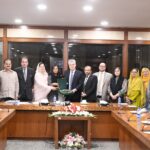




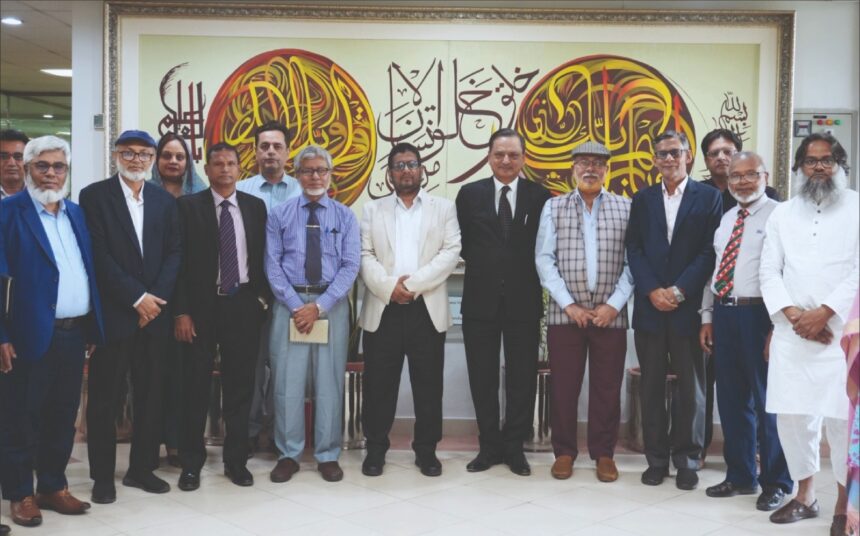
A high-level delegation of 16 senior academics and education experts from leading Bangladeshi public and private universities visited the Islamabad campus of COMSATS University Islamabad as part of the Pakistan-Bangladesh Knowledge Corridor initiative supported by the Higher Education Commission of Pakistan.
The delegation included vice chancellors, pro vice chancellors, deans and senior professors from institutions such as Asian University of Bangladesh, Jahangirnagar University, University of Dhaka, University of Chittagong, North South University, Shahjalal University of Science and Technology, University of Rajshahi, BRAC University and Southeast University. The visit aimed to strengthen people-to-people links and identify new avenues for academic cooperation between the two countries.
Prof. Dr. Raheel Qamar, Rector of COMSATS University Islamabad, received the delegation alongside senior university officials and department heads. The rector outlined the university’s priorities in AI-driven education, digital governance and sustainable campus practices, and emphasised opportunities for joint research and capacity building under the Knowledge Corridor framework.
Muneeba Nasir, Head of the International Office, provided a detailed institutional briefing and showcased several of the university’s modern digital governance platforms. The presentation highlighted COMSATS’ adaptive learning management systems powered by artificial intelligence, paperless administrative processes and initiatives aimed at green campus development and long-term sustainability.
During his remarks Prof. Dr. Raheel Qamar described recent progress in biomedical research and shared the university’s vision for technology commercialisation and making health technologies more accessible to local communities. He also offered to extend COMSATS’ AI and ICT expertise to support improvements in Bangladeshi universities’ learning management systems and digital infrastructure.
Discussions during the visit focused on expanding collaboration in joint research, innovation, entrepreneurship and digital transformation. Delegates exchanged views on practical steps to enhance student and faculty mobility, co-supervised research, and technology transfer mechanisms that can benefit both nations’ higher education ecosystems.
The visiting scholars toured the Junaid Zaidi Central Library and other academic facilities on the Islamabad campus, gaining first-hand insight into the university’s research resources and learning environments. The tour reinforced mutual interest in deepening academic links and exploring collaborative projects that address shared social and technological challenges.
The exchange under the Pakistan-Bangladesh Knowledge Corridor reflects a shared commitment to leveraging academic strengths for regional development. Participants from both sides signalled intent to pursue follow-up actions that translate the dialogue into concrete partnerships in education, research and digital innovation.