



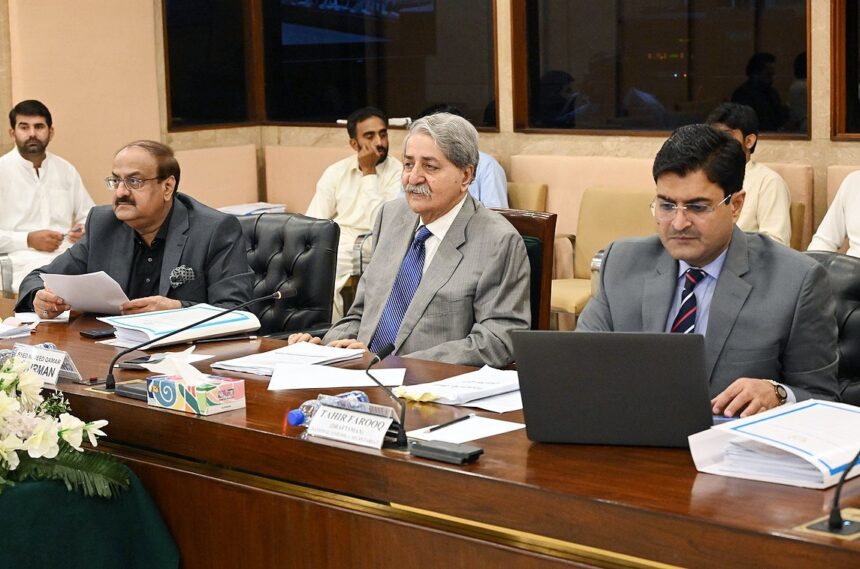
The National Assembly Standing Committee on Finance and Revenue has pushed for a more balanced approach to aviation relief, warning that special fiscal concessions for Pakistan International Airlines alone could distort the market and disadvantage other domestic carriers facing similar pressure.
Meeting at Parliament House during clause-by-clause scrutiny of the Finance Bill, 2026, the committee said government support should not create even the perception of preferential treatment. Members argued that if relief is needed to help the sector recover, it should be extended to all eligible airline operators so competition remains fair and transparent.
Committee Chairman Syed Naveed Qamar said fiscal policy must remain equitable and based on clear rules. He stressed that long-term sector stability depends on a framework that treats all operators on the same footing rather than offering selective benefits to one airline.
The committee recommended that the government adopt a sector-neutral model and provide equivalent fiscal concessions and incentives to eligible airline operators from July 1, 2027. Members said such a move would help create a level playing field, strengthen investor confidence and support a more resilient aviation industry.
Alongside the aviation discussion, the committee approved a series of amendments aimed at improving fairness in tax administration, due process and taxpayer protection. One key change requires written reasons before any freezing order can be issued against property held by a third party, while also ensuring the affected person gets a chance to be heard. An exception was retained for urgent cases where action is needed to stop assets from being moved or concealed.
The committee also endorsed allowing the Independent Case Scrutiny Committee to co-opt a Chartered Accountant as a non-voting member in technically complex matters. Members said expert input would help strengthen decisions in difficult tax and financial cases. It also supported provisions excluding the approval period from statutory limitation calculations and removing unnecessary sub-clauses to improve clarity in the law.
Another major concern was the proposed taxation of mobile phones. Members objected to additional taxes on selected smartphone brands and said phones are no longer luxury items but essential digital tools used for education, freelancing, online payments, e-commerce, e-governance and access to information. The committee warned that excessive taxation could undermine Pakistan’s Digital Pakistan ambitions and make entry-level and mid-range smartphones unaffordable for students, workers and small businesses.
The committee further reviewed the proposed tax mechanism for the steel sector and asked for clarity on electricity consumption benchmarks linked to steel melting and re-rolling. Officials said the standards were written into law and tied to Pakistan Bureau of Statistics data, but members stressed that tax rules must remain scientific, objective and consistently applied.
Chairman Syed Naveed Qamar also reiterated that lawmaking should not be rushed. He said accuracy must take priority over speed, and warned against last-minute amendments that have not undergone proper technical review and parliamentary scrutiny. Members said such changes can create legal confusion and weaken implementation.
During the wider review of the Finance Bill, 2026, the committee received briefings from the Federal Board of Revenue, Ministry of Finance, National Tariff Commission, Ministry of Industries, Ministry of Commerce and other stakeholders. It examined proposals linked to income tax, sales tax, customs, federal excise, tariff reforms, petroleum levy, digital taxation, banking data sharing, compliance rules and sector-specific incentives.
The committee said fiscal policy must balance revenue needs with growth, broaden the tax base and protect taxpayer privacy and rights. It recommended phased implementation of major reforms, stronger oversight and practical enforcement systems to ensure that tax measures achieve their intended goals without harming consumers, businesses or Pakistan’s wider investment climate.
Dr. Sharmila Faruqui submitted a note of dissent on electric vehicle policy, while Muhammad Javed Hanif submitted a note of dissent on the taxation structure for imported mobile phones. The meeting was attended by lawmakers and senior officials from the Finance Division, Federal Board of Revenue and other relevant ministries.