




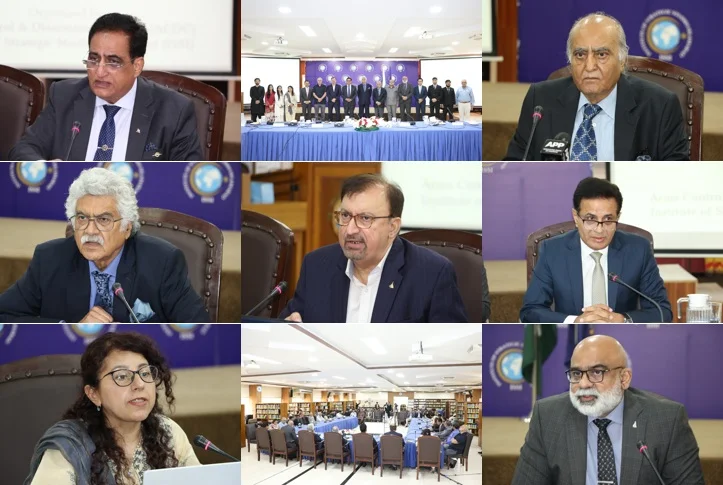
ISLAMABAD: The Arms Control and Disarmament Centre (ACDC) at the Institute of Strategic Studies Islamabad (ISSI) hosted a high-level roundtable discussion today titled “India’s Sea-Based Nuclear Capabilities: Implications for Pakistan”.
The event brought together prominent strategic experts, diplomats and military analysts to assess what speakers described as a qualitative shift in South Asia’s deterrence architecture following the operational deployment of India’s sea-based nuclear arsenal.
In his welcome remarks, Ambassador Khalid Mehmood, Chairman of the Board of Governors, ISSI, underlined the gravity of evolving regional security dynamics. He said the operationalisation of India’s sea-based nuclear deterrent marked a qualitative and structural shift in regional security, requiring a clear-eyed reassessment of deterrence postures and diplomatic frameworks to safeguard regional peace and stability.
Earlier, Malik Qasim Mustafa, Director ACDC, opened the session by outlining the scope of the discussion and welcoming the participants. He said the disruption to South Asian strategic stability required a rigorous evaluation of potential doctrinal and technological posture adjustments necessary for Pakistan to maintain a credible deterrent.
Setting the agenda for the discussion, Ms Ghazala Yasmin Jalil, Research Fellow at ACDC, highlighted what she termed structural turning points confronting the region, including the movement from recessed deterrence to mated warheads. She raised questions on how Pakistan could preserve robust Full Spectrum Deterrence without entering an expensive and open-ended naval arms race, and suggested that ultimate security lay in negotiating robust maritime Confidence-Building Measures (CBMs).
Vice Admiral (Retd) Dr Ahmed Saeed HI(M), former President of the National Institute of Maritime Affairs (NIMA), said a growing strategic imbalance in the Indian Ocean was being driven by India’s massive investment in advanced conventional and nuclear submarines, including SSBNs. He warned that the naval expansion created defence asymmetry, lowered the nuclear threshold and increased the risk of inadvertent escalation between two contiguous nuclear-armed states.
To mitigate maritime risks and prevent an unchecked arms race, Admiral Saeed called for robust bilateral CBMs and a renewed diplomatic effort to declare the Indian Ocean a non-nuclear domain. He said maritime nuclear conflict offered no path to military victory and required mutual strategic restraint.
Ambassador (Retd) Zamir Akram, Advisor to the Strategic Plans Division (SPD), warned that India’s rapid vertical proliferation was encouraging a shift away from its “No First Use” policy towards a pre-emptive first-strike posture aimed at neutralising Pakistan’s Full Spectrum Deterrence. He rejected the view that these capabilities were directed only at China and referred to what he called the “deafening silence” and double standards of the international community over India’s expanding sea-based capabilities.
He said the development posed a threat beyond South Asia and undermined strategic stability at regional and global levels. Ambassador Akram urged Pakistan to expose India’s nuclear behaviour internationally, establish robust crisis-management mechanisms instead of relying on weak bilateral arrangements, and strengthen its defensive posture by fully operationalising and deploying nuclear warheads across land, air and sea-based components to ensure a credible, survivable second-strike capability.
Air Commodore (Retd) Khalid Banuri, Senior Advisor JCCL, Air Headquarters, said India’s transition to a permanently mated sea-based nuclear presence had compressed political-military decision-making windows and eroded traditional peacetime buffers. He said the opacity of the sea leg mixed conventional and nuclear signalling, increasing the risk of unintended escalation and inadvertent launch.
He added that India’s “No First Use” doctrine had become practically meaningless under the new posture, while Pakistan’s credible deterrence faced pressure due to fiscal constraints and the destabilising integration of emerging technologies. He suggested that Pakistan’s response should combine the pursuit of modern technologies, a survivable and strengthened second-strike capability, and proactive diplomatic initiatives.
Dr Aqeel Akhtar discussed the security dilemma linked with sea-based nuclear deterrence, saying the increasing deployment of nuclear submarines introduced challenges for command and control, crisis communication and strategic stability. He stressed the need to strengthen secure communication systems, reduce the risks of miscalculation and develop robust safeguards to prevent inadvertent escalation in a complex maritime security environment.
The presentations were followed by an interactive discussion in which members of the strategic community, academia and media deliberated on policy choices available to Pakistan for maintaining strategic equilibrium.