



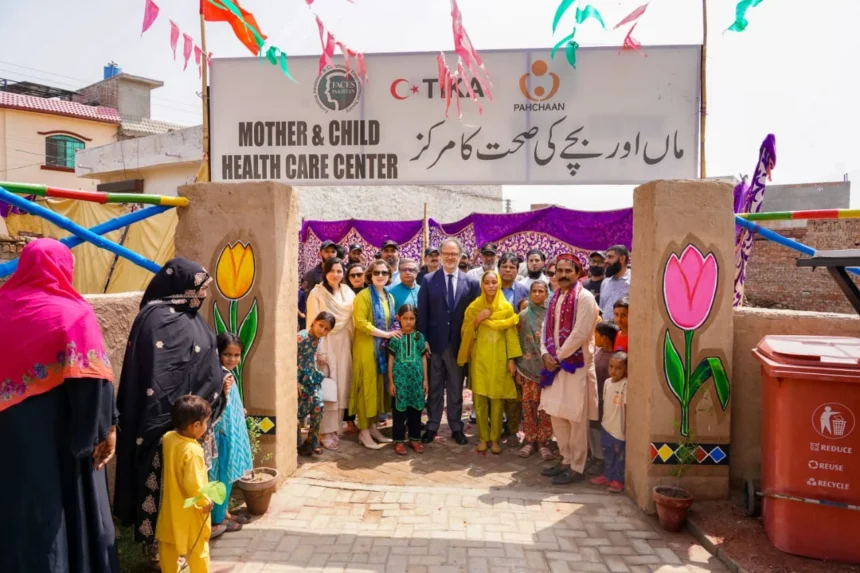
LAHORE: The Turkish Cooperation and Coordination Agency (TİKA) has inaugurated a community-based Mother and Child Healthcare Centre in Raiwind to provide accessible primary healthcare services to around 15,000 people living in nearby communities.
The project has been implemented under the framework of the Year of the Family, declared by the Presidency of the Republic of Türkiye in 2025. It aims to strengthen maternal and child health services and improve access to preventive and community-based healthcare for vulnerable families.
The opening ceremony was attended by Consul General of the Republic of Türkiye in Lahore Mehmet Eymen Şimşek, TİKA Pakistan Coordinator Saliha Tuna, President of FACES Pakistan Javaid William, President of Pehchaan Prof Dr Naeem Zafar, local leaders and members of the community.
Speaking on the occasion, Consul General Mehmet Eymen Şimşek welcomed Pakistan’s progress in reducing maternal and newborn mortality in recent years. He said a healthy future could only be built on healthy mothers and children.
Highlighting the longstanding brotherhood between Türkiye and Pakistan, he said Türkiye, through TİKA, would continue supporting development and healthcare initiatives that directly improve people’s lives.
TİKA Pakistan Coordinator Saliha Tuna said the project reflected Türkiye’s people-centred approach to development cooperation. Referring to the Year of the Family, she said investment in mothers, children and families meant investment in the future of society.
She said the centre represented a sustainable partnership model, with TİKA establishing the facility, FACES Pakistan undertaking its management and Pehchaan providing healthcare professionals required for its operation.
FACES Pakistan President Javaid William thanked TİKA for its support and said the real owners of the project were the people of Raiwind, as the centre had been designed to respond directly to the healthcare needs of the local community.
Unlike large hospitals that mainly provide specialised treatment, community-based primary healthcare centres serve as the first point of contact between families and the health system. Besides basic medical services, such centres provide maternal and child follow-up, preventive healthcare, health education, counselling, early diagnosis and timely referrals when advanced treatment is required.
Strategically located to improve accessibility, the centre will serve an underserved catchment area where both Muslim and Christian communities live, ensuring essential healthcare services are available close to home for families who need them most.
The centre also reflects a sustainable approach to development. Inspired by traditional local architecture, it has been designed as a low-cost, environmentally friendly and climate-responsive facility, combining local building practices with modern healthcare requirements. Its design offers a practical and replicable model for community healthcare infrastructure in underserved areas.