




Author: Arqum Bin Habib

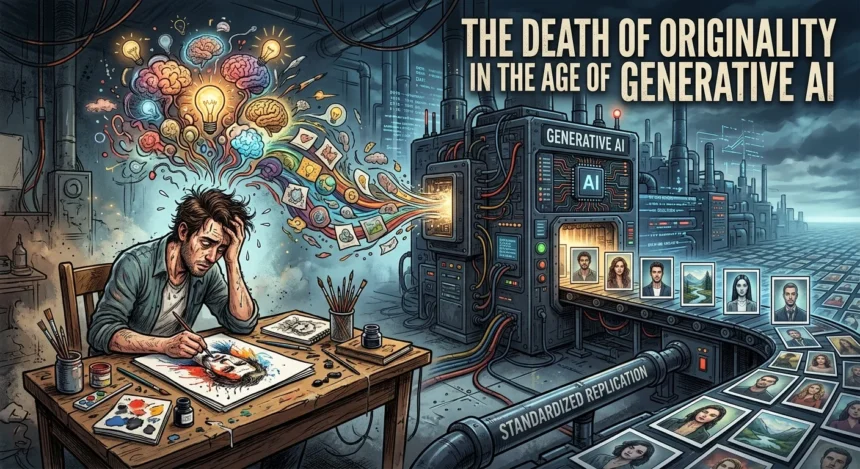
There was a time when a designer’s work was recognizable not because it was perfect, but because it was theirs. A particular use of type, colour, space, imagery, or composition could reveal something about the person behind the work. Design carried personality. It reflected choices, experiences, experimentation, and sometimes years of learning what worked and what did not. Generative AI is changing that relationship between the artist and the artwork. The concern is not that AI can create images. It can, and that capability is remarkable. The concern is what happens when the speed and convenience of generating an image begin to matter more than the thinking that gives the image meaning.
Today, creative industries increasingly expect AI to be incorporated into the design process. There is nothing inherently wrong with that. AI can be an extraordinarily useful creative tool. A designer can develop an idea, use AI to explore visual possibilities, evaluate those possibilities, and then refine the final work through their own judgement and expertise.
Integration, however, should not mean replacement.
A designer does not simply create an image. A designer thinks about why that image needs to exist in the first place. Who is going to see it? What does the audience value? What cultural associations might influence how it is interpreted? What does the brand want to communicate? What emotion should it create? How does the visual fit within a larger identity or narrative? These questions are part of the design process. They are also what separates visual production from visual communication.
Graphic designer Saul Bass described design as “Design is thinking made visual.” The phrase is deceptively simple, but it captures what can easily be forgotten in the excitement surrounding generative AI. Design is not simply the production of an attractive visual. It is the process of giving an idea a visual form. Bass also believed that failure was inseparable from creativity, that real experimentation only happens when getting it wrong multiple times. Generative AI removes that risk almost entirely. It rarely fails in the way a designer does; it just produces another option. And an idea that costs nothing to abandon is rarely an idea anyone fought for. AI can produce an aesthetically convincing image within seconds. But an aesthetically convincing image is not necessarily a meaningful design. A machine can produce a polished visual without understanding the culture, values, experiences, and emotions of the audience for whom that visual was created. It can generate an image for a brand without truly understanding the brand’s history. It can imitate a visual language without having lived within the culture from which that language emerged. It can produce hundreds of possibilities without knowing which one carries the right meaning. We are increasingly living in an environment where technical polish gets mistaken for creativity: an image with perfect lighting, extraordinary detail, and impressive composition that still feels strangely empty. It looks good, but says very little.
This concern is not new. Long before generative AI, designers were questioning what happens when technology makes production easier than thinking. In a 1988 interview, American Art director and Graphic designer Paul Rand described the computer as a valuable practical tool, but warned that its ability to generate too many possibilities could tempt designers into using effects simply because they were available; that technology becomes a source of creative confusion the moment the effect matters more than the idea. His observation feels remarkably relevant today. The difference is that the computer once gave designers more ways to execute an idea. Generative AI now offers to produce the idea itself. That changes the equation. Why spend days developing a concept when an AI system can produce dozens of visual options in minutes? Why experiment with an unfamiliar style when a prompt can produce something immediately polished? The danger isn’t simply that designers will lose their jobs. It’s subtler than that: designers may gradually lose the habit of thinking like designers.
That distinction is increasingly important now. A designer who understands composition, typography, branding, audience psychology, and visual storytelling can use AI very differently from someone who simply asks it to “make something beautiful.” The first treats AI as a way to generate ten rough directions for a brand voice they already understand deeply, then throws out nine of them for reasons a machine could never explain. The second accepts whatever the machine hands back, because they never had a point of view to check it against in the first place. The first uses AI to expand creative possibilities. The second risks letting AI determine what creativity looks like. And this is where originality becomes vulnerable. Originality has never meant creating something from nothing. Every artist is influenced by something. Every designer learns from what came before. Human creativity is built through observation, interpretation, and transformation. But there’s a difference between being influenced by visual culture and surrendering the creative process to a system that predicts what an image should look like. If millions of people begin using similar tools trained on enormous amounts of existing visual material, we may end up producing more images while developing less visual individuality. The internet could flood with technically impressive work that’s increasingly difficult to tell apart. Everything looks polished. Everything looks cinematic. Everything looks perfect. And eventually, perhaps, everything starts to look the same.
That’s the paradox of generative AI: it is homogenizing visual culture. There’s also something valuable about imperfection that we should try not to lose. An unusual composition, an unexpected color choice, an unconventional typeface, or a rough illustration can sometimes communicate more personality than a technically flawless image. Generative AI doesn’t have to be the enemy of creativity. It can help designers explore, experiment, and work more efficiently. But it should remain a tool in the hands of a thinking human, not a substitute for one. The future of design shouldn’t be measured by how quickly an image can be produced, but by whether that image has something meaningful to communicate. A machine can generate possibilities; it’s still the designer who has to decide which one is worth pursuing.
The challenge is not to keep AI out of art. It is to keep the artist in it.
About the Author
Arqum Bin Habib is a Visiting Faculty member in the Arts and Media Department at Foundation University and a Senior Graphic & UI/UX Designer at ITnow Inc. His work combines academic experience with professional expertise in graphic design, digital media, and user experience.