



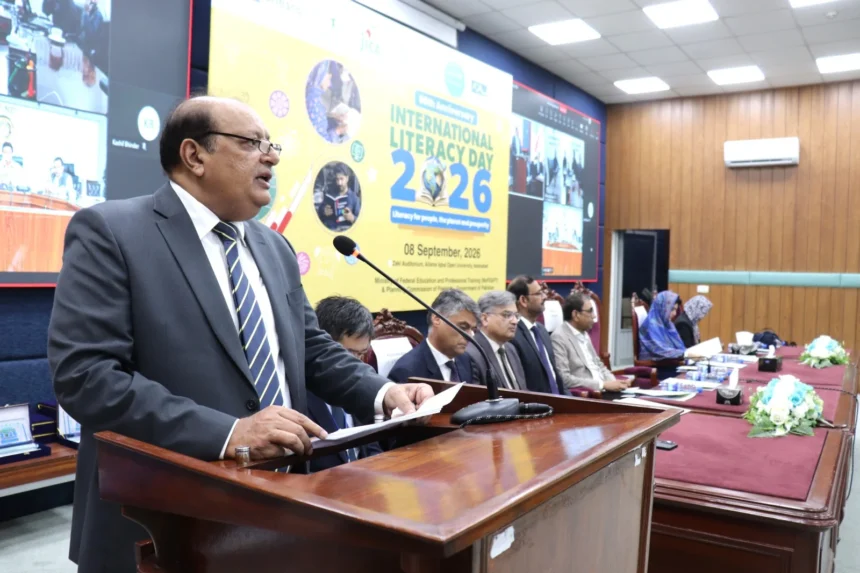
ISLAMABAD, September 8, 2026: The Government of Pakistan, through the Ministry of Federal Education and Professional Training, in collaboration with UNESCO, the National Commission for Human Development (NCHD), UNICEF and the Japan International Cooperation Agency (JICA), on Tuesday commemorated the 60th anniversary of International Literacy Day at Allama Iqbal Open University, Islamabad.
The event, held under the theme “Literacy for People, the Planet and Prosperity,” was organised by NCHD with the support of UNESCO, UNICEF and JICA.
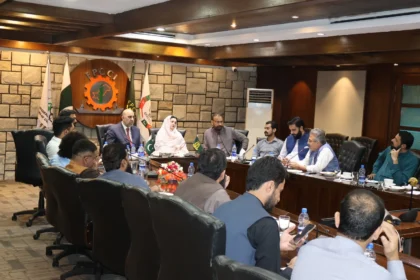
More than 200 representatives from federal and provincial governments, United Nations agencies, development partners and academia attended the ceremony. Participants reviewed progress made in literacy over the past six decades and discussed ways to strengthen literacy as a means of creating better opportunities for individuals, promoting sustainable development and contributing to inclusive prosperity.
The 2026 theme highlighted the transformative role of literacy in improving people’s lives, fostering inclusive and sustainable societies, and creating opportunities for livelihoods and economic development. The anniversary also provided an opportunity to recognise achievements in literacy, take stock of continuing challenges and underline the partnerships required to advance literacy for all.
Federal Minister for Education and Professional Training Dr Khalid Maqbool Siddiqui addressed the gathering as chief guest. UNESCO Representative in Pakistan and Head of Office Fuad Pashayev, UNICEF Deputy Representative for Programmes Sharmeela Rassool, JICA Pakistan Office Deputy Chief Takayuki Sugawara, and MNA and NCHD Chairman Iftikhar Sadiq also spoke on the occasion.
Dr Siddiqui reaffirmed the ministry’s commitment to collaborative efforts aimed at addressing the challenges of out-of-school children and illiteracy. He said efforts would continue to ensure that no child, young person or adult was left behind.
Fuad Pashayev underscored the importance of literacy as a fundamental human right and a cornerstone of sustainable development.
“Literacy is far more than the ability to read and write; it is a fundamental human right and a powerful foundation for dignity, opportunity and sustainable development. As we mark the 60th anniversary of International Literacy Day, we must renew our collective commitment to ensuring that every child acquires foundational skills, every out-of-school child is brought into learning, and every young person and adult has opportunities to learn throughout life. UNESCO remains committed to working with the Government of Pakistan and partners to advance literacy for people, the planet and prosperity,” he said.
Takayuki Sugawara reaffirmed JICA’s longstanding commitment to strengthening literacy and non-formal education in Pakistan. He stressed the importance of continued collaboration to expand quality learning opportunities for out-of-school children, youth and adults. He also highlighted JICA’s support through the Advancing Quality Alternative Learning (AQAL) Project, which works closely with federal and provincial governments and other partners to expand access to quality alternative learning opportunities.
Iftikhar Sadiq highlighted NCHD’s contribution to literacy and non-formal education, and its role as a national lead agency in expanding access to learning opportunities for underserved communities.
He said that over the past two decades, NCHD had worked to bridge the gap between policy and community needs through its network of community-based Adult Literacy Centers and Non-Formal Basic Education Schools, with particular emphasis on women, rural populations and marginalised communities. He also referred to NCHD’s efforts to develop localised learning materials, train teachers and strengthen grassroots partnerships to expand learning opportunities and transform lives.
Sharmeela Rassool called for placing literacy and foundational learning at the heart of education reform.
“Literacy is one of the most powerful foundations we can give every child, equipping them with the skills they need to learn, participate in their communities and shape their futures. Yet too many children in Pakistan are still not acquiring the foundational skills they need to succeed,” she said.
She further emphasised the need for greater investment in teachers, quality learning environments and approaches that effectively reach underserved children. She said such efforts were essential to ensure that every child had the opportunity to learn, thrive and realise their full potential.
A key highlight of the event was the launch of the “Each One, Teach One” mobile application, developed by NCHD to promote literacy through digital technology. The application is designed to make literacy learning more accessible and strengthen community-based literacy initiatives by using digital tools.
Participants stressed the need for sustained investment, stronger partnerships and innovative approaches to ensure that literacy and foundational learning reach all segments of society, particularly children, youth and adults who remain underserved.
International Literacy Day was proclaimed by UNESCO in 1966 and was first celebrated in 1967. It is observed annually on September 8 to highlight the importance of literacy as a foundation for inclusive and sustainable societies.
The Islamabad observance reaffirmed the importance of collective action among the Government of Pakistan, United Nations agencies, development partners and academia to advance literacy and expand learning opportunities across the country.
The global celebration of the 60th anniversary of International Literacy Day is being held on September 8 and 9, 2026, in collaboration with the Government of Mexico.