



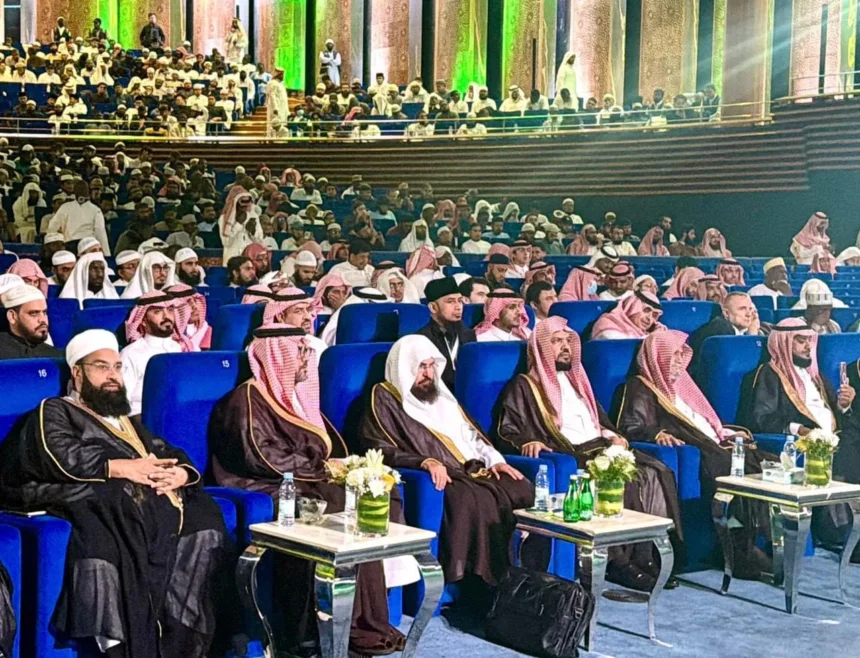
MADINAH, Sept 29, 2026: The Pakistan Ulema Council (PUC) has welcomed and expressed full support for the 31 recommendations and proposals issued at the conclusion of the International Conference on the Kingdom of Saudi Arabia’s Efforts to Counter Intellectual Deviations, held at the Islamic University of Madinah.
The Council said the recommendations offered a comprehensive framework for strengthening intellectual awareness, promoting moderation and balanced thinking, advancing research and education, addressing emerging challenges in the digital environment, and reinforcing cooperation among religious scholars, educational institutions, researchers, media organisations and relevant stakeholders.
Speaking at the conclusion of the two-day conference in Madinah Al-Munawwarah, PUC Chairman, Secretary-General of the International Tazeem-e-Haramain Sharifain Council and Coordinator of the National Paigham-e-Aman Committee, Hafiz Muhammad Tahir Mehmood Ashrafi, appreciated the conference and termed it an important platform for scholarly dialogue, research and exchange of experiences.
Ashrafi said the gathering provided an opportunity for scholars, researchers and specialists from Saudi Arabia and other countries to examine contemporary intellectual challenges and explore effective approaches for prevention, awareness and education.
The conference was organised by the Islamic University of Madinah under the patronage of Madinah Governor Prince Salman bin Sultan bin Abdulaziz on September 27 and 28, 2026. It featured nine dialogue sessions and 56 peer-reviewed research papers, bringing together scholars, researchers and specialists from within and outside the Kingdom. More than 130 research papers had been submitted, of which 56 were approved after academic review.
Ashrafi said the discussions and research presented at the conference highlighted Saudi Arabia’s comprehensive approach to addressing intellectual deviations, combining scholarly, educational, institutional, technological and preventive dimensions.
He appreciated the emphasis placed on scientific research, early identification of emerging intellectual challenges, youth awareness, responsible digital engagement and the use of modern technologies, including artificial intelligence, in analysing contemporary information environments.
He said the conference recommendations provided a broad framework for strengthening research and knowledge-sharing, including proposals for specialised research units, national databases for studies on intellectual deviation and extremism, peer-reviewed academic platforms, national indicators, educational initiatives and digital programmes for promoting intellectual awareness.
Ashrafi also highlighted the recommendations concerning the development of educational curricula, training programmes for teachers, scholars and educators, support for young people, and greater cooperation among academic, religious, media, technological and other professional institutions.
He said particular importance should be attached to strengthening reliable and scholarly religious content in the digital space, promoting responsible engagement with religious guidance and encouraging cooperation among scholars and specialists from different fields while addressing complex contemporary issues.
Referring to the conference’s emphasis on cooperation, Ashrafi said experiences in addressing intellectual challenges should be studied and shared internationally while taking into account the social, educational and cultural contexts of different societies.
He commended the Islamic University of Madinah for hosting the conference and for its academic and international role in promoting research, dialogue and educational initiatives related to intellectual awareness and moderation. The university has described the conference as an international gathering for exchanging expertise and developing recommendations to strengthen efforts to address contemporary intellectual challenges.
Ashrafi expressed appreciation for the patronage and support extended to the conference and praised the university’s administration, scientific and organising committees and all participants for their efforts in making the event successful.
He said the conference had provided an important opportunity to build bridges between academic research and practical initiatives and to encourage continued cooperation in promoting intellectual awareness, moderation, social stability and peaceful coexistence.
He also welcomed the recommendations calling for greater collaboration among educational, religious, media, security and community institutions, describing such cooperation as important for developing comprehensive and preventive approaches to contemporary intellectual challenges.
Ashrafi concluded by expressing gratitude to the Kingdom of Saudi Arabia and the Islamic University of Madinah for hosting the international gathering. He said the outcomes of the conference could provide valuable material for researchers, institutions and policymakers seeking to strengthen intellectual awareness and preventive approaches in their respective societies.