



ISLAMABAD: Federal Minister for Information and Broadcasting Attaullah Tarar (Nishan-i-Imtiaz) has said that the Indus Waters Treaty is a legally binding international agreement and its provisions do not allow either party to unilaterally alter, rescind, revoke or hold it in abeyance.
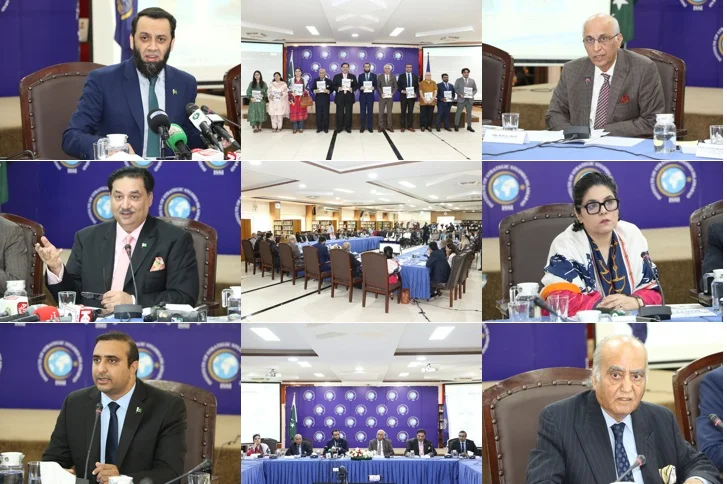
He was speaking at the launch of the Special Report, “Weaponising Waters: Historical, Legal, and Strategic Dimensions of IWT Suspension,” at the Institute of Strategic Studies Islamabad (ISSI).
The minister said the Treaty provided established mechanisms for resolving differences and disputes, requiring Pakistan and India to address disagreements within its legal framework rather than through unilateral action.
He observed that when the Treaty was signed, its signatories “did not envisage that there would come a time a few decades down the line when conditions in India would deteriorate so much that they would be legally ignorant, morally bankrupt and devoid of ethics”.
Mr Tarar reaffirmed that Pakistan would continue to pursue the matter through diplomatic and legal channels and defend its fundamental water rights in accordance with international law.
Eng. Khurram Dastgir-Khan (HI), former Federal Minister for Foreign Affairs and Defence, described India’s evolving water strategy as a real and systemic danger. He warned that it went beyond individual or high-profile hydropower projects and pointed towards a systematic assault on Pakistan’s water security.
He stressed that the growing risks to the Western Rivers and nearly 200 million people dependent on them should not be viewed merely as a diplomatic issue, but as a serious challenge to Pakistan’s strategic stability.
Prof. Dr Arshi Saleem Hashmi, Dean, Faculty of Contemporary Studies, National Defence University Islamabad, said the Indus Waters Treaty was once a “textbook example” of successful water diplomacy, having survived wars and intense political tensions between Pakistan and India.
She noted that water management had historically been decoupled from political and territorial disputes between the two countries. However, she said that following India’s decision to hold the Treaty in abeyance, actions that increased human vulnerability could have serious implications for Pakistan’s agriculture and food security, as well as for peace and regional stability.
The speakers appreciated the India Study Centre at ISSI for undertaking the exercise and producing a comprehensive report examining the Indus Waters Treaty from historical, legal, technical and strategic dimensions.