



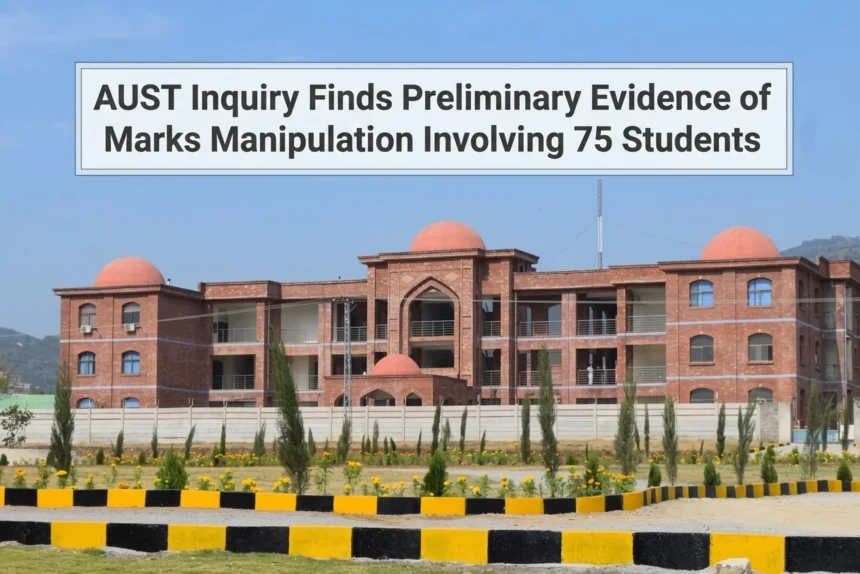
ABBOTTABAD/ISLAMABAD: An inquiry at Abbottabad University of Science and Technology has found preliminary evidence of unauthorised access to the university’s Learning Management System (LMS) and possible manipulation of students’ marks, with the inquiry record provisionally placing four individuals in the main perpetrator category, eight as facilitators and 75 students as beneficiaries.
The findings are part of an ongoing inquiry into alleged academic misconduct involving the university’s online marks system. According to the inquiry committee, preliminary evidence showed that certain individuals gained unauthorised access to the LMS and changed academic records. The committee also found evidence of payments between students and alleged facilitators through transaction receipts and account records.
The committee said several students gave written statements after they were shown LMS access records and payment-related evidence. It also examined available laptops and mobile phones and recommended a detailed digital forensic examination to preserve and verify messages, system access records and financial information.
According to the inquiry record, the individuals were provisionally divided into three groups. Category A includes four people described as the main perpetrators, Category B includes eight facilitators or middlemen, and Category C includes students who allegedly paid money or sought academic benefit through changes in marks. The committee stated that the categorisation remains subject to the evidence available in each individual case.
The inquiry record also refers to an alleged third party who tried to hide his identity and contacted students through unknown or untraceable telephone numbers, mainly during night hours. The record says student statements referred to continued activity involving changes to marks, but the identity of this alleged outside actor was not established during the preliminary inquiry.
The evidence file contains payment records and electronic communications linked by the inquiry committee to the allegations. The documents include several money transfers between students and people described as facilitators, as well as chat messages discussing payments and changes to academic work.
The annexure to the inquiry also records differences between old and later marks in a number of subjects. In some listed cases, marks increased substantially, while in others the recorded marks were lower. The committee recommended that only those changes established through the inquiry should be reversed.
The committee recommended that any marks proved to have been changed illegally should be cancelled and the original marks awarded by the concerned teacher or department restored. For people placed in Category A, the recommended action includes rustication for one or two academic years, counselling after reinstatement, a financial penalty equal to the amount collected and a formal warning in the university’s internal record.
For Category B facilitators, the committee recommended rustication for one or two semesters, an F grade in the relevant courses, a financial penalty equal to the amount collected and academic probation for one semester. For Category C beneficiaries, it recommended an F grade in the affected courses along with a formal warning and academic probation for the active semester. These are recommendations of the inquiry committee and not final punishments.
The university inquiry is not yet over. The committee said most Spring 2026 records had been reviewed, but some results remained under examination. It recommended another one to two months of work to examine earlier semesters and identify whether similar unauthorised changes had occurred in the past. It also called for verification of declared results against the officially approved results in every department.
Meanwhile, the Khyber Pakhtunkhwa Higher Education Department has ordered a separate fact-finding committee to examine wider issues of governance, academic and financial management at Abbottabad University. The committee was constituted on September 28, 2026, and includes the Vice Chancellor of Abdul Wali Khan University Mardan as convener, the Director Quality Assurance of HED, a nominee from the Higher Education Commission and a senior HED official.
The fact-finding committee has been asked to investigate alleged manipulation of examination records, academic assessment processes, college affiliations, possible violations of HEC and HED guidelines, the working of statutory bodies since 2021, implementation of Section 17-A of the KP Universities Act, appointments made since 2021 and the university’s financial records since 2021. It has been given one month to submit its report.
The inquiry committee has also recommended extending audits to historical and migrated academic records across the university where directed by the competent authority. It said further cases should be examined under the same framework and according to the evidence available in each case.
The findings remain part of an ongoing inquiry. The university documents describe the evidence as preliminary in important areas and call for further digital forensic and institutional examination before final conclusions and disciplinary action are reached.