



ISLAMABAD: The Higher Education Commission (HEC) has opened applications for a six-month foreign research fellowship for Pakistani and Azad Jammu and Kashmir students enrolled in full-time PhD programmes in Pakistan.
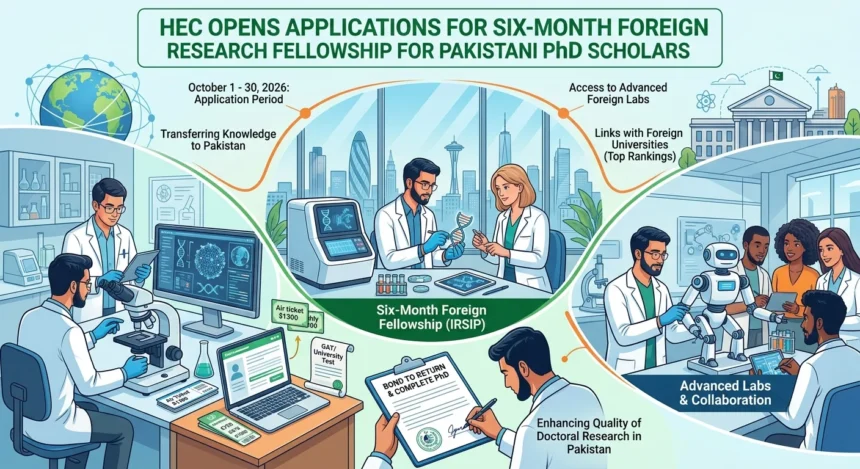
Applications for the International Research Support Initiative Program (IRSIP) will remain open from October 1 to October 30, 2026. Under the programme, selected scholars will be able to conduct research and receive training at universities and research institutes abroad.
According to HEC, the initiative is aimed at improving the quality of doctoral research in Pakistan, developing a larger pool of highly qualified researchers and facilitating the transfer of scientific and technological knowledge to the country. The scheme also seeks to provide PhD students access to advanced research laboratories, opportunities to work with foreign scientists and links between Pakistani and foreign universities and research institutions.
The programme is open to Pakistani and AJK nationals studying full time at a recognised university in Pakistan. Applicants must have completed at least 18 credit hours of PhD coursework and must have been enrolled in their PhD for at least 18 months but not more than three and a half years at the time of application. For Batch 60, the PhD enrolment date must fall between Spring 2023 and Spring 2025.
Applicants are required to have passed the local GAT Subject Test or the university admission test at the time of entry into the PhD programme. Their PhD research topic and synopsis must also have been approved by the Board of Advanced Studies and Research, Directorate of Advanced Studies and Research or another officially recognised university body.
A formal acceptance from a foreign university or research institute is mandatory. The host institution must be located in a developed country and must be among the top-ranked universities overall or in the relevant subject according to the Times Higher Education or QS World University Rankings.
The proposed foreign supervisor must be a full-time faculty member at the level of Assistant Professor or above. The supervisor cannot be a former supervisor of the applicant’s local PhD supervisor. HEC has also stated that two or more applicants working under the same local supervisor must choose different foreign supervisors or different foreign universities.
Students already receiving another HEC scholarship may also apply, but they must provide a no objection certificate from the concerned HEC officer.
HEC has asked eligible students to apply through its online scholarship portal. Applicants have been advised to complete the form carefully and upload all required documents before the October 30 deadline. Only applications showing the status “Submitted” will be considered. Applications left in “Saved” status will be treated as incomplete and will not be processed.
Applicants must submit an official acceptance or invitation letter from the foreign university, research institute or laboratory, along with a completed HEC form signed by the proposed foreign supervisor. They must also provide the supervisor’s updated CV and proof that the supervisor is at least an Assistant Professor.
Other required documents include approval of the PhD research topic and synopsis by the relevant university body, a complete copy of the approved research synopsis, a recommendation letter from the local PhD supervisor, the local supervisor’s CV and, where applicable, a no objection certificate from HEC for scholars already receiving another HEC scholarship. An employee or student on study leave must also provide a no objection certificate from the department or organisation.
Applicants are also required to submit their updated CV, a valid passport or passport token slip, academic records from the Bachelor’s degree onward and a PhD coursework transcript showing completed courses, credit hours and grades. Proof of the GAT Subject Test or university admission test taken at the time of PhD admission is also required.
HEC has issued detailed requirements for the foreign acceptance letter. It must be issued by the head of department or a senior professor or associate. Letters issued by lecturers, laboratory instructors or experts will not be accepted. The letter must explain the research work to be carried out, available research facilities, planned activities, duration of the visit and any bench fee required.
The acceptance letter must also include the terms and conditions of the invitation, where applicable, as well as the full address and contact details of the foreign professor. The foreign supervisor must complete the HEC proforma along with the acceptance letter.
Selected scholars will be required to sign a bond with HEC, undertaking to return to Pakistan and complete their PhD studies at their parent universities. They must use the fellowship within six months of the award letter or within another period specified by HEC. The commission has reserved the right to cancel an award at any stage if documents are found to be false or if any serious ambiguity is discovered.
The fellowship provides financial support for the foreign research visit. HEC will provide a return economy class air ticket up to $1,300 once, with the ticket to be arranged by HEC.
The monthly living allowance will depend on the country where the scholar conducts research. Scholars going to the United Kingdom will receive £750 per month. Those going to Austria, Germany or the Netherlands will receive €975 per month, while the allowance for the rest of Europe is €900. Scholars travelling to the United States will receive $1,500 per month. The allowance is $800 for Korea, China and Malaysia and $1,200 for the rest of the world.
HEC will also provide a bench fee where the foreign institution requires it. The maximum allowed amount is $3,500 in US dollars, £1,750 in British pounds, €2,550 in euros, $4,100 in Australian dollars and $3,700 in Canadian dollars.
The bench fee will only be paid if it is clearly mentioned in the original acceptance letter at the time of selection. HEC will not accept any new demand for a bench fee after the scholar has been selected. The scholar must first pay the fee, after which HEC will reimburse it upon receiving the paid invoice. The invoice must contain the scholar’s name, purpose and duration of the visit and details of the foreign university. HEC has also encouraged scholars to seek a waiver of the bench fee wherever possible.
After returning to Pakistan, scholars must submit an IRSIP feedback form, comments or a progress report from the foreign supervisor, a joining report endorsed by the head of department at their parent institution and relevant passport pages showing their exit and entry. Indigenous scholars must also submit the same documents to the Indigenous Section.
HEC said the programme is designed to improve doctoral research in Pakistan to international standards. According to its statistics, scholarships in Arts, Humanities and Social Sciences have remained lower due to a smaller number of applications from these fields. HEC said it is making efforts to encourage more social science researchers to apply. Agriculture, Biological Sciences, Mathematics, Chemistry, Physics and Computer Sciences have a stronger share of awards, while Engineering and Business have received fewer awards due to lower numbers of PhD students or applications in those fields.