



ISLAMABAD: A new study has linked Pakistan’s first reported cluster of newborn deaths from mpox clade Ib to serious gaps in infection prevention, hospital safety and disease surveillance, warning that long-standing weaknesses in the health system continue to allow infectious diseases to spread.
The study says the 2026 Khairpur outbreak in Sindh was not merely the arrival of a new virus strain, but a sign that the same weaknesses seen in earlier child HIV outbreaks and hospital spread of Crimean Congo haemorrhagic fever (CCHF) remain a major public health concern.
Titled “Neonatal mpox in Pakistan: A Case Study in Infection Prevention and Control Gaps and Opportunities for Improvement”, the paper was written by Mariyam Sarfraz of the Health Services Academy, Islamabad, Nadia Noreen of Border Health Services Pakistan, and Nasim Akhtar of the Pakistan Institute of Medical Sciences, Islamabad. The paper was received on August 6, revised on September 21 and accepted on September 23, 2026. It is currently a journal pre proof and is due for final copyediting and publication.
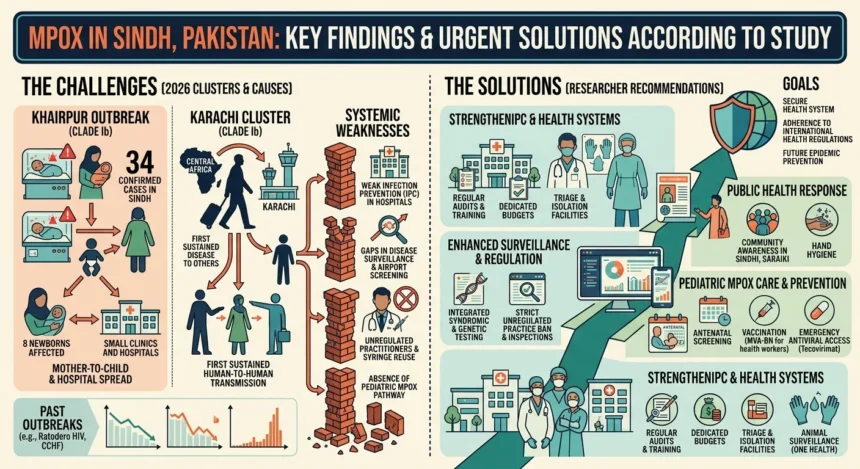
According to the study, 34 mpox cases were confirmed in Sindh between January and April 2026. Of these, 26 were reported from Khairpur and Sukkur districts, while eight were reported from Karachi. Half of the Khairpur cases were children below six months of age, including eight newborns. Among adult cases, seven out of eight were women.
The researchers said the Khairpur cluster appeared to have begun with a female infant born in February 2026. The baby developed a rash and was treated at several healthcare facilities before dying, but was not tested for mpox. Later confirmed cases among infants admitted to the same facilities suggested a possible epidemiological link.
A World Health Organization joint mission concluded that the virus most likely entered healthcare settings through infected newborns and was then amplified inside facilities, followed by household transmission to caregivers, mainly mothers and other female relatives. Several public and private healthcare facilities were identified as possible transmission sites.
The Karachi cluster followed a different pattern. It included six adults, one 13-year-old child and one eight-day-old infant. The study records a three-case chain in which the first patient had recently travelled to Central Africa and transmitted the infection to another person, who then transmitted it to a third person in Karachi. The researchers described this as the first evidence of sustained human-to-human transmission of clade Ib in Pakistan.
The paper says Pakistan had previously recorded imported mpox cases mainly belonging to clade IIb. The country’s first reported imported case was recorded in April 2023. The Khairpur outbreak was different because it involved clade Ib, which the study says can spread through close household contact and from an infected mother to her baby during pregnancy or delivery.
The researchers said this pattern did not require an explanation based on hidden sexual transmission. They said the Khairpur cases were consistent with infected pregnant women not being diagnosed before delivery, weak infection prevention measures in maternity and child care facilities, and the absence of a clear clinical pathway for newborn mpox.
The study compares the Khairpur outbreak with earlier health emergencies in Pakistan. In 2019, more than 1,500 children in Ratodero, Sindh, tested positive for HIV, with studies identifying reused syringes by unregulated practitioners as the main route of transmission. In 2024, Mirpur Khas recorded 150 child HIV diagnoses. Between November 2024 and October 2025, 331 children were reported with HIV infections linked to repeated syringe reuse at Tehsil Headquarters Hospital Taunsa in Punjab, with nine deaths.
The paper also mentions an outbreak at Kulsoom Bai Valika Social Security Hospital in SITE Town, Karachi. According to the study, by early 2026 the outbreak had produced 95 confirmed child cases and nine adult HIV or AIDS cases. The paper says parents publicly linked transmission to repeated reuse of disposable syringes by nursing staff, while 40,000 to 50,000 HIV screening kits were deployed for community contact screening.
CCHF provides another example, according to the study. The disease is already present in Pakistan and tends to rise around Eid ul Azha because of increased contact with livestock, ticks and infected blood. Severe cases admitted to hospitals can then lead to transmission among healthcare workers. The paper says a tertiary care outbreak documented in 2024 included such hospital transmission and that case fatality in hospital-acquired CCHF can reach 30 percent or more.
The researchers said these diseases are caused by different viruses and spread in different ways, but the same basic problem appears repeatedly. They pointed to unsafe medical practices and a health system that may have standards on paper but does not always enforce them in practice.
The researchers studied six infectious disease outbreaks in Pakistan from 2019 to 2026. They reviewed scientific studies, outbreak reports, national surveillance information and international health documents, and compared the outbreaks with the core requirements of the International Health Regulations of 2005 and the One Health approach, which connects human, animal and environmental health.
Across the six outbreaks examined, more than 2,050 children were affected between 2019 and 2026. The study says the Khairpur outbreak, with 34 confirmed cases and eight newborns among them, was consistent with mother-to-child transmission and possible spread inside healthcare facilities. It also found that a separate Karachi cluster showed continued human-to-human transmission from a traveller who had recently returned from Central Africa.
The study raises concerns about surveillance at airports and other points of entry. Earlier mpox cases were mostly imported through returning travellers from Saudi Arabia and other Gulf states and involved clade IIb. The researchers said surveillance systems built around those earlier routes and that particular clade were not designed to detect the newer clade Ib transmission pattern. They also pointed out that some mpox skin lesions can be hidden from normal visual checks, making simple screening less effective.
The paper says Pakistan has ratified the International Health Regulations, but weaknesses remain in disease surveillance, points of entry, infection prevention in hospitals and public risk communication. The researchers also referred to Pakistan’s 2024 State Party Self Assessment Report and the 2023 Joint External Evaluation, both of which identified continuing weaknesses in these areas.
The study says the One Health system is also weak. In the case of CCHF, the researchers argued that disease surveillance should combine information from human health services, livestock and veterinary systems and the environment. This could help identify high-risk districts before patients arrive at hospitals.
For Sindh, the researchers called for an immediate infection prevention audit of maternity and child healthcare facilities in Khairpur and nearby districts. They also recommended stronger action against unregulated practitioners, pointing to earlier responses in Ratodero, Mirpur Khas and Taunsa as examples that emergency action is possible, although maintaining that action over time remains a challenge.
At the federal level, the paper recommended that the National Institute of Health, as Pakistan’s International Health Regulations focal point, conduct an integrated review of surveillance for HIV, mpox, CCHF and infections linked to unsafe injections. It also recommended connecting mpox surveillance with routine sexually transmitted infection services to improve early detection.
The researchers also called for changes at airports and other points of entry. They recommended combining routine symptom-based surveillance with genetic testing and molecular investigation so that new mpox transmission routes can be detected, instead of focusing mainly on traditional groups of returning travellers.
For CCHF, the study recommended making surveillance and protective equipment preparation a routine activity before Eid ul Azha instead of waiting for outbreaks to begin. It also called for discouraging animal slaughter on roads and inside houses and ensuring public slaughterhouses are available in cities.
The researchers said Pakistan already has national infection prevention plans, guidelines and training programmes, but implementation inside healthcare facilities remains weak. They recommended better use of basic safety measures for every patient, dedicated budgets, triage and isolation facilities, trained infection prevention staff and stronger administrative support.
The study also called for a ban on unregulated medical practice, a strict prohibition on syringe reuse and regular registration and inspection of all healthcare facilities, whether small or large.
A major recommendation is the creation of a national clinical pathway for mpox during pregnancy and the newborn period. The researchers called for antenatal screening in affected districts, infection prevention standards during delivery and after birth, isolation facilities for infected newborns, access to MVA-BN vaccine for healthcare workers in districts affected by clade Ib, and public information campaigns in Sindhi, Saraiki and other local languages.
The study also highlighted a treatment supply problem. It says specific antiviral treatment for mpox is not currently registered or stockpiled in Pakistan. Tecovirimat, described in the paper as the only medicine with dedicated mpox evidence, is not available through the national essential medicines list or the National Institute of Health emergency stockpile. The paper also says brincidofovir and cidofovir are unavailable and that access through international routes can be slow.
Because of these shortages, the paper says treatment in severe cases is largely limited to supportive and symptomatic care, which the authors consider inadequate for severe disease in children and pregnancy. The researchers acknowledged that the safety and effectiveness of these medicines in newborns are not well established, but recommended creating an emergency access pathway and considering vaccine stockpiling for future prevention.
The researchers also said infected newborns and children may develop complications differently from adults and should therefore be followed systematically. They recommended early detection through RT-PCR testing, prompt isolation of infected mothers and babies, appropriate protective equipment and repeated hand hygiene after contact with skin lesions or body fluids. The paper also says awareness among patients and healthcare workers is essential to stopping outbreaks.
In its conclusion, the study says the deaths of Pakistani newborns from mpox in 2026 should be viewed largely as a warning about failures in infection prevention and health system controls rather than simply as the arrival of a new virus. The authors argued that the weaknesses seen in Ratodero, Mirpur Khas, Taunsa and repeated hospital CCHF outbreaks have not been fully corrected and that another disease has now exposed the same weaknesses.
The paper says Pakistan now has a choice between treating international health rules as paperwork or using them as real operating standards inside hospitals, laboratories, airports and communities. The authors said long-term improvement will require stronger surveillance, better infection prevention, trained staff, regular inspections and a health system capable of acting before small outbreaks become major crises.