



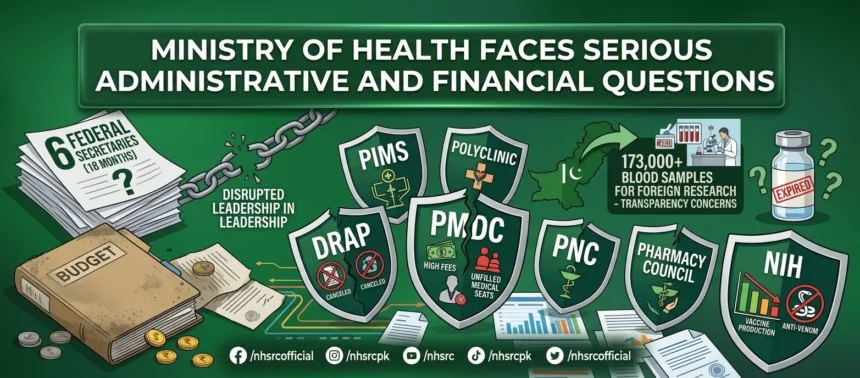
ISLAMABAD: The Ministry of National Health Services, Regulations and Coordination is facing serious administrative and financial concerns, according to an investigative report that has raised questions about leadership changes, the working of health institutions, medical councils, foreign funded projects and the handling of biological samples.
The report, prepared by news analyst Nadeem Chaudhry, points to frequent changes in senior leadership, with six federal health secretaries reportedly being changed within 18 months. It also raises questions about the ministry’s policy direction and the functioning of several institutions working under it.
One of the major issues highlighted in the report is the transfer of about 173,000 blood samples from Pakistan to foreign locations for genome research. The report says health experts have questioned the transparency of the process and called for details about the research project, its funding, foreign scientific partners and the institutions involved.
The report says experts have also raised concerns about the handling and protection of biological material and have called for a detailed examination of how the samples were collected, approved, transferred and used. These concerns are presented in the report as questions requiring clarification.
The report also raises questions about the functioning of several medical and health councils. It refers to complaints and allegations concerning college registrations, recruitment, inspections and administrative decisions at the Pakistan Nursing Council, Pharmacy Council and Allied Health Council.
Regarding the Pakistan Medical and Dental Council, the report highlights concerns about fees charged by private medical colleges. It says high fees may be one factor behind some students choosing to study medicine abroad and refers to unfilled medical seats in the country.
The National Institute of Health has also come under scrutiny in the report. It says the institute, once known for vaccine production and other public health work, has seen a decline in its manufacturing activities and now has a much more limited role in some areas, including maintaining animal stocks used in the preparation of anti venom and anti rabies products.
The report further raises questions about the implementation of recommendations from an inquiry committee at the Pakistan Institute of Medical Sciences. It says some actions recommended by the committee remain pending and that delays have also affected procurement and tender processes.
The Drug Regulatory Authority of Pakistan has also been mentioned in the report, which says some recruitment exercises were cancelled multiple times because of internal disagreements over the selection of candidates.
The Health Services Academy has also been cited in connection with delays in administrative action and financial questions related to international studies. The report further refers to complaints concerning harassment involving a female officer and says administrative action has not moved forward as expected.
At Polyclinic, the report raises questions about delays in tenders and says medicines shown in official records were reportedly not found in store inventories. It also says the National Institute of Rehabilitation Medicine has faced delays because of the absence of an approved PC 1 and raises concerns about doctors performing administrative duties at health institutions.
The report also discusses the management of foreign funds and health programmes. It raises questions about the transfer of a specialised epidemic hospital to the Indus Hospital and refers to audit concerns involving funds linked to the Global Fund. These matters have been presented in the report as issues requiring examination and clarification.
The Federal Directorate of Immunization has also been discussed, with the report referring to audit observations concerning vaccine procurement, including questions about expired vaccines, prices and tender procedures.
Questions have also been raised about Border Health Services after its relocation to Karachi. According to the report, millions of rupees collected through aircrew health clearance services do not have a fully centralised computer based audit trail, raising concerns about record keeping and financial monitoring.
The report has called for an independent forensic review of procurements, appointments and fund allocations made during the last five years. It says such a review could help establish the facts behind the various complaints and determine whether financial or administrative problems occurred.