ISLAMABAD, Oct 7: The Gaza conflict has produced consequences extending far beyond the battlefield, affecting the credibility of international institutions, regional security dynamics, global public opinion and perceptions of the existing world order, speakers at a seminar said.
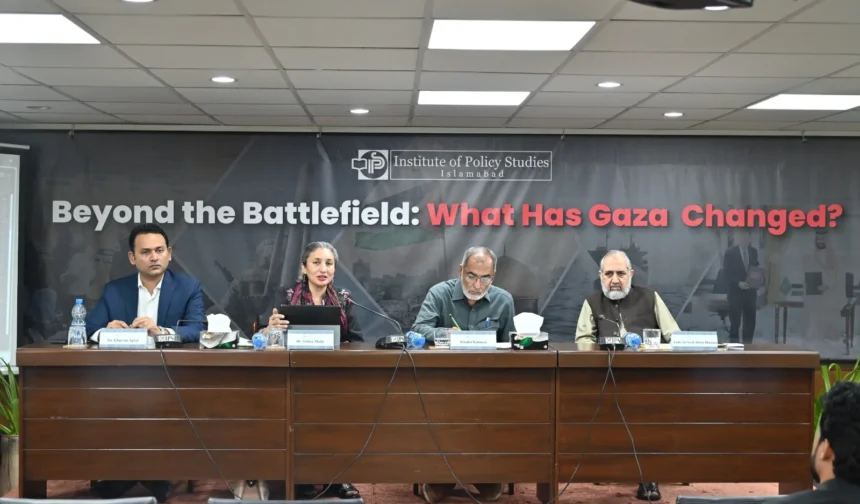
The seminar, titled “Beyond the Battlefield: What Has Gaza Changed?”, was organised by the Institute of Policy Studies (IPS), Islamabad. It brought together academics, security analysts and human rights experts to discuss the wider implications of the conflict for Palestine, Pakistan, the Muslim world and global politics.
The speakers included Dr Khuram Iqbal, associate professor, NIISS, Quaid-i-Azam University; Brig (retd) Said Nazir, defence and security analyst; Dr Salma Malik, associate professor, DSS, Quaid-i-Azam University; and Dr Zarni, human rights activist. The session was chaired by IPS Chairman Khalid Rahman and also featured Amb (retd) Syed Abrar Hussain, vice chairman, IPS.
In his opening remarks, Amb (retd) Abrar Hussain said the consequences of the Gaza conflict could not be confined to the geographical boundaries of the territory. He identified three major areas of change: the weakening credibility of international law and institutions, shifts in regional and global geopolitical dynamics, and the renewed centrality of the Palestine question.
He observed that the selective application of international law had generated growing distrust, particularly in the Global South.
Dr Khuram Iqbal identified three major developments emerging from the Gaza conflict. He said longstanding bipartisan political support for Israel in Western capitals, particularly in the United States, had come under significant pressure from changing public opinion.
He also discussed the regional consequences of the conflict, noting that the process associated with the Abraham Accords had been disrupted and that new interactions among West Asian and South Asian security dynamics were emerging. He highlighted the implications of closer Israel-India relations for Pakistan, particularly amid evolving regional security alignments.
Brig (retd) Said Nazir examined Gaza from humanitarian, military, regional and international perspectives. He discussed the destruction of Gaza, the political and security challenges surrounding reconstruction, Palestinian political divisions and the continuing uncertainty surrounding the peace process.
He argued that the conflict had shattered perceptions of Israel’s military invincibility and highlighted the limitations of military power when not supported by political and diplomatic objectives. At the regional level, he discussed changing deterrence dynamics, energy security, and the importance of strategic chokepoints and regional security arrangements.
Dr Salma Malik focused on the implications of the Gaza conflict for the rules-based international order. She said the crisis had exposed the selective application of international law and raised questions about the credibility of global institutions.
She described the conflict as a broader test of the international system and stressed that repeated violations of ceasefires and humanitarian norms had demonstrated the inadequacy of existing mechanisms. She also discussed the implications of the Gaza conflict for Pakistan, particularly in relation to governance, social cohesion and its diplomatic role in international forums.
Joining the seminar online, Dr Zarni said Gaza had generated a wider reassessment of the international political order. He maintained that the conflict had exposed contradictions in the application of international law and highlighted the growing role of civil society in shaping global perceptions of Palestine.
He further argued that the Gaza experience had challenged established perceptions of Israel’s military and political image and had generated greater awareness of the continuing influence of colonial legacies in contemporary international relations.
In his concluding remarks, Khalid Rahman said complex international problems could not be resolved through shortcuts and required sustained, step-by-step efforts. He observed that the Gaza conflict was connected to broader transformations in the global system and urged that contemporary developments be viewed within their wider historical and international context.
He emphasised the interconnected nature of regional and global challenges and the need for long-term thinking rather than quick solutions.