ISLAMABAD: The Economic Coordination Committee (ECC) of the Cabinet on Thursday approved a series of financing, sectoral development and technical supplementary grant measures, after considering 17 agenda items submitted by various ministries and divisions.
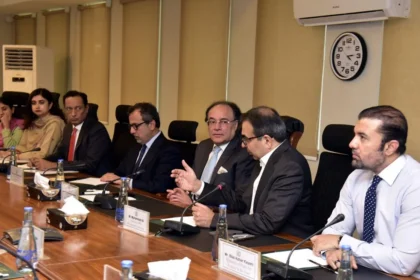
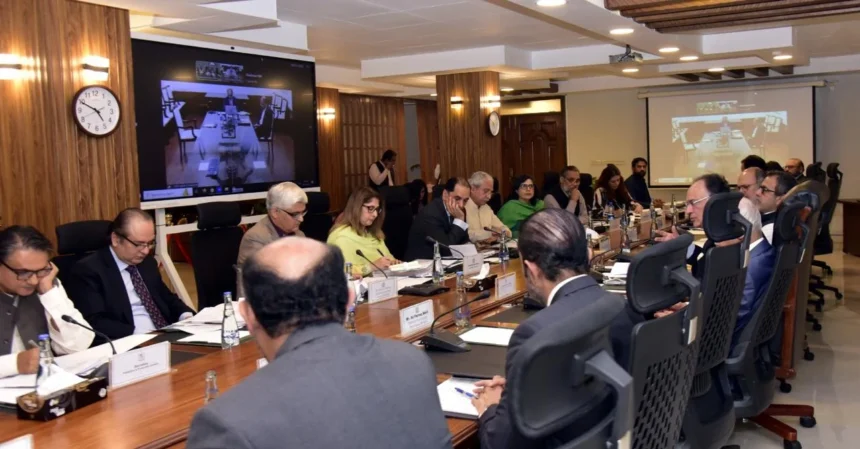
The meeting was held at the Finance Division under the chairmanship of Federal Minister for Finance and Revenue Senator Muhammad Aurangzeb. The agenda covered access to finance, development initiatives, infrastructure, institutional reforms and sectoral measures.
The ECC approved a Finance Division summary regarding a financing framework developed by the State Bank of Pakistan to facilitate the inclusion of Agency Financial Institutions under the government’s existing Risk Coverage Schemes for Small Enterprises and Small Farmers through wholesale and agency arrangements. According to the Finance Division, the framework is aimed at broadening access to finance by using the outreach of eligible microfinance and non-banking financial institutions.
The committee also approved an addendum to the Second Supplemental Trust Deed of the Credit Guarantee Trust Fund, expanding its scope to facilitate more effective utilisation of the existing credit guarantee facility for affordable housing finance.
On a summary submitted by the Industries and Production Division, the ECC approved a Technical Supplementary Grant of Rs2 billion for the Small and Medium Enterprises Development Authority to facilitate implementation of SMEDA’s approved business plan as per the vision of the prime minister.
The committee further approved a TSG of Rs11.329 billion, also on a summary moved by the Industries and Production Division, to meet the immediate funding requirements of the Utility Stores Corporation and facilitate completion of its closure process.
On a summary submitted by the Privatisation Division, the ECC approved a TSG of Rs8 billion for the Public Private Partnership Authority. The allocation will support the development and implementation of infrastructure projects through public-private partnerships.
The ECC also approved a TSG of Rs10 billion for the Ministry of Railways to provide budgetary cover for the Thar Coal Rail Connectivity Project, facilitating the utilisation of indigenous Thar coal for power generation and other industrial sectors.
On a summary submitted by the Election Commission of Pakistan, the committee approved a TSG of Rs596.18 million for the reallocation and revalidation of surrendered funds for local government elections in Islamabad Capital Territory, local government by-elections in Sindh and Balochistan, and delimitation activities in Punjab.
The ECC also considered a separate ECP summary regarding the allocation of Rs17.873 billion for procurement of non-sensitive materials for local government elections in Punjab, Khyber Pakhtunkhwa, ICT and cantonment boards across Pakistan. The committee approved the immediate release of Rs2 billion through a Technical Supplementary Grant.
On a summary submitted by the Ministry of Interior and Narcotics Control, the ECC approved a TSG of Rs300 million for the Capital Development Authority to meet essential repair and maintenance expenditure relating to the Prime Minister’s Office and Prime Minister’s Staff Colony during FY2026-27.
The committee approved a TSG of Rs150 million in favour of the Ministry of Climate Change and Environmental Coordination to meet requirements related to Pakistan’s participation in the 31st Session of the Conference of the Parties, scheduled to be held in Antalya, Turkiye.
The ECC also approved a TSG of Rs934.481 million for the Pakistan Sports Endowment Fund Scheme, 2025, in favour of the Ministry of Inter-Provincial Coordination. The allocation will support operationalisation of the fund in accordance with its approved framework and contribute to the development of the national sports ecosystem.
On a summary submitted by the Ministry of Federal Education and Professional Training, the committee approved a TSG of Rs1,666.176 million for the Prime Minister’s Initiative for short-term training of 1,000 agricultural professionals in China. The initiative is aimed at strengthening expertise in agricultural technology, innovation and research.
The ECC considered and approved a summary submitted by the Ministry of National Food Security and Research regarding Minimum Indicative Prices for the 2026 tobacco crop and revision of cess rates for 2026-27.
The committee also considered a summary submitted by the same ministry regarding adjustment of PASSCO’s outstanding receivables from provincial governments through at-source deductions. The matter was deferred, with directions to bring the proposal back after further consultation with relevant stakeholders.
On a summary submitted by the Revenue Division, the ECC approved an amendment to SRO 693(I)/2006 concerning the levy of Additional Customs Duty on the import of tyres being manufactured locally. The measure is aimed at promoting domestic manufacturing.
The committee also approved a TSG of Rs4 billion for Pakistan Revenue Automation (Pvt) Limited on a summary submitted by the Revenue Division to support ongoing restructuring and implementation of the FBR’s Transformation Plan.
The ECC further approved a summary submitted by the Ministry of Commerce regarding investment of Export Development Fund resources in government securities, in accordance with the approved framework, to ensure productive utilisation of the fund’s resources and sustainable financial management.
The meeting was attended by Federal Minister for Investment Qaiser Ahmed Sheikh, Federal Minister for Commerce Jam Kamal Khan, Federal Minister for Power Sardar Awais Ahmad Khan Leghari and Federal Minister for Education and Professional Training Dr Khalid Maqbool Siddiqui, along with federal secretaries and senior officials from the relevant ministries, divisions and regulatory authorities.
Separately, the Finance Division clarified a media report regarding loans of federal state-owned enterprises, saying the comparison of State Bank of Pakistan and Central Monitoring Unit figures had not been made on a correct basis.
According to the Finance Division, the CMU figure of Rs10.1 trillion represents the overall volume of federal state-owned enterprises’ loans and other interest-bearing liabilities, not new loans. It said federal state-owned enterprises obtained only Rs164 billion in new or additional loans during the reporting period.
The ministry said the increase in the overall volume of state-owned enterprises’ loans from Rs8.8 trillion to Rs10.1 trillion did not mean that Rs1.3 trillion had been obtained as new loans. It said SBP data includes bank loans obtained by state-owned enterprises, while CMU data has a broader scope.
According to the Finance Division, SBP data shows bank loans of state-owned enterprises at Rs2.954 trillion, while CMU data shows overall loans and other interest-bearing liabilities at Rs10.1 trillion. The ministry said the scope and reporting purposes of both institutions’ figures are different and, therefore, a direct comparison is not correct.
The Finance Division said the entire amount of Rs10.1 trillion does not consist of bank loans. It said the share of loans from banks and private institutions is around Rs3.1 trillion. The total also includes Rs2.098 trillion in cash development loans, Rs2.581 trillion in foreign loans, Rs2.181 trillion in accumulated mark-up and costs related to loan renewals, and around Rs135 billion in other interest-bearing liabilities, including liabilities related to leases and use of assets.
The ministry said CMU figures are meant to provide a complete picture of the overall loans, financial obligations and related fiscal risks of federal state-owned enterprises. It added that presenting the Rs10.1 trillion total loans and liabilities as new bank loans is contrary to facts and proper reporting methodology.