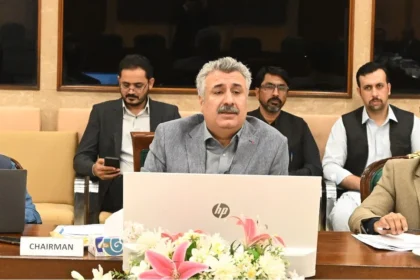




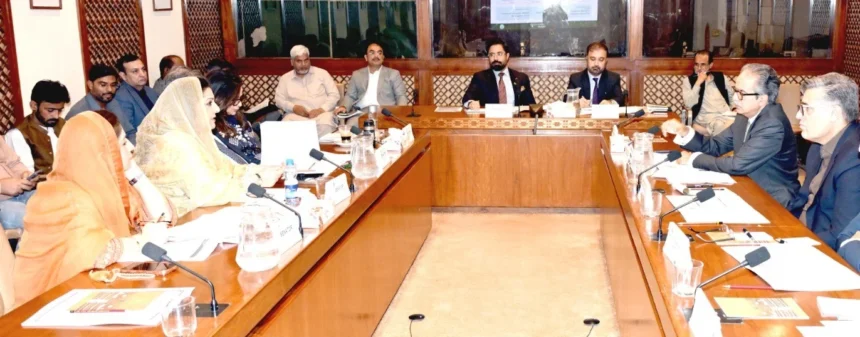
ISLAMABAD: The Senate Standing Committee on Foreign Affairs on Tuesday reviewed Pakistan’s relations with Afghanistan, the Prime Minister’s visit to the United Nations and key diplomatic engagements, reforms in the Ministry of Foreign Affairs’ document attestation process, and Pakistan’s priorities under its leadership roles in the Shanghai Cooperation Organisation and Economic Cooperation Organisation.
The meeting was chaired by Senator Agha Shahzaib Durrani and attended by Senator Sherry Rehman, Senator Rubina Qaim Khani, Senator Anusha Rahman Ahmed and Senator Amir Waliuddin Chishti.
The committee welcomed the newly appointed Foreign Secretary of Pakistan and appreciated his effective representation of Pakistan’s perspective during his tenure as the country’s Permanent Representative to the United Nations.
However, members expressed concern over the absence of the Foreign Minister and stressed the importance of his participation in committee proceedings to ensure meaningful parliamentary oversight and informed deliberations on key foreign policy matters.
The committee was briefed on the Prime Minister’s visit to the United Nations and his key engagements on the sidelines. It was highlighted that the recent visit of the UN Secretary-General to Pakistan also reflected the country’s successful diplomatic outreach.
The chairman directed the Ministry of Foreign Affairs to provide a comprehensive briefing at the next meeting on the Prime Minister’s UN engagements in the context of the Iran-US conflict, the Makkah Pact, and evolving regional and international developments.
Regarding reforms in the document attestation process, the committee was informed that MoFA had digitised general attestation, which accounts for approximately 65 per cent of the total attestation workload, through integration with the Higher Education Commission database. The existing manual facility has also been retained to facilitate the general public.
The committee was further informed that apostille attestation constitutes around 35 per cent of the total workload and that the ministry is planning to integrate its system with NADRA to make the process faster, more secure and efficient.
Members, however, raised concerns over delays in the process despite the extensive digitisation of NADRA’s services. They also questioned the attestation fee charged for government-issued documents and urged the ministry to consider reducing the charges.
The committee proposed the introduction of QR codes on official documents to facilitate instant verification and prevent misuse.
Taking notice of the need for a seamless and citizen-friendly system, the chairman directed HEC, NADRA and MoFA to attend the next committee meeting with a comprehensive plan for an integrated e-attestation mechanism.
He also directed NADRA and MoFA to introduce QR-code-based verification of documents to minimise human interaction, eliminate unnecessary delays and simplify the process. The ministry was further directed to create public awareness about the digitisation of attestation services so that citizens could benefit from the available facilities.
The committee was also briefed on Pakistan’s priorities and preparations under its SCO leadership role, which the country has assumed for the first time. The ministry highlighted plans to engage participating countries through various SCO events, including the upcoming summit, with a focus on artificial intelligence, regional connectivity, youth engagement, bilateral cooperation and strengthening Pakistan’s diplomatic engagement in the region.
While reviewing Pakistan’s upcoming engagement with the ECO Council of Foreign Ministers, the committee emphasised the importance of effectively utilising the country’s leadership role in regional organisations to advance national economic and strategic interests.
The ministry briefed the committee on efforts to operationalise inter-regional trade quotas and establish effective transit trade and transportation mechanisms through these platforms.
Senator Durrani emphasised that Pakistan must translate its diplomatic engagements and leadership roles in the SCO and ECO into tangible economic opportunities, enhanced regional connectivity and stronger bilateral relations. He urged the ministry to pursue a proactive approach to ensure maximum benefits from these regional forums.
The committee also received an in-camera briefing on the current state of relations with Afghanistan, including key issues and recent developments.