



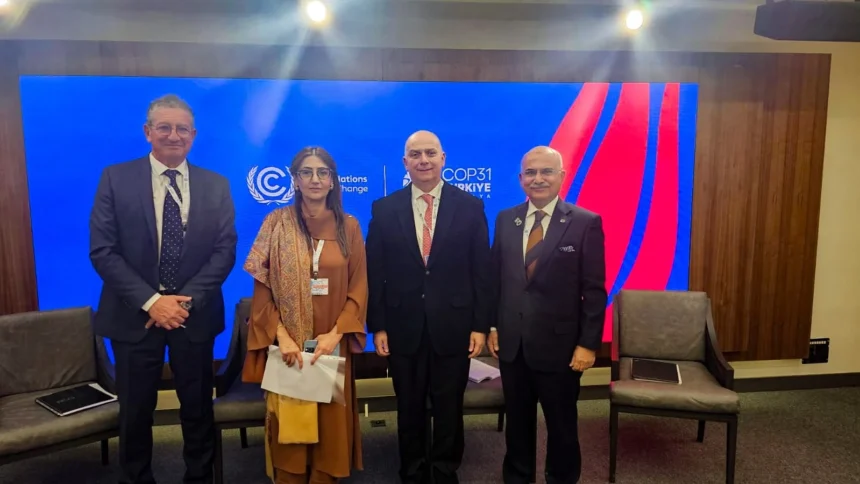
ANTALYA, Türkiye, Nov 12, 2026: Pakistan’s Minister of State for Climate Change and Environmental Coordination, Dr Shezra Mansab Ali Khan Kharal, joined senior executives of Beko and Dawlance at COP31 to discuss inclusive and accessible solutions for advancing the energy transition.
The UN Climate Change Conference is continuing in Antalya, Türkiye, where Koç Holding, Türkiye’s leading investment holding company, is serving as a Global Business Partner. As part of the conference’s series of panels on the energy transition, Beko, Koç Group’s flagship consumer durables company and the parent company of Dawlance, convened a session on cooling and energy access in emerging markets.
The panel, titled “Cooling a Warming World: Energy Access and Climate Change in Emerging Markets”, was held at the Türkiye Pavilion in the Blue Zone.
The session brought together Dr Shezra Mansab Ali Khan Kharal, Beko CEO Can Dinçer and Dawlance CEO Umar Ahsan Khan. The discussion was moderated by Michel Frédeau, Senior Advisor and Global Leader of BCG’s Climate and Environment Impact Area.
Speaking during the session, Beko CEO Can Dinçer referred to Beko’s experience with Dawlance in Pakistan and Defy in South Africa. He noted that the markets where cooling demand is growing fastest are often those where efficiency standards are still developing, adding that high-efficiency products should reach such markets before regulation requires it.
Dawlance said it aims to help more families in Pakistan access appliances that are less costly to run. The company combines local research and development and manufacturing with technology transfer from Arçelik to develop and test energy-efficient appliances suited to local conditions. These include inverter refrigerators and air conditioners designed to operate on low voltage as well as on solar, UPS and generator power.
“Pakistan’s fan replacement programme lets eligible households pay for efficient fans in instalments through their electricity bills. A similar approach could help families replace older refrigerators and air conditioners and start using less electricity while they pay for the upgrade,” said Umar Ahsan Khan, CEO of Dawlance.
Dawlance is also working with the National Energy Efficiency and Conservation Authority, the Pakistan Standards and Quality Control Authority, UNIDO and Pakistan’s Ministry of Climate Change and Environmental Coordination to improve appliance affordability, strengthen energy efficiency standards and help consumers understand how much electricity they could save.
The company said reducing electricity use over the lifetime of its appliances also helps lower Dawlance’s Scope 3 emissions. With support from UNIDO and the Ministry’s National Ozone Unit, Dawlance has converted the insulation foam in its refrigerators and freezers to cyclopentane, which has zero ozone-depleting potential.
In September, Federal Secretary of the Ministry of Climate Change and Environmental Coordination Awais Manzur Sumra visited Dawlance’s Karachi plant to review the transition.
Beko’s COP31 programme will continue in the coming days as part of Koç Holding’s “From Commitments to Action” programme at the Koç Holding Pavilion in the Green Zone. Beko executives are scheduled to join international stakeholders to discuss how the green transition is shaping industrial competitiveness, integrated value chains between Türkiye and Europe, the alignment of climate and trade policies, and financing for low-carbon investment.
Koç Holding and Beko said they remain committed to supporting Pakistan’s economic and industrial progress through continued innovation, strengthened local manufacturing and reliable technologies designed to improve everyday life for Pakistani households.
Koç Group’s operations play a role in strengthening economic relations between Türkiye and Pakistan, two countries connected by shared values and strategic partnership. Bilateral trade between the two countries reached approximately $1.2 billion in 2025.