



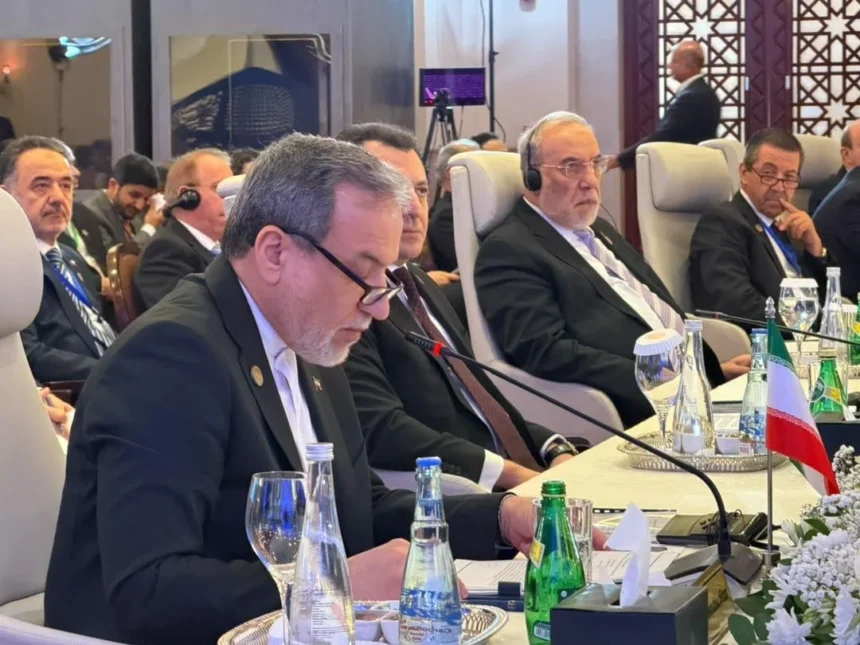
ISLAMABAD: Iranian Foreign Minister Dr Seyed Abbas Araghchi on November 16 urged members of the Economic Cooperation Organization (ECO) to strengthen regional cooperation in trade, transport and energy, saying these areas should form the three strategic pillars of the organisation’s future work.
Addressing the 30th Meeting of the ECO Council of Ministers in Islamabad, Dr Araghchi thanked Pakistan’s Ministry of Foreign Affairs and the ECO Secretariat for convening the meeting. He also appreciated Deputy Prime Minister and Foreign Minister Ishaq Dar for his leadership within ECO and the hospitality extended to the Iranian delegation.
He commended ECO Secretary General Asad Majeed Khan and his team, and expressed appreciation to those who, according to him, had condemned acts of aggression against Iran’s territorial integrity and conveyed condolences and solidarity to the government and people of Iran.
Dr Araghchi said the meeting was being held at a time of major global transformations and growing uncertainty, making collective cooperation, coordination and convergence of positions within ECO more important.
He said ECO was moving beyond its traditional role and becoming a platform for collective action, strengthened cooperation and joint efforts among member states. He said enhanced connectivity, easier intra-regional trade and stronger energy cooperation would reinforce resilience, reduce external vulnerabilities and help build a more integrated and self-reliant region.
The Iranian foreign minister welcomed the establishment of the Technical Negotiation Committee to reform the ECO Trade Agreement (ECOTA). He said current parties should actively pursue negotiations to re-negotiate the agreement, while other member states should also be encouraged to join the process.
He said a modern, new-generation, inclusive and operational trade agreement could expand regional trade, strengthen economic resilience and protect regional economies for the benefit of the people of ECO countries.
Referring to regional security, Dr Araghchi said Iran had consistently upheld international law, the United Nations Charter and the peaceful settlement of disputes, including through diplomacy. He said Iran had remained committed to diplomatic engagement and peaceful solutions over the past two years.
He accused the United States of following a different course, marked by aggression, threats, targeted assassinations, economic coercion and blockades, which he described as violations of international law and the UN Charter. He said these actions had resulted in the martyrdom of Iran’s Supreme Leader and several senior political and military officials, as well as the killing of more than 5,000 Iranian citizens, including 168 students and teachers at the Minab school.
Dr Araghchi said insecurity in the Persian Gulf and developments around the Strait of Hormuz stemmed from what he called hostile policies and joint acts of aggression by the United States and the Zionist regime against Iran.
He said Iran sought friendly and constructive relations with its neighbours and had no inherent dispute with regional countries. However, he stressed that territories, airspace and facilities of regional countries must not be used as platforms for attacks against each other.
He said Iran’s defensive measures were directed exclusively at the targets and military bases of the aggressors and should not be construed as actions against the people or governments of neighbouring countries.
Dr Araghchi called for genuine, inclusive and regionally owned dialogue on security arrangements, particularly on the basis of non-aggression and preventing any third party from using one country’s territory or facilities to commit aggression against another.
He also criticised the continued imposition of sanctions, saying they were intended to deepen economic hardship and deprive the Iranian people of their fundamental rights. He thanked ECO member states that, he said, had shown solidarity with the Iranian people.
On energy, the Iranian foreign minister said the growing impact of US and Israeli regime aggression on regional energy security had made energy cooperation an urgent strategic requirement. He called for an independent security framework and a reliable regional energy mechanism to safeguard energy flows, ensure stable supplies, reduce external vulnerabilities and strengthen resilience against geopolitical shocks and disruptions.
Dr Araghchi said one of ECO’s key priorities over the past year had been the preparation of its vision for the coming decade after extensive consultations. He said the document focused on results-oriented approaches, practical implementation and measurable outcomes, and should be implemented on the basis of directives to be given by leaders at the 18th ECO Summit in Tehran on December 4, 2026.
Turning to Palestine, Dr Araghchi said the situation in the Occupied Palestinian territories was “a shame for humanity” and should remain on the collective agenda of ECO countries.
He said Gaza had witnessed what he described as genocide over the past three years, along with war crimes, continued occupation, attempts to alter the demographic composition of the territory, the use of prohibited weapons, widespread destruction, forced displacement and obstruction of essential humanitarian supplies.
He also referred to conditions in the West Bank and occupied Al-Quds, citing the expansion of settlements, daily attacks by extremist settlers against Palestinians and the displacement of Palestinians in the West Bank. He said nearly 10,000 Palestinians were being held in Israeli regime prisons and were reportedly subjected to physical and psychological torture and ill-treatment.
Dr Araghchi said Gaza urgently required immediate and effective action, particularly during harsh winter conditions, to press the Israeli regime to lift the humanitarian blockade and ensure the unimpeded entry of international humanitarian assistance, including food, medicines, temporary shelter and materials needed for reconstruction of vital infrastructure.
He said such assistance was essential to meet the urgent needs of more than 1.5 million displaced and homeless Palestinians.
The Iranian foreign minister said the international community faced a serious test of its commitment to humanitarian principles and responsibilities in addressing the humanitarian crisis in Gaza and the West Bank.
Concluding his address, Dr Araghchi said Iran believed its stability and prosperity were linked to those of other ECO member states. He said Tehran remained committed to stronger, more effective and tangible cooperation within ECO and looked forward to welcoming delegations to the 18th ECO Summit in Tehran on December 4.