



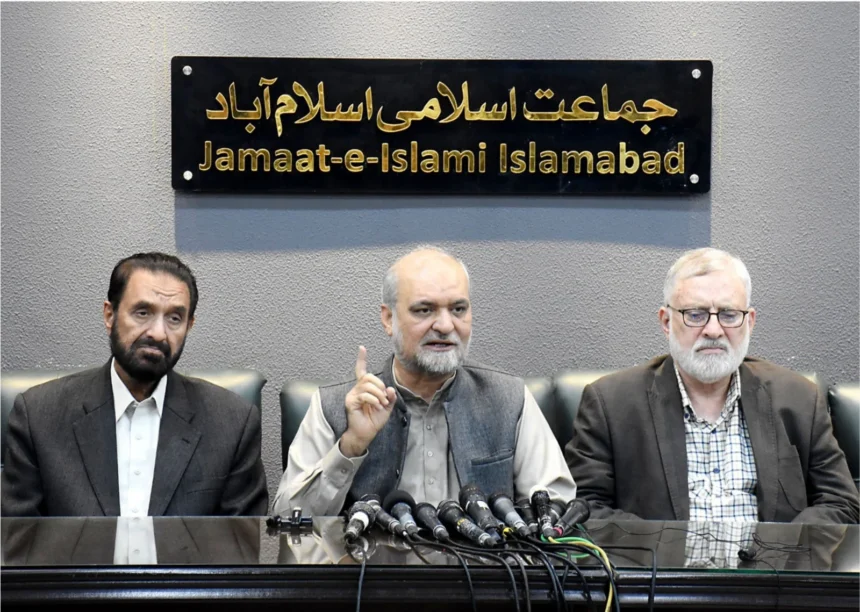
ISLAMABAD: Jamaat-i-Islami Pakistan Emir Hafiz Naeemur Rehman on Wednesday criticised PPP Chairman Bilawal Bhutto Zardari over his opposition to the creation of new administrative provinces, saying those speaking of bloodshed should first review the past role of the Pakistan Peoples Party.
Addressing a press conference in Islamabad, Hafiz Naeemur Rehman said the PPP had laid the basis for unrest in Sindh by introducing a language bill in 1972. He challenged Bilawal to bring forward Form 45s for the PPP’s seven National Assembly seats from Karachi, saying the reality of the party’s electoral mandate would become clear.
The JI chief said Jamaat-i-Islami supported an increase in the number of administrative provinces, but added that it should be done through the constitutional procedure and under an appropriate framework.
He also announced that Jamaat-i-Islami would stage sit-ins outside sugar mills on Friday over the failure to start sugarcane crushing. JI Vice Emir Mian Muhammad Aslam and Deputy Secretary Syed Farasat Shah were also present at the press conference.
Hafiz Naeemur Rehman said the PPP on the one hand described the present government as illegitimate, while on the other hand Asif Ali Zardari had been elected president through the votes of the same government. He said the PPP was a beneficiary of the 2024 elections and was also part of the government.
“If this government is illegitimate, Asif Zardari should resign from the presidency,” he said.
He alleged that the PPP’s seven National Assembly seats in Karachi were illegal and said manipulation had also taken place in the election of the Karachi mayor. He asked Bilawal why the PPP had played a role in bringing down the PTI government in the past if it now had sympathy for the party.
Referring to Khyber Pakhtunkhwa, Hafiz Naeemur Rehman said the PPP’s position on governor’s rule was contradictory, adding that Asif Ali Zardari had signed the decision while a PPP governor was running affairs in the province.
The JI emir said the PPP, which he accused of having a history of undermining democracy, should not lecture others on democracy. He said corruption continued in Sindh and urged political leadership to adopt an approach that helped resolve issues rather than pushing the country towards violence.
Speaking about agriculture, Hafiz Naeemur Rehman said the situation in the country had become extremely poor. He said sugarcane crushing had not started and farmers were facing serious difficulties. He said rising prices of agricultural inputs had made it increasingly difficult for growers to cultivate crops, while the condition of other crops was also not satisfactory.
He demanded that the sugarcane price be fixed at Rs700 per maund and said Jamaat-i-Islami would hold strong protest sit-ins outside sugar mills on Friday, November 20. He said the Sharif and Zardari families also owned sugar mills, and urged the government to pay attention to farmers’ problems and the role of sugar mills.
He said flour had become extremely expensive and asked where the companies set up by the Punjab government for wheat procurement were. He also alleged that substandard and waste wheat was being supplied to flour mills in Sindh, affecting both the public and farmers.
On petroleum prices, the JI chief said there had been some reduction, but oil companies had earned unjustified profits during the recent crisis. He said Jamaat-i-Islami’s protest had prevented the government from further increasing petroleum prices, although a minister had indicated that petrol could reach Rs1,500 per litre.
He said Jamaat-i-Islami had prepared and submitted a draft for negotiations with the government. According to him, the government had agreed to expand the scope of relief. He said the final round of talks with the government on levy would be held on Thursday, November 19, and added that Jamaat-i-Islami stood by its demands to secure real relief for the people.
Hafiz Naeemur Rehman said Jamaat-i-Islami had also told the government that the benefit obtained on the issue of independent power producers should be passed on to the public. He demanded that the government immediately end capacity payments to IPPs.
Expressing concern over the severe gas crisis in the country, he said Pakistan had been importing around 55 per cent of its LPG requirements from Iran, but the country was now facing an acute LPG shortage. He said LPG was not available anywhere at official rates and urged the government to immediately resolve import-related issues.
He asked why LNG terminals were being paid $538,000 per day when RLNG was not being imported into the country. He said capacity payments were also being made to these terminals, which he termed an injustice to the people, and urged the government to take immediate notice.
He also said local government elections in Islamabad had been postponed for the sixth time, holding the federal government responsible.