



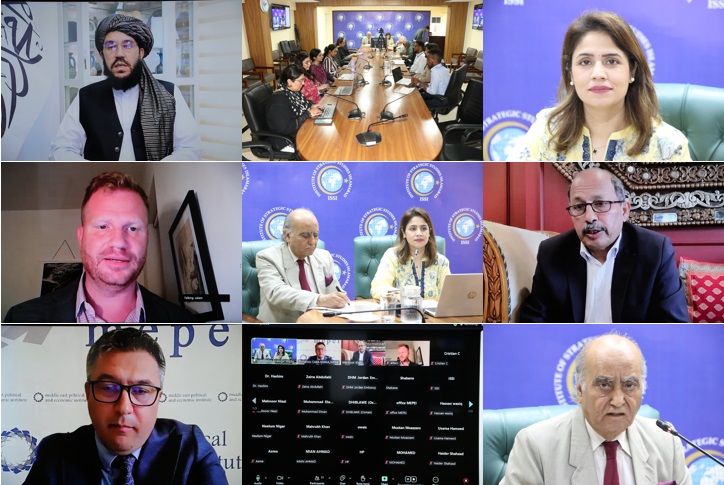
A webinar hosted by the Centre for Afghanistan Middle East and Africa (CAMEA) at the Institute of Strategic Studies Islamabad (ISSI) brought together diplomats and experts to discuss Afghanistan’s progress and challenges four years after the Taliban’s return to power. Participants examined the state of governance under the Islamic Emirate, domestic developments, and Afghanistan’s evolving relations with the international community, highlighting both achievements and persistent issues.
Ambassador Khalid Mahmood, Chairman of the Board of Governors at ISSI, opened the discussion by acknowledging the Taliban’s consolidation of power and increased international engagement, including limited recognition from countries such as Russia. However, he stressed that widespread international recognition is still withheld due to ongoing concerns about human rights, inclusivity, and terrorism. Mahmood pointed out the Taliban’s continued authority inside Afghanistan but warned about the threat posed by groups like ISKP, Al-Qaeda, and TTP. He described Pakistan-Afghanistan relations as mixed, characterized by cross-border security challenges but also by diplomatic initiatives, such as ambassadorial appointments and reviving joint committees.
Ms. Amina Khan, Director of CAMEA, noted that the Islamic Emirate has brought a measure of stability to Afghanistan, curbed corruption, banned poppy cultivation, and sought to expand diplomatic ties. Nonetheless, she said these achievements are overshadowed by the Taliban’s failure to implement promised reforms—especially in areas related to women’s rights, inclusivity, and counter-terrorism—as laid out in the Doha Agreement. She characterized the current situation as transitional, with ongoing shortcomings.
From the Afghan perspective, Ambassador Sardar Ahmad Shakeeb highlighted the government’s efforts to ensure national security, eliminate narcotics production, and establish a justice system throughout the country. He underscored initiatives toward economic self-reliance with projects in agriculture, energy, and infrastructure, as well as social programs for vulnerable groups. In foreign policy, Shakeeb emphasized Afghanistan’s engagement with more than 100 countries, identifying Russia’s recognition as a notable step toward international integration.
Ambassador Mansoor Ahmad Khan, Pakistan’s former envoy to Afghanistan, acknowledged improvements in security and governance but flagged lingering issues, such as international sanctions, lack of recognition, and ongoing restrictions on women’s rights, girls’ education, and counter-terrorism efforts. He mentioned internal divisions within the Taliban between hardliners and moderates, warning that Afghanistan faces a critical choice between reform and further isolation. He argued that constitutional changes reflecting the aspirations of the Afghan people, along with improved security, are necessary to foster economic cooperation between Afghanistan and Pakistan.
Adam Weinstein, Deputy Director at the Quincy Institute, pointed out that despite the U.S. being the largest donor since 2021 with nearly $10 billion in aid, Afghanistan now occupies a lower priority in Washington. He remarked that both the Taliban and the Afghan population have shown resilience in the face of declining aid but insisted that the Taliban must pursue reforms and regional cooperation to avoid isolation. Weinstein described current U.S. policy as inconsistent and suggested that the diplomatic process established in Doha has largely stalled.
Dr. Flavius Caba-Maria from the Middle East Political and Economic Institute observed that, even after four years, Afghanistan remains largely isolated on the international stage. While security has generally improved and drug trafficking has diminished, the humanitarian situation is severe and the forced return of refugees continues. He explained that while the European Union remains preoccupied with other crises, it is still coordinating humanitarian aid but has not moved toward recognition of the Taliban government. Some EU member states are considering increased engagement, but he argued that a more pragmatic approach is needed to address realities on the ground in Afghanistan.
In closing, Ambassador Khalid Mahmood reiterated that Afghanistan is at a pivotal moment. He emphasized that inclusive policies and responsiveness to international concerns are essential for Afghanistan’s long-term stability, development, and integration into the international community.