



By Tazeen Akhtar
ISLAMABAD: A dinner hosted by Senator Mushahid Hussain Sayed brought together the administration of Al-Hijrah Schools Trust, its founder Mohammad Abdul Karim Saqib (Sitara-e-Imtiaz), trust officials and senior media persons for a discussion on the organisation’s work in Ziarat, Balochistan, aimed at eradicating poverty through quality education.
Ambassador R. Asif Ali Khan Durrani, who is basically a journalist, was also present at the gathering held at Islamabad Club. The interaction highlighted the educational work being carried out in Balochistan and presented a positive picture of a province often associated with difficult news.
Senator Mushahid Hussain Sayed, who has worked on issues related to Balochistan through meetings, speeches and writings, had recently visited the province and spent a couple of days in Quetta. During the visit, he was a guest speaker at NDU forums where matters of national integrity and unity were discussed.
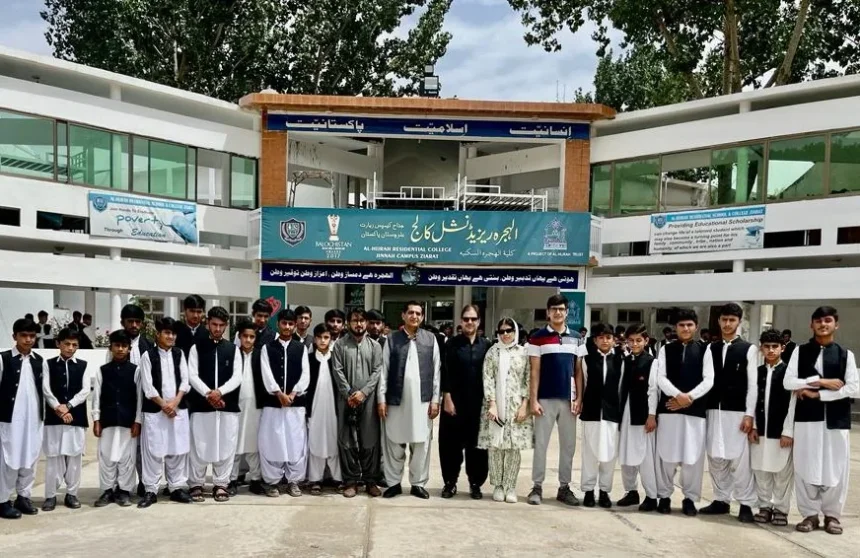
Al-Hijrah Schools Trust is providing free education, boarding and lodging to 380 students from all districts of Balochistan at its main campus in Ziarat. The residential school and college is located near the Quaid-e-Azam Residency, where the Founder of Pakistan spent his last days during illness.
The trust says it seeks guidance from the teachings of Quaid-e-Azam and has been spreading his message of “Humanity, Islam and Pakistanism” through education in Balochistan for the last 22 years.
The initiative was launched by Mohammad Abdul Karim Saqib and his brother, Overseas Pakistanis based in Birmingham, United Kingdom. Out of their passion for Pakistan, they selected Balochistan for their mission because the province required greater attention in terms of development and opportunities.
In 2004, they started the school in Ziarat from Class 6 to Intermediate level. At that time, two intelligent children were selected from each district of the province whose parents’ annual income was less than Rs150,000. The income criterion has now been revised to less than Rs450,000 per annum in view of inflation.
Over the last two decades, Al-Hijrah has contributed to spreading education across Balochistan, strengthening national unity and uplifting deprived segments of society. A large number of its students are now serving in different sectors in the province and across the country, including the medical field, civil services and the military.
According to details shared at the gathering, among the former students now in practical life, more than 150 are doctors and a similar number are engineers in different fields. More than 700 students have received scholarships for higher studies.
Al-Hijrah is also setting up another campus in Dera Ghazi Khan, where intelligent students from underprivileged families of rural Sindh and South Punjab will be admitted for free education. Classes have already commenced at the newly established campus, where the first phase of student induction has been completed.
More than 35 students have been enrolled at the new campus out of a target of 60. Efforts are continuing to recruit the remaining students from different areas of Sindh and Punjab.
Mohammad Abdul Karim Saqib also shared the background of the trust’s work in Birmingham, where Al-Hijrah first set up a school a quarter of a century ago with 800 students from Muslim communities, especially from Pakistan. He said no student of that school was involved in any crime and no FIR was ever registered against any of them, while prisons there were mostly filled with Muslims involved in different crimes.
The Birmingham school, he said, promoted harmony among students between East and West. Students were sensitised to carry Islamic and oriental traditions with them while respecting the laws and norms of the society in which they lived.
The Al-Hijrah Schools project was described as a commitment rooted in gratitude and service, with the potential to transform the lives of students and their communities. Its work in Balochistan stands as an example of how quality education can support deprived communities and contribute to a peaceful future for Pakistan.