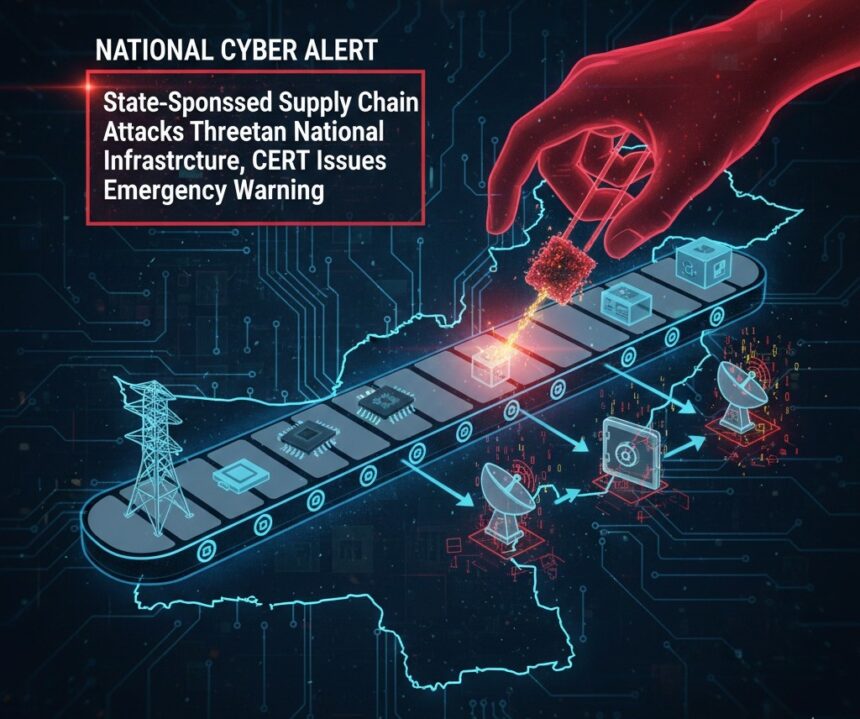
The National Computer Emergency Response Team has issued an emergency advisory warning that state-sponsored actors are exploiting manufacturing, logistics and software distribution channels to compromise equipment and code before deployment, elevating supply chain security into a national priority.
According to the advisory, attackers now favour tampering with hardware and software along supply chains rather than relying solely on traditional network intrusions. The agency cautioned that such methods could enable sovereign sabotage, allowing adversaries to disable critical systems without direct confrontation.
Officials highlighted the risk of cascading failures where a single compromised vendor or shipment could impact entire sectors. The alert specifically names Pakistan’s power grid, banking systems and defence infrastructure as at-risk, warning that up to 100 percent of connected infrastructure could be exposed if a trusted supplier is compromised.
The advisory raised particular concern about weaponized hardware: devices with concealed microphones or malicious components that are only detectable through X-ray and acoustic screening. It also warned that unverified software updates can carry hidden backdoors capable of remote control or disabling of systems.
Vendors with unclear ownership or front companies were identified as a major threat vector. Tampered seals, abnormal device behaviour and suspicious network activity were listed as immediate red flags, and the agency urged strict verification of Ultimate Beneficial Ownership to uncover hidden links to hostile entities.
All critical institutions have been directed to adopt a Zero-Trust security model and to treat every device and software update as untrusted until fully validated. Under emergency measures, organisations must implement behavioural sandboxing for all software updates within seven days and commence physical inspection of hardware through certified national laboratories within 14 days. The advisory also mandates tamper-proof delivery systems and real-time tracking for sensitive equipment.
In the event of a detected compromise, the prescribed response protocol is immediate disconnection of affected systems, preservation of hardware for forensic analysis and permanent blacklisting of the implicated vendor. Authorities stressed that preserving evidence and isolating impacted assets are essential to prevent wider disruption.
National officials warned that failure to act on supply chain security could leave built-in backdoors across critical systems and hand adversaries the ability to disrupt Pakistan’s infrastructure at will, urging prompt and comprehensive implementation of the prescribed controls.